

On this page
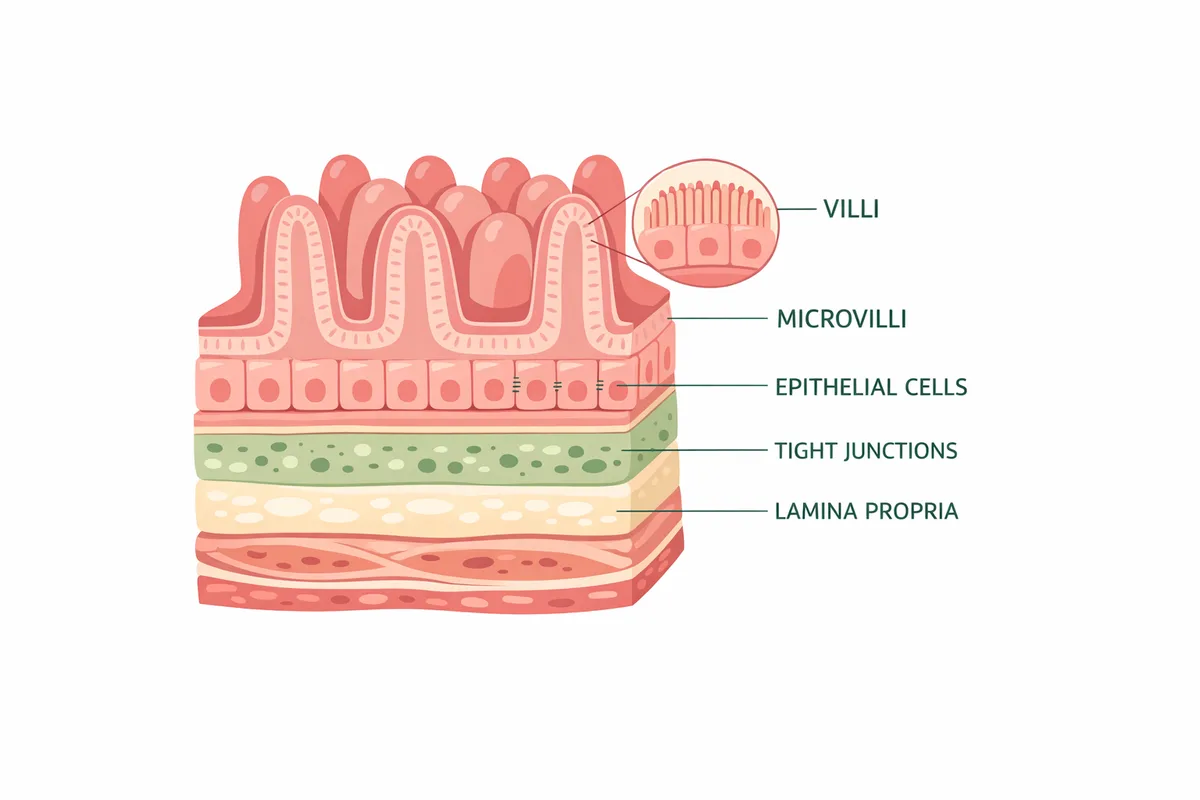
Your gut lining is a single-cell-thick barrier that separates the contents of your intestine from your bloodstream and immune system. This remarkably thin layer — made up of epithelial cells held together by tight junctions — is all that stands between properly digested nutrients and potentially harmful bacteria, toxins, and undigested food particles. Understanding its anatomy — as outlined by the National Institute of Diabetes and Digestive and Kidney Diseases (NIDDK) — is the foundation for understanding how gluten causes damage and how your body heals.
Key Takeaways
- Your gut barrier is just one cell thick — a single layer of epithelial cells is the only thing separating your intestinal contents from your bloodstream.
- Villi and microvilli create a tennis-court-sized surface — these finger-like projections expand the absorptive area of your small intestine to roughly 30 square meters.
- Tight junctions are the gatekeepers — these protein complexes seal the gaps between cells and regulate what passes through the barrier.
- Your gut lining replaces itself every 3–5 days — one of the fastest-regenerating tissues in the human body, which is great news for healing.
A Tour of Your Gastrointestinal Tract
Your GI tract is a roughly 30-foot tube running from your mouth to your rectum. While every section plays a role, the small intestine — about 20 feet long — is where the most critical action happens for nutrient absorption and, unfortunately, for gluten-related damage.
The small intestine has three sections: the duodenum (first 10–12 inches, where digestive enzymes from the pancreas and bile from the liver join the party), the jejunum (the middle section, primary site of nutrient absorption), and the ileum (the final section, absorbs vitamin B12 and bile salts). Celiac disease most commonly damages the duodenum and jejunum — the areas with the most direct gluten exposure.
Villi and Microvilli: Your Nutrient Absorption System
The inner surface of your small intestine isn’t smooth — it’s covered in millions of tiny, finger-like projections called villi (singular: villus). Each villus is about 0.5–1.5 millimeters tall. If you could see them under a microscope, they’d look like a shaggy carpet covering the entire inner wall.
Each villus is covered in even smaller projections called microvilli — roughly 1,000 per cell. Together, the microvilli form what’s called the “brush border.” This layered structure — folds, villi, and microvilli — dramatically expands the absorptive surface area. Without these structures, your small intestine would have about 0.3 square meters of surface area. With them, it’s roughly 30 square meters — about the size of a studio apartment.
This surface area is critical because nutrients need direct contact with the intestinal wall to be absorbed. Each villus contains a network of blood capillaries and a lymphatic vessel (called a lacteal) that carry absorbed nutrients into your circulatory system. When celiac disease destroys villi — a process called villous atrophy — that surface area collapses, and nutrient absorption plummets.
The Epithelial Barrier: One Cell Between You and Trouble
Here’s the fact that surprises most people when they learn about gut lining anatomy: the barrier between your intestinal contents and your bloodstream is literally one cell thick. A single layer of columnar epithelial cells is all that separates the food, bacteria, and digestive juices inside your gut from your sterile internal environment.
These cells are connected by tight junctions — complex protein structures that act like a zipper between adjacent cells. The main proteins involved include claudins, occludins, and zonula occludens (ZO) proteins. When these proteins are properly assembled, the junctions are sealed. When zonulin signals them to disassemble — as it does in response to gliadin from gluten — the junctions open and the barrier becomes permeable.
The cells themselves are constantly turning over. Stem cells located in the crypts (valleys between villi) continuously produce new epithelial cells that migrate up the villi over 3–5 days before being shed into the intestinal lumen. This rapid regeneration is why your gut has such remarkable healing capacity — and why removing gluten allows relatively fast recovery.
The Mucus Layer and Goblet Cells
Sitting on top of the epithelial cells is a protective mucus layer produced by specialized cells called goblet cells. This gel-like coating adds an additional physical barrier that prevents bacteria from directly contacting the epithelial surface.
In the small intestine, the mucus layer is relatively thin (a single loose layer), while in the colon it’s much thicker (two distinct layers). The mucus also contains antimicrobial peptides and secretory IgA antibodies that help neutralize pathogens before they can reach the cells.
Research suggests that the mucus layer can be disrupted by several factors beyond gluten — including certain food additives (emulsifiers like carboxymethylcellulose and polysorbate-80), alcohol, and some medications. Supporting mucus production through adequate hydration and a diet rich in omega-3 fatty acids is part of comprehensive gut healing.
The Enteric Nervous System: Your “Second Brain”
Embedded within the walls of your gastrointestinal tract is a vast network of over 100 million neurons called the enteric nervous system (ENS). This is more neurons than your spinal cord contains, which is why researchers often call it the “second brain.”
The ENS operates largely independently, controlling gut motility (the muscular contractions that move food through), enzyme secretion, blood flow to the intestinal lining, and immune responses. It also communicates bidirectionally with your central nervous system via the vagus nerve — the gut-brain axis that explains why gut problems can cause mood changes and vice versa.
Your gut also produces approximately 95% of your body’s serotonin, a neurotransmitter critical for mood regulation, sleep, and appetite. When gluten damages the intestinal lining and disrupts the enteric nervous system, it can directly affect serotonin production — one reason why anxiety, depression, and brain fog are common symptoms in celiac disease and NCGS.
Frequently Asked Questions
How thick is the gut lining?
The functional barrier of your gut lining is just one cell thick — a single layer of columnar epithelial cells roughly 25–30 micrometers tall. The mucus layer on top adds additional protection, and the underlying lamina propria contains immune cells, blood vessels, and connective tissue that support the barrier.
How often does the gut lining replace itself?
The epithelial cells of your gut lining completely replace themselves every 3–5 days. Stem cells in the crypts between villi continuously produce new cells that migrate upward and replace older cells. This rapid turnover is why your gut has remarkable healing potential when the damaging trigger — like gluten — is removed.
What are villi and why do they matter?
Villi are tiny finger-like projections covering the inner wall of your small intestine. They dramatically increase the surface area available for nutrient absorption — from about 0.3 square meters to roughly 30 square meters. When celiac disease causes villous atrophy (destruction of villi), nutrient absorption drops significantly, leading to deficiencies.
What happens when tight junctions open?
When tight junctions open, the gaps between intestinal epithelial cells widen, allowing molecules to pass through that normally wouldn’t — including bacteria, toxins, and partially digested food particles. This is called increased intestinal permeability. In gluten-sensitive individuals, the protein zonulin signals these junctions to open in response to gliadin.
Can you feel gut lining damage?
Not always. While many people experience digestive symptoms like bloating, pain, and diarrhea, gut lining damage can be “silent” — causing nutrient deficiencies, fatigue, or systemic inflammation without obvious digestive complaints. According to the Celiac Disease Foundation, up to 60% of adults with celiac disease have no digestive symptoms at diagnosis.
Your Gut Lining Is Resilient — Give It What It Needs
Your gut lining is an engineering marvel — a single-cell-thick barrier with an enormous surface area, rapid regeneration, its own nervous system, and a complex community of microorganisms working together to keep you healthy. Understanding this anatomy helps you appreciate both how vulnerable the gut is to gluten-related damage and how powerfully it can heal when given the right conditions.
The fact that your gut lining replaces itself every 3–5 days is genuinely encouraging. It means that every day you maintain a strict gluten-free diet, your body is actively rebuilding the barrier that protects your health. Give it time, give it good nutrition, and your gut’s natural resilience will do the rest.
This content is for educational purposes only and does not constitute medical advice. Consult your healthcare provider for diagnosis and treatment of gut-related conditions.