

On this page
Celiac disease and non-celiac gluten sensitivity (NCGS) both cause real gut damage in response to gluten — but through fundamentally different mechanisms. Celiac disease is an autoimmune condition where gluten triggers antibodies that destroy the intestinal villi, causing measurable structural damage visible on biopsy. NCGS triggers an innate immune response with inflammation and symptoms but without the autoimmune antibodies or villous atrophy. Both conditions require a strict gluten-free diet, but the differences matter for diagnosis, monitoring, and long-term health management.
Key Takeaways
- Celiac disease is autoimmune; NCGS is not — celiac produces specific antibodies (tTG-IgA) that attack intestinal tissue, while NCGS uses a non-specific inflammatory response.
- Celiac causes villous atrophy; NCGS does not — this structural damage to the intestinal villi is the defining difference on biopsy.
- Testing matters enormously — celiac has definitive blood tests and biopsy markers; NCGS is currently diagnosed by exclusion only.
- Both require strict GF diet — the treatment is the same, but celiac patients need lifelong medical monitoring for complications and associated conditions.
- Get tested before going GF — celiac blood tests require active gluten consumption to be accurate.
Celiac Disease: The Autoimmune Response
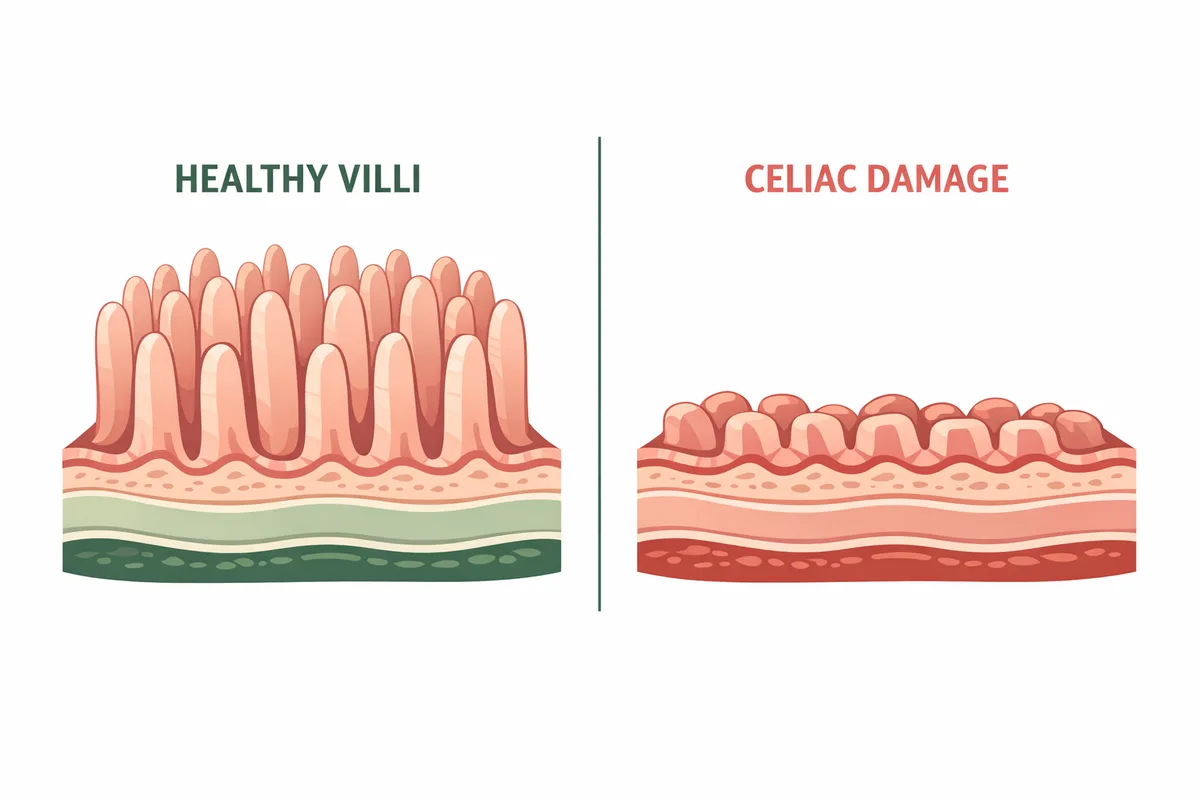
Celiac disease is a systemic autoimmune condition triggered by gluten in genetically predisposed individuals. When someone with celiac disease eats gluten, the gliadin peptides cross the intestinal barrier and are modified by the enzyme tissue transglutaminase (tTG). This modification makes gliadin fragments highly recognizable to specific immune cells.
The adaptive immune system then launches a targeted attack — producing tTG-IgA antibodies that damage both the gliadin fragments and the intestinal tissue itself. The result is villous atrophy: the finger-like projections that absorb nutrients are progressively destroyed, reducing the intestinal surface area and leading to nutrient malabsorption.
Key facts about celiac disease:
- Affects approximately 1 in 100 people worldwide, according to the Celiac Disease Foundation
- Requires the HLA-DQ2 or HLA-DQ8 gene (present in ~30–40% of the population, but only ~3% of carriers develop celiac)
- Diagnosed via tTG-IgA blood test followed by endoscopic biopsy showing villous atrophy
- Associated with other autoimmune conditions: type 1 diabetes, Hashimoto’s thyroiditis, autoimmune liver disease
- Untreated celiac increases risk of osteoporosis, anemia, lymphoma, and fertility complications
- Requires lifelong strict GF diet with ongoing medical monitoring
Non-Celiac Gluten Sensitivity: The Inflammatory Response
Non-celiac gluten sensitivity is a condition where gluten causes real, documented symptoms and immune activation — but through the innate immune system rather than the autoimmune pathway seen in celiac disease.
In NCGS, the body treats gliadin as a general threat and mounts an inflammatory response. There are no tTG-IgA antibodies, no villous atrophy on biopsy, and no genetic requirement for HLA-DQ2/DQ8 (though some NCGS patients do carry these genes). The symptoms, however, are very real and can be just as debilitating as celiac symptoms.
Key facts about NCGS:
- Estimated to affect up to 6% of the U.S. population — roughly six times more common than celiac disease, per Beyond Celiac
- No definitive diagnostic test — currently diagnosed by excluding celiac disease, wheat allergy, and other conditions, then confirming symptom resolution on a GF diet
- No villous atrophy, but research shows increased intestinal permeability and innate immune activation
- Not associated with the same long-term complications as celiac (osteoporosis, lymphoma)
- Symptoms often improve more quickly than celiac after going GF (days to weeks vs. months)
- Research is ongoing — biomarkers for definitive diagnosis are being actively studied
Side-by-Side Comparison: Celiac Disease vs Gluten Sensitivity
| Feature | Celiac Disease | Non-Celiac Gluten Sensitivity |
|---|---|---|
| Immune mechanism | Autoimmune (adaptive immune) | Innate immune (non-autoimmune) |
| Antibodies | ✓ tTG-IgA, EMA, DGP | ✗ None specific |
| Villous atrophy | ✓ Yes — visible on biopsy | ✗ No structural damage |
| Genetic markers | HLA-DQ2/DQ8 required | No genetic requirement |
| Prevalence | ~1% of population | ~6% of population (estimated) |
| Diagnosis | Blood test + biopsy | Exclusion diagnosis only |
| Long-term risks | Osteoporosis, lymphoma, anemia, fertility issues | Not associated with same complications |
| Treatment | Lifelong strict GF diet | Strict GF diet (duration debated) |
| Healing timeline | 6–24 months for mucosal recovery | Days to weeks for symptom resolution |
| Medical monitoring | Regular follow-up, bone density, nutrient labs | Less intensive monitoring |
Why Getting the Right Diagnosis Matters
It might seem like the distinction doesn’t matter — both conditions are treated with a GF diet. But the diagnosis has significant practical implications:
- Medical monitoring. Celiac patients need regular follow-up: repeat antibody testing, nutrient level monitoring (iron, calcium, vitamin D, B12, folate), bone density scans, and screening for associated autoimmune conditions. NCGS doesn’t require the same surveillance.
- Family screening. Celiac disease is genetic. First-degree relatives have a 1 in 10 chance of also having celiac and should be tested. NCGS doesn’t carry the same genetic risk.
- Strictness of the GF diet. For celiac patients, even trace amounts of gluten (less than 20 ppm) can sustain intestinal damage, even without symptoms. For NCGS, individual tolerance thresholds may be higher, though strict avoidance is still recommended.
- Long-term risk. Untreated or poorly managed celiac disease carries real long-term risks including osteoporosis, intestinal lymphoma, and fertility problems. A celiac diagnosis motivates the strict compliance needed to prevent these outcomes.
The Overlap Zone: Where It Gets Complicated
In practice, the line between celiac and NCGS isn’t always clear-cut. Some complicating scenarios:
- Seronegative celiac disease — a small percentage of celiac patients have negative blood tests but positive biopsies. This is why gastroenterologists sometimes recommend biopsy even when blood tests are normal but clinical suspicion is high.
- Potential celiac disease — some people have positive blood tests but normal biopsies. They may be in early stages before visible villous atrophy develops. Guidelines recommend monitoring and repeat biopsy.
- Can NCGS become celiac? — This is debated. Some researchers hypothesize that NCGS may be an early stage of celiac in genetically susceptible individuals, but this hasn’t been proven. If you have NCGS and carry HLA-DQ2/DQ8, periodic celiac re-screening may be reasonable.
- FODMAPs confusion — wheat contains fructans (a FODMAP), and some people thought to have NCGS may actually be reacting to fructans rather than gluten itself. This is an active area of research.
Frequently Asked Questions
Can you have gluten sensitivity without celiac disease?
Yes. Non-celiac gluten sensitivity is estimated to affect up to 6% of the U.S. population — far more common than celiac disease. NCGS involves real immune activation and symptoms in response to gluten, but without the autoimmune antibodies or villous atrophy that define celiac disease.
Is celiac disease worse than gluten sensitivity?
Celiac disease carries greater long-term health risks, including osteoporosis, intestinal lymphoma, and associated autoimmune conditions. However, NCGS symptoms can be equally debilitating in daily life. Neither condition should be dismissed — both require dietary management and medical attention.
Can gluten sensitivity turn into celiac disease?
This is debated among researchers. Some hypothesize that NCGS could be an early or mild form of celiac in genetically susceptible individuals, but this has not been proven. If you have NCGS and carry the HLA-DQ2 or HLA-DQ8 genes, periodic celiac rescreening is reasonable.
How is each condition diagnosed?
Celiac disease is diagnosed with a tTG-IgA blood test confirmed by endoscopic biopsy showing villous atrophy. NCGS has no definitive test — it’s diagnosed by excluding celiac disease and wheat allergy, then confirming symptoms improve on a GF diet and return with gluten reintroduction.
Do both celiac and NCGS require a strict gluten-free diet?
Yes. Both conditions are treated with a gluten-free diet. For celiac disease, even trace amounts of gluten can cause ongoing intestinal damage, so strict avoidance is medically necessary. For NCGS, individual tolerance thresholds may vary, but strict avoidance is recommended for symptom management.
Different Conditions, Same Commitment to Healing
Celiac disease and non-celiac gluten sensitivity are different conditions with the same trigger and the same primary treatment. Celiac is autoimmune, causes villous atrophy, has definitive diagnostic tests, and carries long-term health risks that require monitoring. NCGS causes real immune activation and symptoms but without the structural damage or autoimmune markers.
Getting the right diagnosis isn’t just academic — it determines your monitoring plan, your family’s screening needs, and how strictly you need to avoid trace gluten. If you’re experiencing symptoms, get tested for celiac disease first, while you’re still eating gluten. From there, whether it’s celiac or NCGS, you’ll have clarity — and a clear path forward to healing your gut.
Download our free 7-Day Gut Healing Meal Plan — designed for both celiac and NCGS recovery, with simple, delicious meals that support digestive health.
This content is for educational purposes only and does not constitute medical advice. Always consult your healthcare provider for diagnosis and treatment decisions.