

On this page
Collagen supplements have surged in popularity for skin and joint health, but their potential for gut healing is where the science gets especially interesting for people with celiac disease and gluten sensitivity. Collagen peptides provide the specific amino acids — glycine, proline, and hydroxyproline — that your intestinal lining uses as building blocks for repair. Emerging research suggests they may support gut barrier integrity, reduce intestinal inflammation, and complement a gut-healing diet — particularly important for the intestinal damage described by the Celiac Disease Foundation. Here’s what we know, what’s still being studied, and how to choose the right product.
Key Takeaways
- Collagen provides the amino acids your gut lining needs — glycine, proline, and hydroxyproline are structural building blocks for intestinal epithelial cells.
- Research is promising but still emerging — animal studies and early human research suggest collagen peptides support gut barrier function, but large-scale clinical trials are still needed.
- Collagen peptides are the most practical form — hydrolyzed collagen dissolves easily, is virtually tasteless, and provides concentrated amino acids in a convenient daily dose.
- It’s a complement, not a magic bullet — collagen works best alongside a GF diet, bone broth, and other gut-healing strategies.
How Collagen Supports Gut Healing
Your intestinal lining is essentially a collagen-rich tissue. The extracellular matrix that supports epithelial cells is built from collagen fibers, and the amino acids in collagen are used directly in gut tissue repair. When this lining is damaged by celiac disease or gluten sensitivity, the demand for these specific amino acids increases.
Glycine
Glycine makes up about one-third of collagen’s amino acid content. It has documented anti-inflammatory properties — research shows glycine inhibits NF-kB activation (a key inflammatory pathway), supports glutathione production (your body’s master antioxidant), and promotes restful sleep. Since gut repair is most active during sleep, this is a meaningful dual benefit.
Proline and Hydroxyproline
These amino acids are essential for collagen synthesis in the body. Your intestinal lining uses them to rebuild the structural matrix that supports epithelial cells. Without adequate proline and hydroxyproline, tissue repair is slower. Collagen supplements provide these in concentrated, bioavailable form.
Gut Barrier Support
Emerging research suggests that collagen peptides may directly support intestinal barrier integrity. A study published in the Journal of the Science of Food and Agriculture found that collagen peptides reduced markers of intestinal permeability in animal models. While human studies are still catching up, the mechanism is biologically plausible — you’re providing the raw materials your gut lining needs for its constant rebuilding process.
Collagen vs. Bone Broth: Which Is Better?
Both provide the same core amino acids — but in different formats with different advantages:
| Factor | Collagen Peptides | Bone Broth |
|---|---|---|
| Amino Acid Content | ✓ Concentrated | Moderate (varies) |
| Additional Nutrients | Amino acids only | ✓ Minerals, gelatin, L-glutamine |
| Convenience | ✓ Add to anything | Requires heating |
| Taste | ✓ Virtually none | Savory (not for everyone) |
| Cost per Serving | ~$0.75–$1.50 | ✓ ~$0.50 homemade |
| Whole-Food Profile | Supplement | ✓ Whole food |
The ideal approach: use both. Bone broth provides a broader nutrient profile including L-glutamine and minerals, while collagen peptides offer convenience and concentrated amino acids for people who don’t enjoy bone broth or want an easy daily option.
Types of Collagen Supplements
Not all collagen supplements are the same. Here’s what to know about the different types:
- Hydrolyzed collagen peptides — collagen broken down into small, easily absorbed peptides. Dissolves in hot or cold liquids. This is the most practical form for daily supplementation and the one used in most research.
- Gelatin — partially hydrolyzed collagen that gels in cold liquid. Same amino acid profile as collagen peptides but less versatile (can’t add to cold drinks). Great for cooking and homemade gummies.
- Undenatured type II collagen — a specific form studied for joint health, not gut healing. Different mechanism of action. Not the right choice for gut repair.
Source matters too. Collagen supplements come from bovine (cow), marine (fish), chicken, or eggshell membrane sources. For gut healing, bovine and marine collagen peptides are most commonly used. Both provide Types I and III collagen — the types most relevant to intestinal tissue.
Our Top Picks: Best Collagen for Gut Health
The gold standard in collagen supplements. 20g collagen per serving, grass-fed and pasture-raised bovine, certified GF, dissolves completely in coffee or smoothies with zero taste. It’s what I add to my morning coffee every single day — the boys get theirs mixed into smoothies.
Best overall. 20g collagen, grass-fed bovine, certified GF, Whole30 approved. Dissolves clean. ~$25 for 20 servings.
Best value. 11g collagen per scoop, grass-fed bovine, GF, third-party tested. Excellent quality at a lower price. ~$20 for 41 servings.
Best for gut-specific formulation. Grass-fed bovine, GF, no additives. Company focuses specifically on gut health. ~$30 for 28 servings.
Best for pescatarians. Wild-caught fish source, 12g collagen, GF. Slightly more expensive but excellent for those avoiding beef. ~$30 for 14 servings.
What to Look for in a Collagen Supplement
- Hydrolyzed collagen peptides (for best absorption and versatility)
- Certified gluten-free or explicitly tested below 20 ppm
- Grass-fed and/or pasture-raised sourcing (bovine) or wild-caught (marine)
- Third-party tested for purity and heavy metals
- Minimal ingredients — collagen peptides should be the only ingredient
- Types I and III collagen (most relevant for intestinal tissue)
How to Use Collagen for Gut Health
Dose: 10–20g daily is the commonly recommended range for gut-healing purposes. Most studies use 10–15g. One to two scoops of a quality collagen peptide powder delivers this amount.
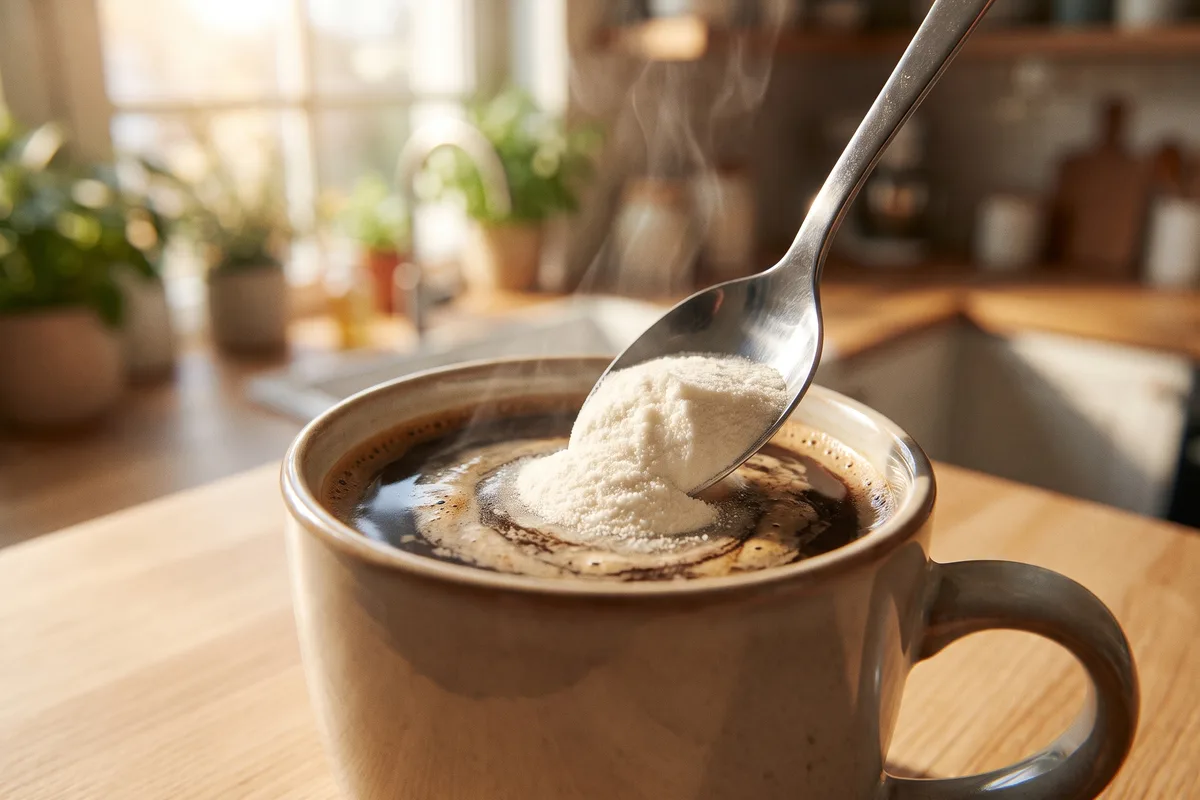
How to take it: Collagen peptides dissolve in virtually anything — hot coffee, cold smoothies, soups, oatmeal, water. They’re tasteless and odorless when dissolved. Consistency matters more than timing — take it whenever works for your daily routine.
Duration: Plan on at least 8–12 weeks of daily use to see benefits. Gut tissue repair is gradual, and collagen provides the building blocks for a process that takes months. Many people continue collagen supplementation long-term as part of their maintenance routine.
Common Mistakes with Collagen Supplements
- Choosing flavored or multi-ingredient collagen products. Many flavored collagens contain added sugars, artificial sweeteners, or fillers that aren’t ideal during gut healing. Stick to unflavored collagen peptides and add your own flavors.
- Expecting collagen alone to heal your gut. Collagen provides building blocks, but gut healing requires a comprehensive approach — GF diet, anti-inflammatory foods, stress management, and sleep.
- Not checking GF certification. While pure collagen from bovine or marine sources is naturally GF, some products add fillers or flavorings that may contain gluten. Always verify.
- Confusing type II collagen with gut-healing collagen. Undenatured type II collagen (UC-II) is studied for joint health via immune modulation — a completely different mechanism. For gut repair, you want hydrolyzed Types I and III collagen peptides.
- Using too little. A 5g serving provides some amino acids, but most research and practitioners recommend 10–20g daily for meaningful gut-healing support.
Frequently Asked Questions
Does collagen actually help gut health?
Collagen provides the specific amino acids — glycine, proline, and hydroxyproline — that intestinal tissue uses for repair and regeneration. Emerging research suggests collagen peptides may support gut barrier integrity and reduce intestinal inflammation. While large-scale human trials are still needed, the biological mechanism is well-supported and many practitioners recommend it as part of a gut-healing protocol.
What type of collagen is best for gut health?
Hydrolyzed Types I and III collagen peptides from bovine or marine sources are most relevant for gut healing. These types are the primary structural collagens in intestinal tissue. Avoid undenatured type II collagen, which is formulated for joint health through a different mechanism.
How much collagen should I take for gut healing?
Most practitioners recommend 10-20g of hydrolyzed collagen peptides daily for gut-healing purposes. This typically equals 1-2 scoops of a quality collagen powder. Consistency over weeks and months matters more than taking a large single dose.
Is collagen better than bone broth for gut health?
They complement each other. Bone broth provides collagen amino acids plus additional nutrients like L-glutamine, minerals, and gelatin in a whole-food form. Collagen peptides offer convenience and concentrated amino acids. The ideal approach is using both — bone broth as a food and collagen peptides as a convenient daily supplement.
Are collagen supplements gluten-free?
Pure collagen from bovine or marine sources is naturally gluten-free. However, some products add flavors, fillers, or other ingredients that may contain gluten. Always choose products that are certified GF or explicitly tested below 20 ppm, especially if you have celiac disease.
Worth Adding to Your Gut-Healing Toolkit
Collagen peptides provide the specific amino acids your intestinal lining uses for structural repair — glycine, proline, and hydroxyproline in concentrated, bioavailable form. While the research is still emerging, the biological mechanism is sound and many gut-health practitioners include collagen as part of their healing protocols. Combined with bone broth, a nutrient-dense GF diet, and other targeted supplements, collagen peptides give your gut the raw materials it needs to rebuild.
Start with 10–20g daily in your coffee, smoothie, or soup. Give it 8–12 weeks of consistent use before evaluating results. The simplest approach is often the most effective — one scoop, every day, mixed into something you’re already eating. Your gut lining replaces itself every few days. Give it the best building materials you can.
This content is for educational purposes only and does not constitute medical or nutritional advice. Consult a healthcare provider for personalized guidance.