

On this page
If you’ve been diagnosed with IBS and haven’t been tested for celiac disease, you may be treating symptoms while missing the cause. Research shows that up to 4–5% of people diagnosed with IBS actually have undiagnosed celiac disease — and a much larger percentage may have non-celiac gluten sensitivity. The symptom overlap between IBS and gluten-related conditions is so significant that the American College of Gastroenterology now recommends celiac screening for all IBS patients. Understanding where these conditions overlap — and where they differ — is essential for getting the right diagnosis and the right treatment.
Key Takeaways
- IBS and celiac disease share many symptoms — bloating, diarrhea, constipation, abdominal pain, and gas are common to both conditions.
- Up to 4–5% of IBS patients have undiagnosed celiac disease — celiac testing should be routine for anyone diagnosed with IBS.
- A GF diet helps many IBS patients even without celiac — research suggests that gluten independently triggers symptoms in some IBS patients through non-celiac mechanisms.
- FODMAPs and gluten overlap — wheat contains both gluten and fructans (a FODMAP), making it difficult to determine which component causes symptoms without systematic elimination.
IBS vs. Celiac Disease vs. NCGS: What’s the Difference?
| Feature | IBS | Celiac Disease | NCGS |
|---|---|---|---|
| Cause | Functional disorder (no structural damage) | Autoimmune (gluten triggers immune attack on villi) | Immune/non-immune reaction to gluten |
| Intestinal damage | ✗ No villous atrophy | ✓ Villous atrophy confirmed by biopsy | ✗ No villous atrophy |
| Blood markers | ✗ No specific antibodies | ✓ tTG-IgA positive | ✗ No specific antibodies |
| Genetics | No specific genes | HLA-DQ2/DQ8 required | No specific genes required |
| Treatment | Symptom management (diet, stress, meds) | Strict lifelong GF diet | Gluten elimination (may not need to be as strict) |
| Systemic symptoms | Primarily GI | GI + systemic (joints, skin, brain, bones) | GI + some systemic |
Why the Overlap Is So Confusing
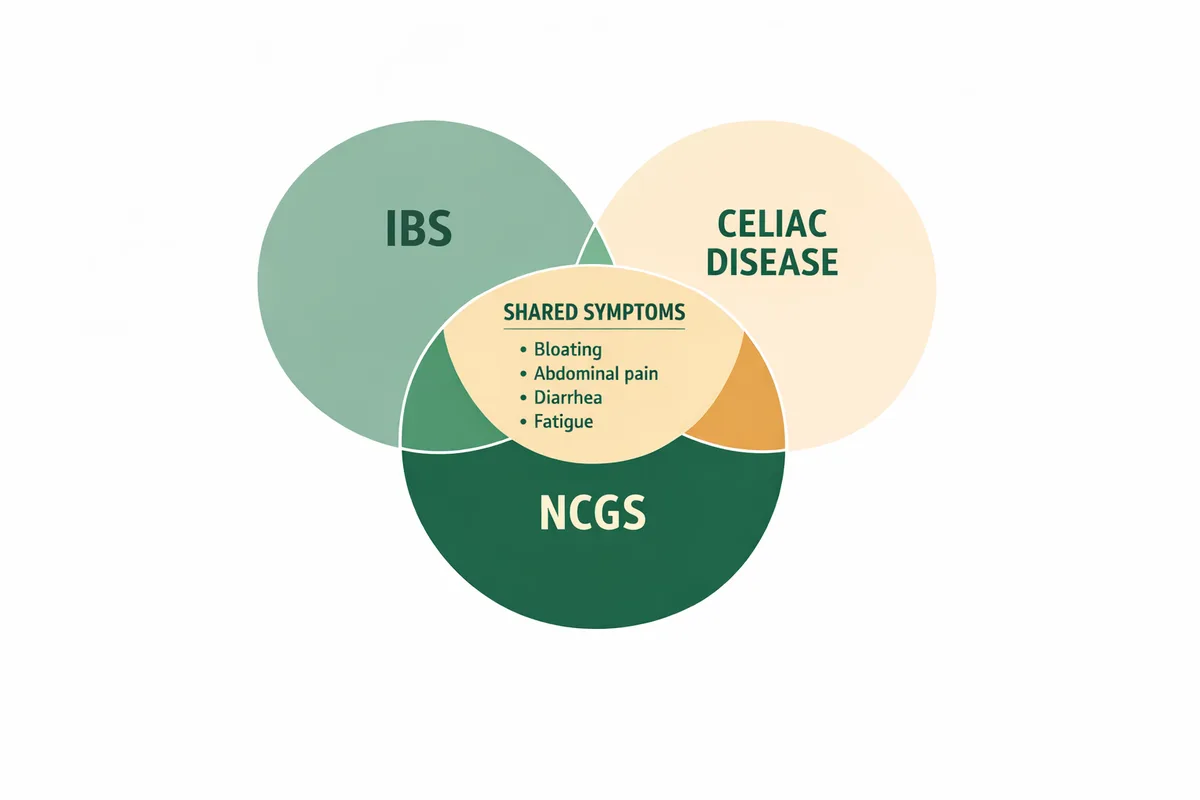
The core symptoms of IBS — bloating, abdominal pain, diarrhea, constipation, and gas — are identical to many celiac disease and NCGS symptoms. This overlap creates two major problems:
- Celiac disease gets misdiagnosed as IBS. If a doctor doesn’t test for celiac antibodies and jumps straight to an IBS diagnosis, the underlying autoimmune condition goes untreated — sometimes for years or decades. The patient manages symptoms while intestinal damage continues silently.
- IBS patients who respond to a GF diet don’t know why. When someone with IBS feels better after removing wheat, it could be due to gluten elimination, fructan (FODMAP) elimination, or both. Without proper testing, they may not understand their condition or know how strict they need to be.
The Gluten-Fructan Question
One of the most important developments in IBS research is the recognition that wheat contains both gluten (a protein) and fructans (a fermentable carbohydrate classified as a FODMAP). Many IBS patients who feel better on a “GF diet” may actually be responding to fructan reduction rather than gluten elimination — because removing wheat removes both simultaneously.
A landmark 2018 study published in Gastroenterology found that among self-reported NCGS patients, fructans triggered more symptoms than gluten in a controlled crossover trial. This doesn’t mean gluten sensitivity isn’t real — it means the picture is more complex than it appears, and proper diagnostic workup matters.
For practical purposes: if you have IBS and feel better without wheat, the relevant questions are:
- Have you been tested for celiac disease? (If positive, it’s a lifelong strict GF diet regardless.)
- Do you react to non-wheat gluten sources like barley and rye? (If yes, gluten may be the primary trigger.)
- Do you also react to other high-FODMAP foods like onions, garlic, and apples? (If yes, fructans/FODMAPs may be the primary issue.)
Managing IBS When Gluten Is a Factor
If You Have Celiac Disease + IBS Symptoms
Some celiac patients continue to have IBS-type symptoms even after going strictly GF and achieving mucosal healing. This is called “IBS in celiac disease” and affects approximately 20–30% of treated celiac patients. Possible causes include persistent microbiome dysbiosis, visceral hypersensitivity, concurrent SIBO, or FODMAP sensitivity independent of gluten.
If You Have IBS + Gluten Sensitivity (No Celiac)
A trial GF elimination diet (after celiac has been ruled out by testing) is a reasonable approach. Eliminate gluten for 4–6 weeks, then systematically reintroduce to assess response. If symptoms improve significantly on GF and return with gluten reintroduction, a GF or gluten-reduced diet may be an effective long-term management strategy.
If You Have IBS + FODMAP Sensitivity
The low-FODMAP diet — developed at Monash University — is the most evidence-based dietary intervention for IBS. It involves temporarily eliminating all high-FODMAP foods (including wheat, onions, garlic, certain fruits, and dairy), then systematically reintroducing each FODMAP group to identify specific triggers. This is best done with a registered dietitian experienced in FODMAPs.
Common Mistakes with IBS and Gluten
- Accepting an IBS diagnosis without celiac testing. The ACG recommends serological testing for celiac disease in all patients meeting IBS criteria. If your doctor diagnosed IBS without testing for celiac, request the test.
- Going GF before getting tested for celiac. Celiac blood tests require active gluten consumption. If you’ve already gone GF, you may need a gluten challenge (eating gluten for 6–8 weeks) before testing — which is miserable. Test first, eliminate second.
- Assuming wheat sensitivity = gluten sensitivity. Wheat contains gluten, fructans, amylase-trypsin inhibitors, and wheat germ agglutinin — any of which could trigger symptoms. Without systematic testing, you can’t be sure which component is the problem.
- Treating IBS symptoms without addressing gut health. IBS management often focuses on symptom control (antispasmodics, laxatives, fiber) without addressing microbiome health, food sensitivities, or stress — all of which influence the condition.
- Self-diagnosing based on symptom resolution. Feeling better on a GF diet doesn’t confirm celiac disease, NCGS, or any specific diagnosis. Proper testing matters — both for understanding your condition and for knowing how strict you need to be.
Frequently Asked Questions
Can gluten cause IBS symptoms?
Yes. Gluten can trigger IBS-type symptoms (bloating, diarrhea, abdominal pain, gas) through multiple mechanisms — celiac disease, non-celiac gluten sensitivity, or fructan sensitivity (wheat contains fructans, a FODMAP). Up to 4-5% of IBS patients have undiagnosed celiac disease, and a larger percentage may have NCGS.
Should IBS patients be tested for celiac disease?
Yes. The American College of Gastroenterology recommends serological testing for celiac disease in all patients meeting IBS criteria. A simple tTG-IgA blood test can screen for celiac disease. You must be actively eating gluten for the test to be accurate.
Is it IBS or gluten sensitivity?
The symptoms overlap significantly, making clinical distinction difficult without testing. Key differences: celiac disease shows positive tTG-IgA antibodies and villous atrophy on biopsy. IBS has no specific biomarkers. NCGS is diagnosed by symptom improvement after gluten elimination and exclusion of celiac and wheat allergy. Proper testing is essential.
Does a gluten-free diet help IBS?
Research shows that a GF diet improves symptoms in a significant subset of IBS patients — potentially those with undiagnosed NCGS or fructan sensitivity. However, wheat also contains FODMAPs (fructans), so improvement may be due to FODMAP reduction rather than gluten elimination. A systematic elimination and reintroduction approach helps clarify the trigger.
What is the difference between IBS and celiac disease?
IBS is a functional disorder — symptoms without structural damage. Celiac disease is an autoimmune condition that causes measurable intestinal damage (villous atrophy) with specific blood markers (tTG-IgA antibodies) and genetic markers (HLA-DQ2/DQ8). Celiac requires strict lifelong gluten avoidance, while IBS management focuses on symptom control through diet, stress management, and medications.
Getting the Right Diagnosis Changes Everything
The overlap between IBS, celiac disease, and gluten sensitivity is significant — and misdiagnosis in either direction has real consequences. If you have IBS, get tested for celiac disease. If you respond to a GF diet, investigate whether gluten, fructans, or both are your triggers. And if you have celiac disease but still have IBS-type symptoms after going GF, know that additional investigation (SIBO testing, FODMAP assessment, microbiome support) can help.
The goal isn’t just symptom management — it’s understanding your specific condition so you can treat the root cause. A proper diagnosis changes everything: your treatment plan, your dietary strictness, your monitoring schedule, and your long-term health outcomes. Don’t settle for a vague diagnosis when clarity is available.
This content is for educational purposes only and does not constitute medical advice. Consult your gastroenterologist for proper diagnosis and treatment of digestive conditions.