

On this page
The MTHFR gene mutation does not cause celiac disease or gluten sensitivity — but research shows it can make both conditions significantly harder on your body. MTHFR variants impair folate metabolism, elevate homocysteine levels, and slow gut repair, compounding the damage gluten causes in genetically susceptible people. Understanding this connection changed how our family manages our gluten-free life.
When I first learned that I carry the MTHFR C677T variant — and that both of my sons do too — I did what any nurse would do: I pulled up PubMed and started reading. What I found was both reassuring and frustrating. The research connecting MTHFR to celiac disease is real, but it’s also nuanced. And the internet has a way of taking nuance and turning it into panic. So let me walk you through what the science actually says — no hype, no fear-mongering, just the evidence.
Key Takeaways
- MTHFR does not cause celiac disease — but it can worsen outcomes by impairing folate conversion, elevating homocysteine, and slowing intestinal repair.
- The C677T variant reduces MTHFR enzyme activity by 30–70%, depending on whether you carry one or two copies — this directly affects how well your body processes folate.
- Elevated homocysteine is the key clinical marker — multiple studies show celiac patients with MTHFR variants have higher homocysteine levels, which drives inflammation and cardiovascular risk.
- A strict gluten-free diet combined with methylfolate supplementation can normalize homocysteine levels in most people — breaking the vicious cycle.
- Not all MTHFR claims online are accurate — separate evidence-based findings from wellness blog hype by sticking to peer-reviewed research.
What MTHFR Actually Is (and Isn’t)
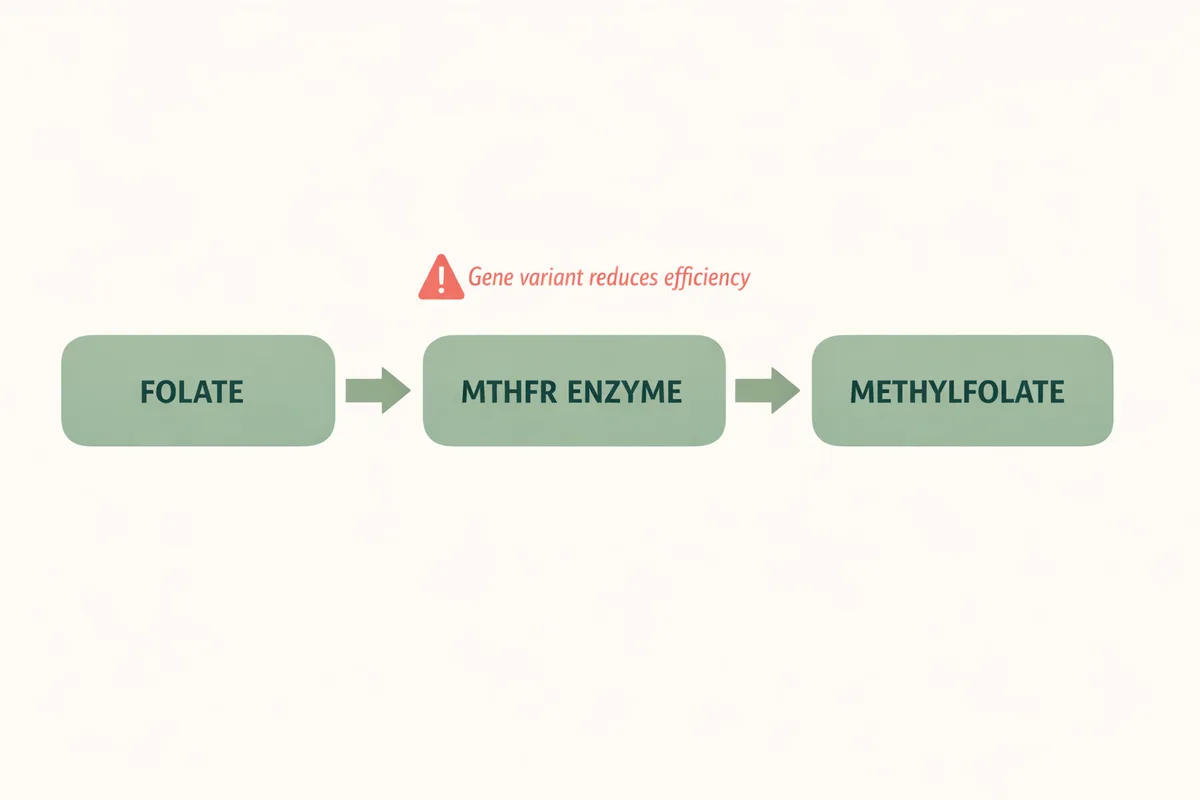
MTHFR stands for methylenetetrahydrofolate reductase. It’s not just a gene — it’s the name of an enzyme your body produces using instructions from the MTHFR gene. This enzyme performs one specific but critical job: it converts 5,10-methylenetetrahydrofolate into 5-methyltetrahydrofolate (5-MTHF), which is the active, usable form of folate in your body.
Methylfolate is essential for a process called methylation — a biochemical reaction that happens billions of times per day in your cells. Methylation is involved in DNA repair, neurotransmitter production, detoxification, immune regulation, and the maintenance of your gut lining. When the MTHFR enzyme works at reduced capacity, the entire methylation cascade slows down.
The Two Common Variants
Two MTHFR variants account for nearly all clinically significant cases. The C677T variant is the more impactful: one copy reduces enzyme activity by approximately 30%, and two copies (homozygous) reduce it by up to 70%. According to the National Library of Medicine, about 10–15% of the U.S. population is homozygous for C677T, with higher prevalence in Hispanic and Mediterranean populations.
The A1298C variant has a milder effect on enzyme function when present alone. However, carrying one copy of each variant (compound heterozygous — C677T + A1298C) can have a compounding effect that reduces enzyme activity more than either variant alone.
The MTHFR-Gluten Connection: What the Research Shows
Let me be clear about what the research does and doesn’t say. MTHFR variants are found at roughly similar rates in celiac patients and the general population. Having MTHFR does not increase your risk of developing celiac disease. The genes operate through completely different pathways — HLA-DQ2 and HLA-DQ8 determine celiac risk, while MTHFR affects methylation and folate processing.
Where MTHFR matters is in how severe celiac’s consequences become and how effectively your body can recover. The connection runs through three key mechanisms.
1. The Homocysteine Connection
This is the most well-documented link. When MTHFR enzyme activity is reduced, less folate gets converted to its active form. One of methylfolate’s critical jobs is converting homocysteine (an amino acid) into methionine. Without enough methylfolate, homocysteine accumulates in the blood — a condition called hyperhomocysteinemia.
A landmark study by Saibeni et al. (2005), published in the American Journal of Gastroenterology, found that celiac patients had significantly higher homocysteine levels than controls, and that MTHFR C677T homozygosity was an independent risk factor for hyperhomocysteinemia in this population. Wilcox and colleagues (2006) further documented that even treated celiac patients on a gluten-free diet had higher homocysteine levels when they also carried MTHFR variants.
Elevated homocysteine is not just an abstract lab number. It’s associated with increased cardiovascular risk, chronic inflammation, and — relevant for our discussion — impaired tissue repair throughout the body, including the gut lining.
2. The Folate Malabsorption Double Hit
Celiac disease damages the villi in the proximal small intestine — and this is precisely where folate absorption occurs. So celiac reduces your body’s ability to absorb folate from food. Then MTHFR reduces your body’s ability to convert whatever folate you do absorb into the active form you need. It’s a double hit: less coming in AND less being processed.
Research published in PubMed has documented folate deficiency in up to 20–40% of newly diagnosed celiac patients. For those who also carry MTHFR variants, the deficiency can be more severe and more resistant to standard supplementation with folic acid — because folic acid itself requires the MTHFR enzyme for conversion.
3. The Gut Repair Slowdown
Your intestinal lining replaces itself every 3–5 days — one of the fastest cell turnover rates in the body. This rapid regeneration requires robust DNA methylation and cell division, both of which depend on adequate methylfolate. When MTHFR impairs methylation, the gut lining may not repair as efficiently after gluten-induced damage.
This is emerging science, not yet settled consensus. But early research suggests that impaired DNA methylation may affect intestinal epithelial cell development and barrier function. For people with celiac who also carry MTHFR variants, this could mean longer healing timelines after diagnosis and greater vulnerability to damage from accidental gluten exposure.
Separating Fact from Hype
Let’s address the elephant in the room. MTHFR has become a lightning rod in the wellness space, with claims ranging from evidence-based to wildly exaggerated. Some blogs and supplement companies attribute everything from autism to anxiety to cancer to MTHFR variants — often without citing any research. This makes it harder for people with legitimate concerns to get accurate information.
Here’s what the evidence supports versus what it doesn’t:
Supported by evidence: MTHFR variants reduce enzyme activity, impair folate conversion, and can lead to elevated homocysteine. In people with celiac disease, this combination can worsen folate deficiency and slow gut repair. Methylfolate supplementation is a reasonable intervention for documented deficiency in MTHFR carriers.
Not supported by evidence: MTHFR causes celiac disease. Everyone with MTHFR should be gluten-free. MTHFR is the root cause of chronic illness. High-dose methylfolate protocols cure anything. These claims go well beyond what peer-reviewed research demonstrates.
What This Means for You Practically
If you have celiac disease or gluten sensitivity and carry an MTHFR variant, here’s what the research suggests you should do:
- Ask your provider to check homocysteine levels. This is a simple blood test that reveals whether impaired methylation is actually affecting you clinically — not everyone with MTHFR has elevated homocysteine.
- Discuss methylfolate supplementation. If your homocysteine is elevated or your folate levels are low, switching from folic acid to methylfolate (5-MTHF) may help normalize these levels.
- Maintain strict gluten-free compliance. The combination of MTHFR and gluten creates a compounding damage cycle. Strict adherence to the GF diet is even more important when methylation is impaired.
- Monitor B12, B6, and folate regularly. These nutrients are the key players in methylation, and they’re commonly deficient in people on a GF diet — even more so with MTHFR.
Common Mistakes When Dealing with MTHFR and Gluten
- Self-diagnosing based on consumer genetic tests alone. 23andMe can flag MTHFR variants, but a clinical evaluation including homocysteine levels gives you the full picture. A variant without elevated homocysteine may not need aggressive intervention.
- Mega-dosing methylfolate without medical guidance. More is not always better. Overmethylation can cause anxiety, insomnia, and irritability. Start low, go slow, and work with a provider.
- Assuming MTHFR means you must go gluten-free. MTHFR alone is not a reason to eliminate gluten. It matters most when combined with celiac or confirmed gluten sensitivity.
- Ignoring folic acid in fortified GF products. Many gluten-free breads, cereals, and flours contain synthetic folic acid. If you carry MTHFR variants, reading labels for folate form matters.
- Treating MTHFR as a standalone diagnosis. MTHFR variants are common and usually only clinically significant in combination with other factors. Context matters more than the variant alone.
Frequently Asked Questions
Does MTHFR cause celiac disease?
No. MTHFR and celiac disease are caused by different genes. Celiac requires HLA-DQ2 or HLA-DQ8 genes. MTHFR variants are found at similar rates in celiac patients and the general population. However, MTHFR can worsen celiac outcomes by impairing folate metabolism and slowing gut repair.
Can MTHFR make gluten sensitivity worse?
Research suggests yes. MTHFR impairs folate conversion, which can elevate homocysteine and increase inflammation. In people with celiac or gluten sensitivity, this compounds gut damage and may slow intestinal healing. The combination creates a vicious cycle of malabsorption and impaired repair.
What is the connection between MTHFR and homocysteine?
The MTHFR enzyme converts folate into methylfolate, which is needed to convert homocysteine into methionine. When MTHFR activity is reduced, homocysteine accumulates in the blood. Studies show celiac patients with MTHFR C677T variants have significantly higher homocysteine levels than those without.
Should everyone with MTHFR avoid gluten?
No. MTHFR alone is not a reason to go gluten-free. The MTHFR-gluten connection matters most for people who already have celiac disease or confirmed gluten sensitivity. For them, MTHFR makes strict gluten-free compliance and proper supplementation even more important.
How common is the MTHFR mutation?
Very common. According to the National Library of Medicine, about 10-15% of the U.S. population is homozygous for the C677T variant, and up to 40% carry at least one copy. The A1298C variant is similarly prevalent. Having MTHFR variants is normal — clinical significance depends on other factors.
What I Wish Someone Had Told Us Sooner
I spent almost a year after we went gluten-free wondering why the boys still seemed tired, why Paul’s homocysteine kept creeping up, why going strictly gluten-free didn’t fix everything the way we expected. The MTHFR piece was the missing corner of the puzzle. Not the whole picture — but the part that made the rest of it snap into focus.
If you’re reading this and nodding along — if you’ve done everything right with your GF diet and something still feels off — ask your doctor about MTHFR testing. It’s a simple blood test, it’s inexpensive, and the results are actionable. Methylfolate supplementation, homocysteine monitoring, a smarter approach to B vitamins. None of it is dramatic. All of it matters.
You can also dig deeper into the supplement side of things in our MTHFR Supplement Guide, or learn whether your kids should be tested in MTHFR in Kids: What Parents Need to Know.
Building your GF foundations? Grab our free 30-day gluten-free guide — it covers nutrition gaps, supplement basics, and the stuff I wish I’d known from day one.