

On this page
Folic acid and methylfolate are both forms of vitamin B9, but they are not interchangeable — especially if you carry an MTHFR gene variant and eat gluten-free. Folic acid is the synthetic form that requires enzymatic conversion before your body can use it. Methylfolate (5-MTHF) is the already-active form that bypasses that conversion entirely. For MTHFR carriers on a GF diet, this distinction can affect energy, gut healing, and long-term health.
This is one of those topics that sounds like it should be simple — folic acid, folate, methylfolate, what’s the difference? But once you’re managing both MTHFR and a gluten-free diet, these details genuinely matter. It was one of the first things I overhauled after our family’s MTHFR results came back, and it’s one of the most impactful changes we’ve made.
Key Takeaways
- Folic acid is synthetic and must be converted by the MTHFR enzyme into active methylfolate — MTHFR variants reduce this conversion by 30–70%.
- Methylfolate (5-MTHF) is the active form your body actually uses — it skips the conversion step entirely, making it more effective for MTHFR carriers.
- Many gluten-free products are fortified with folic acid (breads, cereals, flour blends) — MTHFR carriers should learn to read labels for folate form.
- Unmetabolized folic acid can accumulate in the bloodstream of MTHFR carriers, and emerging research suggests this may not be benign.
- Switching supplements from folic acid to methylfolate is simple — but always work with your provider on dosing, especially during pregnancy.
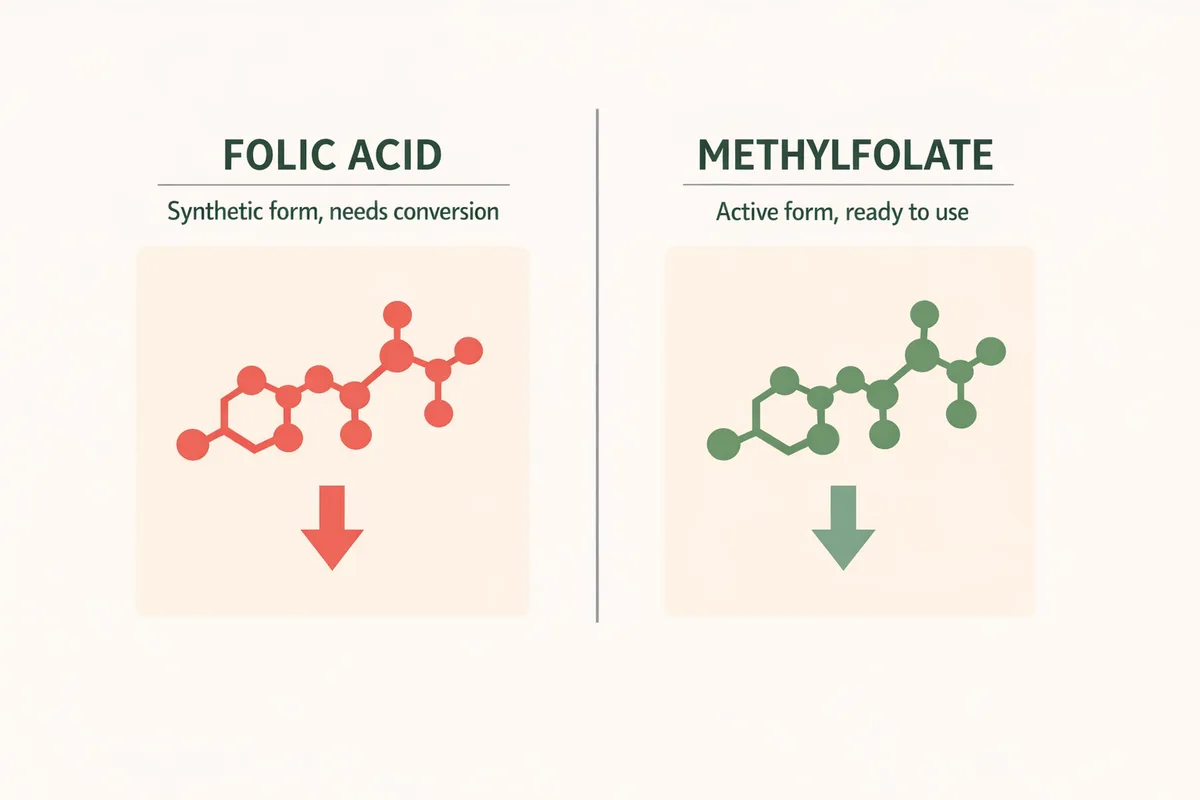
The Core Difference: Folic Acid vs. Methylfolate
All forms of vitamin B9 are broadly called “folate,” but the specific form matters. Here’s the pathway: you eat food containing folate (from leafy greens, legumes) or folic acid (from fortified products and supplements). Your body then needs to convert these into the active form — 5-methyltetrahydrofolate (5-MTHF), also called methylfolate — through several enzymatic steps. The final and rate-limiting step in this conversion is performed by the MTHFR enzyme.
For people with fully functional MTHFR enzymes, folic acid works fine. The conversion happens efficiently, and the body gets the methylfolate it needs. But for MTHFR carriers — particularly those homozygous for C677T — the conversion is significantly reduced. Folic acid enters the system but can’t be fully processed into its usable form.
Methylfolate supplements bypass this bottleneck entirely. Because 5-MTHF is already in its active form, it doesn’t need MTHFR enzyme conversion. It’s ready to participate in methylation reactions immediately — supporting DNA repair, homocysteine conversion, neurotransmitter production, and gut lining maintenance.
| Feature | Folic Acid | Methylfolate (5-MTHF) |
|---|---|---|
| Form | Synthetic | Bioactive / natural |
| Requires MTHFR conversion | ✗ Yes — requires full enzymatic conversion | ✓ No — already active |
| Effective for MTHFR carriers | ✗ Reduced (30–70% less conversion) | ✓ Fully effective |
| Found in fortified GF products | ✓ Very common | ✗ Rare |
| Risk of accumulation | ✗ Can accumulate unmetabolized | ✓ Minimal risk |
| Cost | Lower ($5–15/month) | Higher ($15–35/month) |
| Prescription needed | No | No (OTC at most doses) |
Why This Matters More When You’re Gluten-Free
Here’s the GF-specific angle that most MTHFR articles miss. In the United States, the FDA mandates that enriched grain products be fortified with folic acid. When you go gluten-free, you switch from wheat-based products to GF alternatives — and many of those GF alternatives are also fortified with folic acid to match the nutritional profile of their wheat-based counterparts.
Check the ingredient list on your favorite gluten-free bread, cereal, or flour blend. You’ll likely find “folic acid” listed. For most people, this is a health benefit. But for MTHFR carriers, every serving of folic acid-fortified food adds to the unconverted folic acid load in your system.
Compounding the issue: celiac disease damages the part of the small intestine where folate is absorbed. So you’re already dealing with reduced absorption. Add MTHFR’s impaired conversion on top, and the gap between what your body needs and what it can actually use widens further.
The Unmetabolized Folic Acid Question
When your body can’t fully convert folic acid, the unconverted form — called unmetabolized folic acid (UMFA) — circulates in your bloodstream. Research on the effects of UMFA is still evolving, but it’s an area of growing scientific interest.
Some studies have raised concerns that high levels of UMFA may interfere with natural folate metabolism by competing for the same cellular receptors. Other research has explored potential associations between elevated UMFA and immune function changes. These findings are preliminary, and it would be inaccurate to call UMFA definitively “harmful” — but the emerging evidence is enough that many healthcare providers now recommend methylfolate over folic acid for patients with known MTHFR variants.
The National Institutes of Health acknowledges that MTHFR variants affect folate metabolism, and several clinical guidelines now suggest methylfolate as a preferred supplementation form for individuals with documented MTHFR variants and elevated homocysteine.
The Pregnancy Angle
This is critically important for women of childbearing age. Adequate folate before and during early pregnancy is essential for preventing neural tube defects. Standard prenatal vitamins almost universally contain folic acid — not methylfolate. For most women, this works fine.
But for women with MTHFR variants, the reduced conversion capacity means folic acid may not provide adequate active folate during the critical early weeks of pregnancy when neural tube closure occurs. If you carry MTHFR and are planning a pregnancy or are currently pregnant, this is a conversation to have with your OB-GYN or midwife immediately. Prenatal vitamins containing methylfolate (sometimes listed as Metafolin or Quatrefolic) are widely available.
How to Audit Your GF Pantry for Folic Acid
You don’t need to overhaul everything at once. Start by checking the products you eat most frequently.
GF Pantry Audit for MTHFR Carriers
- Check ingredient lists on GF breads and wraps — look for “folic acid” in the enrichment section
- Review GF cereals — most fortified cereals use folic acid, not methylfolate
- Check GF flour blends — enriched blends commonly contain folic acid
- Review your current multivitamin and B-complex supplement labels
- Check prenatal vitamins for folate form (folic acid vs. methylfolate/Metafolin/Quatrefolic)
- Look for “L-methylfolate,” “5-MTHF,” “Metafolin,” or “Quatrefolic” as the preferred forms
- Consider switching to unfortified GF products where available as an alternative
Common Mistakes to Watch Out For
- Assuming “folate” on a label means methylfolate. The term “folate” is sometimes used generically. Check the specific form — “folic acid” and “methylfolate” are different compounds with different bioavailability for MTHFR carriers.
- Stopping folic acid cold turkey without a replacement. If you’ve been taking folic acid, don’t just drop it — switch to methylfolate at an equivalent dose under your provider’s guidance. Going without any folate source is worse than taking the synthetic form.
- Over-supplementing methylfolate. More is not better. Excessive methylfolate can cause anxiety, irritability, and insomnia in some people — a phenomenon sometimes called “overmethylation.” Start with a low dose and work up with your provider.
- Ignoring the B12 connection. Methylfolate and methylcobalamin (active B12) work together in the methylation cycle. Supplementing one without the other can create imbalances. Most providers recommend both for MTHFR carriers.
Frequently Asked Questions
What’s the difference between folic acid and methylfolate?
Folic acid is the synthetic form of vitamin B9 used in fortified foods and most supplements. Methylfolate (5-MTHF) is the biologically active form your body actually uses. Folic acid must be converted by the MTHFR enzyme to become methylfolate — people with MTHFR variants have reduced conversion capacity.
Can folic acid be harmful if you have MTHFR?
Folic acid itself is not toxic, but MTHFR carriers may accumulate unmetabolized folic acid in their bloodstream because they can’t convert it efficiently. Emerging research suggests high levels of unmetabolized folic acid may interfere with natural folate metabolism. Most providers now recommend methylfolate for known MTHFR carriers.
Do gluten-free products contain folic acid?
Yes — many GF breads, cereals, flour blends, and pasta products are fortified with folic acid to match the nutritional profile of their wheat-based counterparts. Check ingredient lists carefully, especially the enrichment section. Products labeled unfortified or those using methylfolate are available but less common.
What form of folate should MTHFR carriers take?
Healthcare providers typically recommend methylfolate (5-MTHF) for MTHFR carriers, especially those with elevated homocysteine or documented folate deficiency. Common supplement forms include L-methylfolate, Metafolin, and Quatrefolic. Always work with your provider on dosing.
Is methylfolate safe during pregnancy?
Methylfolate is considered safe and is increasingly recommended for pregnant women with MTHFR variants. Several prenatal vitamins now contain methylfolate instead of folic acid. However, never change your prenatal supplementation without consulting your OB-GYN or midwife — adequate folate during early pregnancy is critical.
One Small Switch That Made a Real Difference for Us
Honestly? Swapping folic acid for methylfolate felt almost too simple when our functional medicine provider first suggested it. I remember thinking, “Really? Just change the type of B vitamin?” But within a couple months, Paul’s homocysteine levels dropped for the first time in years. The boys’ energy evened out. I stopped getting those afternoon brain fog crashes that I’d blamed on motherhood and coffee dependency.
I’m not promising miracles — everyone’s body is different, and MTHFR variants come in different severities. But if you’re GF and still taking supplements with folic acid on the label, it’s worth a conversation with your provider. Flip the bottle over, check the form, and ask whether methylfolate might be a better fit. It’s one of those rare situations where the science is straightforward and the fix is easy.
If you want specifics on dosing and brands, our MTHFR Supplement Guide breaks it all down. And if you’re new to the MTHFR conversation entirely, start with The MTHFR-Gluten Connection for the full backstory.
Still building your GF toolkit? Our free 30-day guide walks you through the nutrition essentials — including which supplement forms to look for and which to skip.