

On this page
HLA-DQ2 and HLA-DQ8 are the two genetic markers required for celiac disease. If you don’t carry either gene, you almost certainly won’t develop celiac — making genetic testing one of the most definitive rule-out tools in medicine. HLA-DQ2 is present in approximately 90–95% of celiac patients, while HLA-DQ8 accounts for most of the remainder. But carrying these genes doesn’t mean you have celiac — about 30–40% of the general population carries them, yet only around 3% of carriers ever develop the disease.
When families first hear the terms “HLA-DQ2” and “HLA-DQ8,” it can sound intimidating — like something from a genetics textbook you’d rather not open. But as a nurse and a mom managing these realities for my own family, I promise you: the concepts are simpler than they sound, and understanding them gives you real power over your family’s health decisions.
Key Takeaways
- HLA-DQ2 and HLA-DQ8 are immune system genes that allow your body to recognize and react to gluten peptides — they’re the “lock” that gluten’s “key” fits.
- You must carry at least one of these genes to develop celiac disease — if you carry neither, celiac is essentially ruled out.
- Carrying the genes doesn’t guarantee celiac: 30–40% of the population has them, but only ~3% of carriers develop the disease.
- Not all carriers face equal risk: DQ2.5 homozygous carriers have the highest risk, while DQ2.2 and DQ8 carry progressively lower risk.
- Family testing matters: if one family member tests positive, first-degree relatives should consider HLA testing for their own risk assessment.
What HLA Genes Actually Do
HLA stands for Human Leukocyte Antigen — a group of genes that are central to your immune system’s ability to distinguish between “self” (your own cells) and “non-self” (foreign invaders like bacteria, viruses, and in this case, gluten). Everyone has HLA genes — they’re part of normal immune function. The specific question is which variants you carry.
HLA-DQ2 and HLA-DQ8 are variants within this system that code for specific proteins on the surface of antigen-presenting cells (APCs). These surface proteins have a binding groove — a molecular shape that determines what peptides they can grab onto and present to T cells. Think of it like a lock and key: HLA-DQ2 and HLA-DQ8 have binding grooves that fit gluten-derived peptides perfectly. When a gluten peptide binds, the APC presents it to T cells, which then mount an immune response — attacking the intestinal lining in the process.
Other HLA variants have differently shaped binding grooves that simply can’t grab gluten peptides effectively. That’s why people without HLA-DQ2 or HLA-DQ8 don’t develop celiac disease — their immune system literally can’t “see” gluten as a threat in the same way.
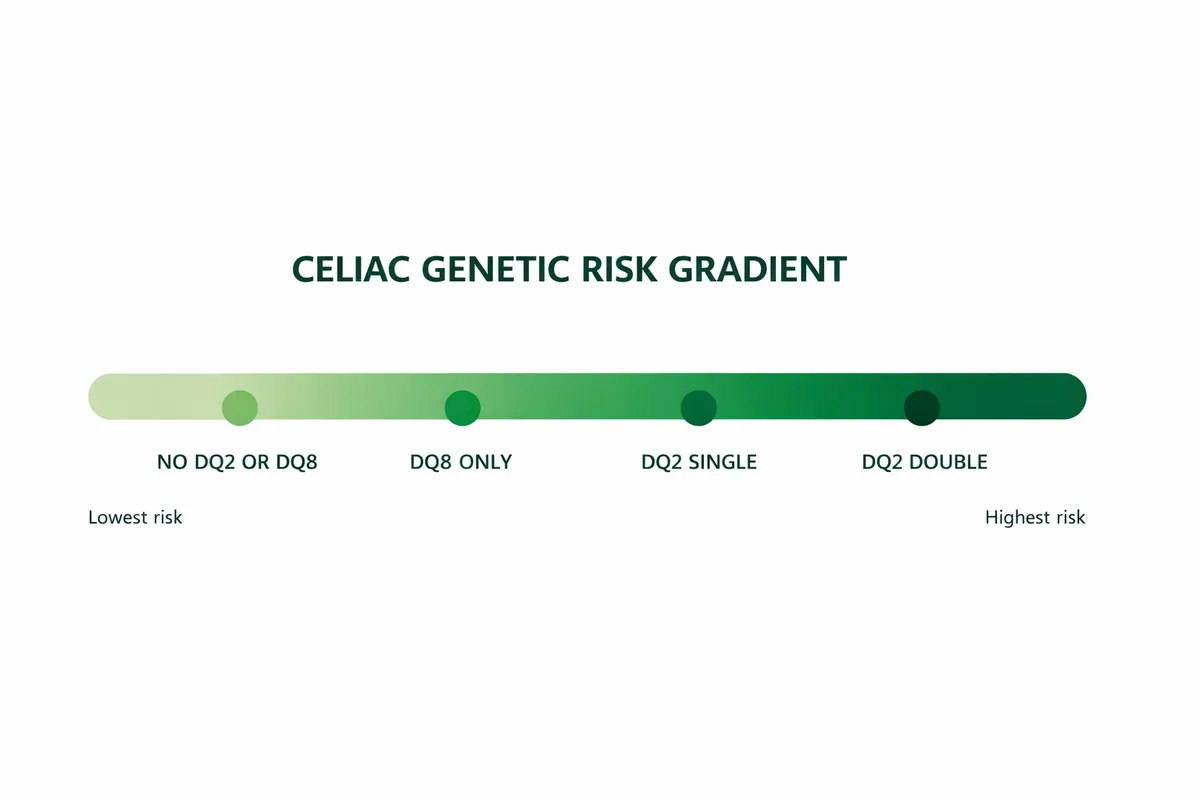
The Risk Gradient: Not All Carriers Are Equal
One of the most important things to understand about celiac genetics is that risk exists on a gradient. Not all HLA-DQ2 carriers face the same level of risk. The specifics depend on which version of DQ2 you carry and whether you have one copy or two.
| Gene Variant | Encoded By | Risk Level | Found In Celiac Patients |
|---|---|---|---|
| DQ2.5 (homozygous — 2 copies) | DQA1*05 / DQB1*02 | Highest risk (~5x higher than heterozygous) | ~30% of celiac patients |
| DQ2.5 (heterozygous — 1 copy) | DQA1*05 / DQB1*02 | High risk | ~50–55% of celiac patients |
| DQ2.2 | DQA1*02 / DQB1*02 | Moderate risk | ~5% of celiac patients |
| DQ8 | DQA1*03 / DQB1*0302 | Lower risk (but still possible) | ~5–10% of celiac patients |
| Neither DQ2 nor DQ8 | — | Extremely low (essentially ruled out) | <1% of celiac patients |
Research published in Frontiers in Nutrition has demonstrated that DQ2.5 homozygous individuals — those who inherited the DQ2.5 variant from both parents — face approximately five times the risk of developing celiac compared to heterozygous carriers. This is because having two copies of DQ2.5 means more of those gluten-binding proteins are present on cell surfaces, increasing the chance of an immune response being triggered.
Homozygous vs. Heterozygous — Simplified
You inherit one copy of each gene from each parent. If you got HLA-DQ2.5 from both parents, you’re homozygous — highest risk. If you got it from only one parent, you’re heterozygous — still at risk, but lower. Think of it like volume: one copy turns the dial to 5, two copies crank it to 10. The more DQ2.5 protein on your cell surfaces, the more efficiently your immune system can detect and react to gluten peptides.
The “Necessary but Not Sufficient” Concept
This is perhaps the single most important concept for families to understand. HLA-DQ2 and HLA-DQ8 are necessary for celiac disease — you must carry at least one to develop the condition. But they are not sufficient — carrying them doesn’t mean you will develop celiac.
The numbers tell the story clearly. According to the Celiac Disease Foundation, approximately 30–40% of the general U.S. population carries HLA-DQ2 or HLA-DQ8. But the prevalence of celiac disease is approximately 1% of the population. That means the vast majority of gene carriers — roughly 97% — never develop the disease.
Something else has to happen to trigger celiac disease in a genetically susceptible person. Researchers believe this involves a combination of factors: environmental triggers (GI infections, stress, pregnancy, antibiotic use), gut microbiome changes, and increased intestinal permeability. The genes load the gun, but environment pulls the trigger. Learn more about this in our guide on why most carriers never develop the disease.
Family Cascade Testing: Why Relatives Should Consider Testing
Celiac disease clusters in families. The National Institute of Diabetes and Digestive and Kidney Diseases reports that first-degree relatives of someone with celiac disease have approximately a 1 in 10 chance of developing it — compared to about 1 in 100 in the general population. That’s a tenfold increase in risk.
This is why healthcare providers recommend “cascade testing” — when one family member is diagnosed with celiac, their parents, siblings, and children should be tested. HLA testing is a logical first step because a negative result essentially removes the concern. First-degree relatives who test positive for HLA-DQ2 or HLA-DQ8 should then be monitored with periodic antibody testing (tTG-IgA), even if they’re currently symptom-free.
Inheritance Patterns
HLA genes follow standard inheritance patterns. If one parent carries HLA-DQ2 or HLA-DQ8, at least 50% of their children will inherit the variant. If both parents carry celiac-associated genes, the percentage increases further. This doesn’t mean those children will develop celiac — it means they have the genetic prerequisite, and monitoring is prudent.
When Family Members Should Consider HLA Testing
- A first-degree relative (parent, sibling, or child) has been diagnosed with celiac disease
- A family member has unexplained GI symptoms, nutrient deficiencies, or autoimmune conditions
- A child has symptoms but standard celiac blood tests are inconclusive
- You’ve been eating gluten-free for years without a formal celiac diagnosis
- You want to know whether celiac is possible before deciding on further testing
- You’re planning a pregnancy and want to understand risk for future children
What Your Results Mean
Positive HLA-DQ2 or HLA-DQ8
A positive result means celiac disease is possible — not confirmed. You carry the genetic prerequisite, but ~97% of carriers never develop the disease. Next steps: discuss monitoring with your gastroenterologist. Most providers recommend periodic tTG-IgA antibody testing (every 2–3 years for asymptomatic carriers, or sooner if symptoms develop). Do not go gluten-free preemptively — this makes future diagnosis harder because antibody levels drop on a GF diet.
Negative for Both HLA-DQ2 and HLA-DQ8
A negative result is extremely powerful. It essentially rules out celiac disease — less than 1% of celiac patients lack both genes, and those rare cases are sometimes attributed to unusual HLA configurations. For practical purposes, a negative HLA result means you can stop worrying about celiac. This test only needs to be done once — your genes don’t change.
To read your own result rather than the general case, our decoder covers each genotype in turn — what it does and does not rule out, where it sits on the published risk gradient, and what to ask a doctor next. It also distinguishes a 23andMe result from comprehensive clinical HLA typing, which matters most when the answer is negative.
Common Mistakes to Watch Out For
- Treating a positive HLA result as a celiac diagnosis. It’s not. It means celiac is possible. Diagnosis requires antibody testing and typically biopsy while eating gluten.
- Going gluten-free before completing diagnostic testing. Once you stop eating gluten, antibody levels drop and biopsy results may be unreliable. If you’re considering a celiac workup, keep eating gluten until testing is complete.
- Assuming consumer genetic tests are comprehensive for celiac HLA. 23andMe and AncestryDNA flag some HLA variants but don’t provide full DQA1/DQB1 typing. Clinical HLA testing through your doctor is the gold standard.
- Not testing family members after a diagnosis. Celiac clusters in families. If one person is diagnosed, first-degree relatives should be tested.
- Panicking over a positive result. Remember: 97% of carriers never develop celiac. A positive gene test is information for monitoring, not a reason for fear.
Frequently Asked Questions
What does it mean if I have HLA-DQ2?
Having HLA-DQ2 means you carry the genetic prerequisite for celiac disease — your immune system has the molecular machinery to recognize and react to gluten peptides. However, 30-40% of the general population carries this gene, and only about 3% of carriers develop celiac. It indicates risk, not diagnosis.
Can you have celiac disease without HLA-DQ2 or DQ8?
It’s extremely rare — less than 1% of confirmed celiac patients lack both HLA-DQ2 and HLA-DQ8. For practical purposes, the absence of both genes essentially rules out celiac disease. Some rare cases may involve unusual HLA configurations that standard testing doesn’t detect.
Should I test my children for celiac genes?
If celiac disease runs in your family, HLA testing for your children is a reasonable step. First-degree relatives have a 1 in 10 chance of developing celiac. A negative HLA result rules it out; a positive result guides future monitoring with periodic antibody screening.
What’s the difference between HLA-DQ2.5 and DQ2.2?
DQ2.5 (encoded by DQA1*05/DQB1*02) carries the highest celiac risk and is found in about 85-90% of celiac patients. DQ2.2 (encoded by DQA1*02/DQB1*02) carries a lower risk but can still be associated with celiac, especially if combined with other genetic factors. DQ2.5 homozygous carriers have roughly five times the risk of heterozygous carriers.
Does a positive HLA test mean I have celiac disease?
No. A positive HLA test means celiac disease is genetically possible — not that you have it. Roughly 97% of people with these genes never develop celiac. Diagnosis requires positive serological testing (tTG-IgA antibodies) and typically an endoscopic biopsy confirming villous damage while eating gluten.
Your Genes Are a Chapter, Not the Whole Book
When our family’s HLA results came back, I remember staring at the report like it was a verdict. DQ2-positive. It felt final — like the genetics had decided something about our future that we couldn’t change. But the more I learned, the more I realized that HLA status is just the opening chapter of a much longer story. It tells you what’s possible, not what’s inevitable.
Ninety-seven percent of people who carry these genes never develop celiac disease. That number changed how I think about our results entirely. We’re informed now, not sentenced. We know to screen the boys regularly. We know what symptoms to watch for. And if anything ever does develop, we’ll catch it early — years before it would have been caught otherwise. That’s the gift of genetic knowledge: not certainty, but preparedness.
If your family just got HLA results and you’re trying to figure out what comes next, My Child Has a Celiac Gene — Now What? is the practical guide I wish I’d had. And if you’re wondering why the gene doesn’t always lead to disease, The Celiac Gene Gap explains exactly that.
New to all of this? Our free 30-day GF guide gives you the fundamentals — whether you’re managing active celiac or just keeping an eye on genetic risk.