
About 30–40% of the general population carries celiac disease genes (HLA-DQ2 or HLA-DQ8), yet only approximately 3% of carriers ever develop the disease. This massive gap between genetic potential and actual disease — what researchers call the “celiac gene gap” — means that genes alone don’t determine your fate. Something else has to happen to trigger celiac in a genetically susceptible person, and understanding those triggers is one of the most active areas in celiac research today.
This is the question that kept my husband up late reading research papers after both boys tested positive for HLA-DQ2: “They have the genes — but does that mean they’ll get celiac?” The honest answer is probably not. But understanding what separates the 3% who develop celiac from the 97% who don’t gives us something better than hope — it gives us informed vigilance.
Key Takeaways
- Genes are necessary but not sufficient: you need HLA-DQ2 or HLA-DQ8 to develop celiac, but carrying them gives you only a ~3% lifetime risk.
- The “three-legged stool” model: celiac requires genetic susceptibility + an environmental trigger + a breakdown in gut barrier function — all three must converge.
- Known environmental triggers include GI infections, significant stress, pregnancy, surgery, and possibly early antibiotic exposure — though no single trigger guarantees activation.
- The gut microbiome appears to play a gatekeeper role — certain microbial profiles may protect against or predispose to celiac activation.
- Celiac can develop at any age — from infancy to the 70s — suggesting that triggers accumulate or change across a lifetime.
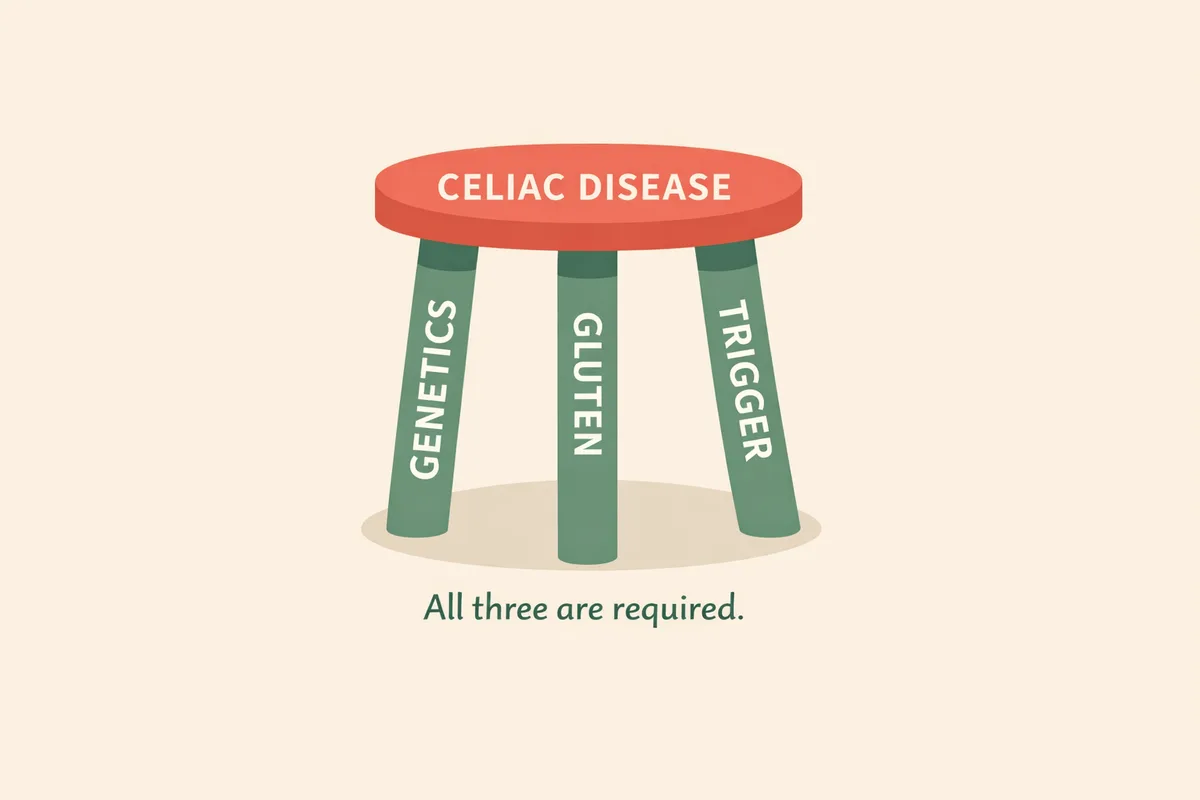
The Three-Legged Stool: What It Takes to Develop Celiac
Researchers increasingly describe celiac disease development using a “three-legged stool” model. All three legs must be present for the disease to activate. Remove any one leg, and the stool falls — celiac doesn’t develop. This framework helps explain both why most gene carriers stay healthy and why celiac can seem to “appear” suddenly in someone who’s eaten gluten without problems for decades.
The genius of this model is that it explains the variability. Different people encounter different environmental triggers at different times. Some people’s gut barriers are more resilient than others due to factors like microbiome composition, diet quality, and overall health. And the genetic component itself varies — DQ2.5 homozygous carriers are more susceptible than DQ8 heterozygous carriers. The combinations are nearly endless, which is why celiac appears so unpredictable from the outside.
Environmental Triggers: What Might “Activate” Celiac
If genes load the gun, what pulls the trigger? Researchers have identified several environmental factors associated with celiac disease onset, though no single trigger has been definitively proven to cause the disease independently.
Gastrointestinal Infections
GI infections — particularly viral gastroenteritis — are among the most studied potential triggers. Research published by the Celiac Disease Foundation has highlighted studies showing that certain viral infections (especially reovirus) can disrupt immune tolerance to gluten in genetically susceptible individuals. The theory: an infection that inflames the gut lining creates a temporary “opening” where gluten peptides cross the barrier and are presented to the immune system in a way that triggers the autoimmune cascade.
Significant Life Stress
Major life stressors — divorce, job loss, bereavement, chronic psychological stress — have been associated with autoimmune disease onset broadly, including celiac. Stress affects the gut through the gut-brain axis, altering microbiome composition, increasing intestinal permeability, and modulating immune function. While stress alone doesn’t cause celiac, it may create conditions that lower the threshold for activation.
Pregnancy and Hormonal Changes
Some women report celiac symptoms beginning during or shortly after pregnancy. Pregnancy involves significant immune system modulation — the body must tolerate a genetically foreign fetus — and this immune reshuffling may alter how the body responds to gluten afterward. Hormonal changes, microbiome shifts during pregnancy, and the physical stress of delivery may all contribute.
Surgery and Physical Trauma
Abdominal surgery, severe illness requiring hospitalization, and other forms of significant physical stress have been reported as preceding celiac onset. The mechanism likely involves transient gut barrier disruption combined with immune system activation during recovery.
Antibiotic Exposure
Emerging research suggests that antibiotic exposure — particularly repeated courses in early childhood — may alter the gut microbiome in ways that increase celiac risk. Antibiotics can reduce microbial diversity, and certain bacterial populations may play protective roles against autoimmune activation. This research is still early-stage, and antibiotics should never be withheld when medically necessary.
The Gut Microbiome as Gatekeeper
One of the most exciting areas of celiac research involves the gut microbiome — the trillions of bacteria, viruses, and fungi that inhabit your digestive tract. Studies have found that the microbiome composition of celiac patients differs from healthy controls, even among genetically susceptible individuals.
Certain bacterial species appear to play a protective role — they help maintain gut barrier integrity, regulate immune responses, and may even influence how gluten peptides are processed in the intestine. When these protective species are reduced (by antibiotics, poor diet, infection, or other factors), the balance may shift in favor of celiac activation.
This line of research suggests a potential future where microbiome-targeted interventions — probiotics, prebiotics, or even fecal microbiota transplantation — could help prevent celiac onset in genetically susceptible individuals. We’re not there yet, but the direction is promising. For more on the microbiome connection, see our guide on leaky gut and gluten.
Why Celiac Can Develop at Any Age
One of the most confusing aspects of celiac disease for families is its unpredictable timing. Some children develop symptoms in infancy, shortly after gluten is introduced. Others eat gluten without problems for 20, 30, even 50 years before developing the disease. What explains this?
The three-legged stool model helps. The genes are constant — you’re born with them. But the environmental triggers and gut barrier status change throughout life. A genetically susceptible person might go through childhood without the right (or rather, wrong) combination of triggers. Then a severe GI infection at 35, combined with high stress and a course of antibiotics, creates the perfect storm. Suddenly, the immune system starts reacting to gluten in a way it hadn’t before.
This is why periodic monitoring of gene-positive family members is important even when they’re currently symptom-free. Celiac can develop at any age, and earlier detection leads to better outcomes.
The Hope: Can We Prevent Celiac in Gene Carriers?
Understanding triggers opens the door to prevention — a concept that was essentially unthinkable a decade ago. While we can’t change someone’s genes, we may eventually be able to influence the other two legs of the stool.
Several large-scale studies are investigating whether interventions like controlled gluten introduction timing, microbiome support (probiotics during infancy), or immune tolerance therapies can reduce celiac activation rates in gene-positive children. The results so far are mixed but encouraging. The Beyond Celiac organization tracks ongoing clinical trials for anyone interested in following this research.
For now, the practical takeaway for families is this: you can’t prevent celiac with certainty, but you can maximize the odds. Support gut health through a diverse, nutrient-dense diet. Use antibiotics only when medically necessary. Manage stress. And maintain regular monitoring for gene-positive family members.
Frequently Asked Questions
Why don’t all people with celiac genes develop the disease?
Celiac disease requires three elements to converge: genetic susceptibility (HLA-DQ2/DQ8), an environmental trigger, and a breakdown in gut barrier function. About 30-40% of the population carries the genes, but only ~3% develop celiac because the other two conditions must also be met simultaneously.
What triggers celiac disease to activate?
Research has identified several associated triggers including GI infections (especially viral), significant psychological stress, pregnancy, surgery, and repeated antibiotic exposure. No single trigger has been definitively proven to cause celiac independently — it appears to require a combination of genetic and environmental factors.
Can celiac disease develop later in life?
Yes. Celiac disease can develop at any age — from infancy through the 70s. Many people eat gluten for decades without problems before the disease activates. This likely occurs when environmental triggers and gut barrier changes converge in a genetically susceptible person at a specific point in time.
If I carry the gene should I worry?
Carrying HLA-DQ2 or HLA-DQ8 means celiac is possible, not probable. About 97% of carriers never develop the disease. The appropriate response is informed monitoring — periodic antibody testing every 2-3 years and awareness of potential symptoms — not anxiety or preemptive dietary restriction.
Can I prevent celiac disease if I have the genes?
There’s no proven prevention method yet, but research is promising. Supporting gut health through diverse nutrition, using antibiotics only when necessary, managing stress, and maintaining a healthy gut microbiome may help reduce risk. Large-scale clinical trials are investigating microbiome and immune tolerance interventions.
Watch, Don’t Worry
That’s the mantra I keep coming back to with our boys. They carry the genes. They eat gluten. And every time one of them complains about a stomachache, there’s a little voice in my head that says is this it? But the science reminds me to take a breath. Ninety-seven percent of carriers are fine. The stomachache is probably the three popsicles they had at their friend’s house.
The gene gap isn’t just an abstract statistic — it’s the reason our family can live normally while staying prepared. We do our annual antibody screening. We keep an eye on growth curves and energy levels. We feed them a diverse, gut-friendly diet without making it weird. And we trust that if anything changes, we’ll catch it early because we know what to look for. That balance between vigilance and normalcy is the whole game.
If you’re wondering what actually closes the gap between “gene carrier” and “active celiac,” the emerging research on epigenetics and gluten is fascinating. And for the practical side of monitoring gene-positive kids, My Child Has a Celiac Gene — Now What? lays out the playbook.
Want a head start on gut health? Our free 30-day GF guide covers the dietary foundations that support a healthy gut — whether your family is GF already or just keeping watch.