Following a gluten-free dairy-free diet can feel like you’re eliminating everything worth eating. I remember standing in my kitchen after my youngest son Alex’s allergist added dairy to our already gluten-free household, thinking, “What on earth are we going to eat now?” Spoiler: we eat incredibly well.
When you’re managing celiac disease or gluten sensitivity alongside a dairy intolerance or allergy, the overlap of restrictions can feel suffocating. Grocery shopping takes twice as long. Restaurant menus shrink to a handful of options. Birthday parties become logistical nightmares.
As a registered nurse and mom who’s navigated both eliminations simultaneously, I want you to know something: a gluten-free dairy-free lifestyle doesn’t have to feel restrictive — it just requires a shift in perspective and a well-stocked pantry. Research from Beyond Celiac suggests that lactose intolerance is common in newly diagnosed celiac patients, so many of us are walking this dual path together.
This guide covers everything from pantry staples and dairy swaps to meal planning strategies and products that make the gluten-free dairy-free life genuinely enjoyable. Let’s get into it.
Key Takeaways
- You’ll build a versatile pantry with naturally gluten-free dairy-free staples that form the foundation of hundreds of meals — no specialty products required.
- You’ll discover dairy alternatives that actually perform well in cooking, baking, and everyday use without sacrificing taste or nutrition.
- You’ll stop dreading meal planning once you have a simple framework for building satisfying GFDF plates for the whole family.
- You’ll know which brands to trust for products that are both certified gluten-free and dairy-free, saving you label-reading time.
- You’ll feel confident dining out with practical strategies for communicating both dietary needs at restaurants.
Why So Many People Go Gluten-Free and Dairy-Free at the Same Time
If you’re wondering why these two eliminations so often travel together, you’re not alone. There are several common reasons people end up managing both, and understanding yours matters for how strictly you need to approach each one.
Celiac disease with secondary lactose intolerance is one of the most common pairings. When gluten damages the villi in your small intestine, it can temporarily impair your ability to produce lactase — the enzyme that digests lactose. Many people with celiac find that dairy tolerance improves after 6-12 months on a strict gluten-free diet as the gut heals, though some need to stay dairy-free longer.
Casein sensitivity alongside gluten sensitivity is another pattern. Some research suggests that the casein protein in dairy may trigger an inflammatory response similar to gluten in certain individuals. This is different from lactose intolerance and means all dairy — not just milk — may need to go.
Autoimmune protocol (AIP) diets eliminate both gluten and dairy as part of a broader elimination approach. And some families, like mine, simply have members with different needs that make a combined GFDF kitchen the most practical solution.
Building Your Gluten-Free Dairy-Free Pantry
The secret to not feeling restricted? A pantry so well-stocked that meals come together without constant trips to specialty stores. The good news is that the vast majority of naturally gluten-free dairy-free foods are things you probably already know and love.
Proteins That Are Naturally GFDF
Fresh, unprocessed proteins are your best friends. Plain chicken, beef, pork, fish, eggs, tofu, and legumes are all naturally free of both gluten and dairy. The key word here is plain — it’s the marinades, seasonings, and breading where trouble sneaks in.
Grains and Starches
Rice, quinoa, potatoes, sweet potatoes, corn, millet, buckwheat, and certified gluten-free oats are all naturally dairy-free too. These form the carbohydrate base of most GFDF meals. Stock at least three different options to keep things interesting.
Fats and Oils
Butter is the most obvious dairy fat to replace, but it’s also one of the easiest. Olive oil, avocado oil, coconut oil, and ghee (if you tolerate it — ghee is technically dairy but contains minimal casein and lactose) cover virtually every cooking need. For spreading and baking, dairy-free butter alternatives have come a long way.
Your GFDF Flavor Arsenal
This is where people get tripped up. Without cheese, cream sauces, and butter, food can taste flat — unless you lean into these flavor builders:
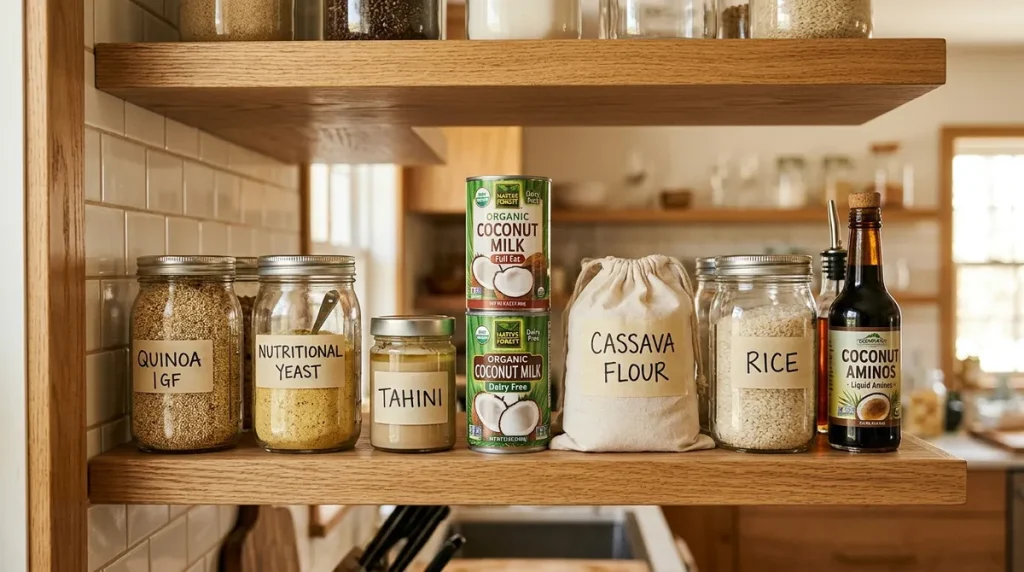
- Nutritional yeast — adds a cheesy, umami flavor that’s naturally GFDF
- Coconut aminos — a gluten-free, soy-free alternative to soy sauce
- Tahini — creates creamy dressings and sauces without any dairy
- Full-fat coconut milk — your cream sauce and soup base replacement
- Fresh citrus, herbs, and good quality salt — the simplest flavor elevators
🛒 GFDF Pantry Starter Kit
- Certified GF oats (Bob’s Red Mill or GF Harvest)
- Full-fat canned coconut milk (Thai Kitchen or Native Forest)
- Nutritional yeast (Bragg or Bob’s Red Mill)
- Coconut aminos (Coconut Secret)
- Tahini (Soom or Once Again)
- Dairy-free butter (Miyoko’s Creamery or Earth Balance)
- Cassava flour for baking (Otto’s Naturals)
- Avocado oil for high-heat cooking
- Unsweetened oat milk or almond milk
The Best Dairy Swaps That Actually Work
Not all dairy alternatives are created equal, and the “best” one depends entirely on what you’re using it for. After three years of testing, here’s what I’ve found works best in each category.
Milk Alternatives
For drinking and cereal, it comes down to personal taste. Oat milk has the creamiest texture, but you must choose a certified gluten-free oat milk — conventional oat milk is a cross-contamination risk. Almond milk works well for lighter applications. Coconut milk is great for smoothies.
Cheese Alternatives
I’ll be honest — dairy-free cheese has been the hardest swap for our family. But the market has improved dramatically. Violife and Miyoko’s Creamery make the most convincing options I’ve found. For cooking, nutritional yeast mixed with cashew cream often outperforms pre-made dairy-free cheese.
Butter and Cream Alternatives
Miyoko’s Creamery European Style Cultured Vegan Butter is the closest thing to real butter I’ve tasted. For cream in soups and sauces, full-fat coconut cream is unbeatable. Cashew cream (soaked cashews blended with water) is another excellent neutral-flavored option for pasta sauces.
Our Top Picks for Gluten-Free Dairy-Free Products
These are the products that have earned permanent spots in my kitchen. Every single one is both certified gluten-free (or naturally gluten-free with dedicated facilities) and completely dairy-free.
The closest dairy-free butter to the real thing. Made from coconut oil and cashews, it melts, bakes, and spreads like conventional butter. Certified plant-based and free from all top allergens except tree nuts.
Rich, creamy texture for coffee and cereal. Verified gluten-free (purity protocol oats). Around $4-5 per half gallon.
Best melting dairy-free cheese for pizza, quesadillas, and casseroles. Free from top 14 allergens. About $5 per bag.
Incredibly creamy GFDF ice cream. The Salted Caramel Cluster flavor is our family’s favorite. Certified gluten-free. Around $5-6 per pint.
Certified gluten-free AND dairy-free. One of the few GF breads that’s also free of milk — many GF breads contain dairy. About $6-7 per loaf.
Products to Watch Out For
Many gluten-free products contain dairy. This catches people off guard constantly. Gluten-free baked goods often rely on butter, milk powder, or whey protein for moisture and flavor. Always flip the package — a “gluten-free” label says nothing about dairy content.
Dairy-free cheese with wheat starch. Some imported dairy-free cheese alternatives use wheat starch as a binding agent. Always verify both claims on a single label rather than assuming one-free means both-free.
Meal Planning Strategies That Prevent Burnout
The number one reason people feel restricted on a gluten-free dairy-free diet isn’t actually the food — it’s the mental load of planning every single meal from scratch. Here’s the framework that saved my sanity.
The GFDF Plate Formula
Every meal follows the same simple structure: protein + starch + vegetable + fat + flavor. That’s it. When I stopped trying to recreate gluten-and-dairy-heavy comfort foods and started building simple plates, everything got easier.
Batch Cooking Is Your Best Friend
I spend about 90 minutes on Sunday prepping components for the week: a big pot of rice, roasted sweet potatoes, marinated chicken thighs, and a jar of tahini dressing. These mix-and-match components turn into bowls, wraps, stir-fries, and salads all week without repeating the same meal twice.
Cuisines That Are Naturally GFDF
Stop trying to make GFDF versions of fettuccine alfredo and lean into cuisines that are naturally aligned with your dietary needs. Thai, Vietnamese, Mexican, Indian (many dishes), Ethiopian, and Japanese cuisines all feature abundant dishes built on rice, vegetables, proteins, and dairy-free flavor profiles.
A Thai coconut curry over jasmine rice? Naturally gluten-free dairy-free. Chicken tacos on corn tortillas with guacamole and salsa? Same. Vietnamese pho with rice noodles? You get the idea.
Common Mistakes to Watch Out For
- Assuming “gluten-free” means “dairy-free” — These are completely separate claims. Many GF products contain milk, butter, whey, or casein. Always check both.
- Forgetting hidden dairy ingredients — Casein, whey, lactalbumin, lactoglobulin, and “natural flavors” can all be dairy-derived. The FDA’s FALCPA labeling law requires milk to be declared, but it can appear in the “Contains” statement rather than the main ingredient list.
- Not getting enough calcium — When you eliminate dairy, you need to be intentional about calcium sources. Fortified plant milks, leafy greens, almonds, sardines, and tofu made with calcium sulfate can help fill the gap. Talk to your doctor about whether you need a supplement.
- Neglecting to read labels every time — Manufacturers change formulations without warning. That bread that was dairy-free last month might not be today. Make label-reading a non-negotiable habit.
- Trying to do everything at once — If you’re newly managing both restrictions, give yourself grace. Tackle gluten-free first (especially if you have celiac disease), then layer in dairy elimination once you’ve got GF basics down.
- Isolating yourself socially — Don’t skip the dinner party. Bring a dish you can eat, eat beforehand, or call the host. Connection matters more than perfection.
Dining Out Gluten-Free and Dairy-Free
Restaurants are where the dual restriction feels most challenging. But with the right approach, eating out is absolutely doable — and still enjoyable.
Call ahead and be specific. Don’t just say “I have dietary restrictions.” Say, “I need to avoid all gluten and all dairy, including butter and cream. Can the chef accommodate this?” Most restaurants can — they just need clear information.
Stick to simply prepared dishes: grilled proteins, steamed or roasted vegetables, and plain rice or baked potatoes. Ask for olive oil instead of butter. Skip the bread basket without mourning it — you’ve got better things to look forward to on the menu.
Restaurant Communication Checklist
- State both restrictions clearly: “I cannot have any gluten OR dairy”
- Name the hidden culprits: “That includes wheat, barley, rye, butter, cream, and cheese”
- Ask about cooking surfaces and shared fryers
- Request olive oil as a substitute for butter
- Confirm sauces and dressings are safe — most contain one or both
- Tip generously when the kitchen accommodates you well
Yes, a well-planned gluten-free dairy-free diet can be completely nutritionally adequate for both adults and children. The key is ensuring you get enough calcium, vitamin D, B vitamins, and fiber from alternative sources. Many healthcare providers recommend working with a registered dietitian, especially during the first year of combined elimination.
Many people with celiac disease find that their lactose intolerance improves or resolves after 6-12 months on a strict gluten-free diet as the intestinal villi heal. However, this isn’t universal. Work with your gastroenterologist to trial reintroduction at the appropriate time rather than guessing on your own.
For those avoiding both gluten and dairy, certified gluten-free oat milk offers the creamiest texture, while almond milk and coconut milk are naturally gluten-free options. Avoid conventional oat milk unless it’s specifically certified gluten-free, as oats are frequently cross-contaminated with wheat during growing and processing.
No — many popular gluten-free breads contain milk, butter, or whey protein. Brands like Canyon Bakehouse, BFree, and Schar (select products) offer options that are both GF and dairy-free, but you should always verify by reading the full ingredient list and allergen statement on every purchase.
Calcium-fortified plant milks (aim for brands offering 300mg+ per cup), leafy greens like kale and bok choy, canned sardines and salmon with bones, almonds, tofu processed with calcium sulfate, and fortified orange juice are all excellent sources. Many adults on a GFDF diet benefit from a calcium supplement — consult your doctor for personalized guidance.
Thriving Gluten-Free and Dairy-Free Is Absolutely Possible
Living gluten-free and dairy-free simultaneously is absolutely manageable — and it can even be delicious. The learning curve is real, and I won’t pretend those first few weeks aren’t overwhelming. But once you build your pantry, find your go-to brands, and develop a rotation of meals your family loves, it becomes second nature.
The biggest shift isn’t in your kitchen — it’s in your mindset. Instead of focusing on what you can’t eat, start noticing how many incredible foods are naturally GFDF. A perfectly seasoned chicken thigh over coconut rice with mango salsa. A warm bowl of Thai curry. Tacos piled high with all the fixings. None of these require gluten or dairy to be absolutely craveable.
You’ve got this. And you don’t have to figure it all out alone. Grab our free GF Starter Checklist to help you navigate your first 30 days with confidence — it includes a GFDF pantry list, label-reading cheat sheet, and 10 easy dinner ideas the whole family will enjoy.