
Your baby is a few weeks from starting solids, and the two loudest voices in your life disagree. Your pediatrician says start cereal and stop overthinking it. Your celiac group says wait as long as you can, or skip gluten entirely, because you know exactly what this disease does.
The stakes feel enormous because they are personal. If you have celiac disease, or your older child does, this baby carries roughly a 1 in 14 chance of developing it too, and the decisions you make at the high chair feel like the only lever you have. The fear runs both ways: that introducing gluten to your baby will cause celiac disease, and that avoiding it will hide the disease until real damage is done.
I am a registered nurse, and I have spent a decade helping families make exactly this call. For this guide I went to the trials themselves: PreventCD and CELIPREV, the two randomized studies that tested timing; the TEDDY cohort, which has followed more than 6,000 genetically at-risk children for years; and the 2024 position paper from the European pediatric gastroenterology society’s celiac group, which pulls the evidence together.
Here is what the research actually says about when to introduce gluten, how much, what to watch for, when to test, and how to keep the celiac adult in the house safe while the baby learns to eat toast.
Key Takeaways
- Timing does not change the odds. Gluten can be introduced any time between 4 completed months and 12 months. Introducing it earlier brings celiac disease on earlier in children who were going to get it, but it does not create more cases.
- Amount may matter, but nobody can give you a number. In the TEDDY study, each extra gram of gluten a day at age 2 raised the absolute risk of celiac disease by age 3 by about 7 points, and more than 2 grams a day, roughly one slice of white bread, was the tipping point. European experts still say the evidence is too thin to set a limit.
- Breastfeeding neither protects nor harms. Feed your baby however works for your family. It will not change the celiac math.
- Genes do most of the work. About 1 in 14 first-degree relatives develops celiac disease, and a child with two copies of the DQ2 gene has roughly a 1 in 4 chance of celiac antibodies by age 5. Most carriers still never get it.
- The plan is introduce, keep it modest, watch, and test. A single-grain wheat infant cereal is the cleanest first gluten, and a blood test around age 2 to 3, repeated every few years, catches what symptoms miss.
How Much Risk Are We Actually Talking About?
Start with the number. A 2024 meta-analysis pooling 34 studies and more than 10,000 first-degree relatives found biopsy-confirmed celiac disease in 7% of them, about 1 in 14, against roughly 1 in 100 in the general population.
Daughters and sisters ran highest, at 23% and 14%, while sons and brothers came in at 6% and 9%. One in three of the relatives who turned out to have celiac disease had no symptoms at all.
| Relationship to the person with celiac | 2024 meta-analysis (34 studies) | 2015 meta-analysis (54 studies) |
|---|---|---|
| Daughter | 1 in 4 | 1 in 8 |
| Sister | 1 in 7 | 1 in 7 |
| Brother | 1 in 11 | 1 in 16 |
| Son | 1 in 16 | 1 in 13 |
| Mother or father | 1 in 20 | About 1 in 32 |
| Any first-degree relative | 1 in 14 | 7.5%, about 1 in 13 |
The two big meta-analyses disagree on the details, which tells you how much these estimates depend on which families get studied. The direction never changes: girls run higher than boys, and siblings and children run higher than parents.
Genes explain most of that clustering. Celiac disease almost only develops in people who carry the HLA-DQ2 or HLA-DQ8 gene variants, which about 30% of people have. Yet only about 3% of carriers ever develop the disease, according to the National Institute of Diabetes and Digestive and Kidney Diseases. The gene is the ticket to the lottery, not a winning number, which is why most carriers never develop celiac disease.
Which version of the gene, and how many copies, changes the odds a great deal. The TEDDY study followed 6,403 children carrying risk genes from birth in the United States, Finland, Germany and Sweden.
By age 5, children with one copy of DQ2 had an 11% chance of celiac antibodies and a 3% chance of celiac disease. Children with two copies of DQ2 had a 26% chance of antibodies and an 11% chance of disease.
Two more facts about onset shape everything that follows. In TEDDY, new cases peaked between ages 2 and 3. And in the Italian CELIPREV trial, by age 10 celiac antibodies had appeared in 38% of children with the highest-risk genes and 19% of children with standard-risk genes. The risk is front-loaded into toddlerhood, but it does not end there.
When to Introduce Gluten: What the Trials Found
For years parents were told about a window. Introduce gluten between 4 and 6 months, while still breastfeeding, and you might prevent celiac disease. The idea grew out of Sweden’s celiac epidemic in the 1980s, and it was tested head-on by two randomized trials published in 2014. Both came up empty.
PreventCD enrolled 944 babies who carried the risk genes and had a first-degree relative with celiac disease. From 16 to 24 weeks, half received 100 milligrams of gluten a day and half received a placebo. By age 3, 5.2% had celiac disease, with no difference between the groups, and breastfeeding made no difference either.
The Italian CELIPREV trial asked the opposite question: does waiting help? Babies with a celiac relative were assigned to start gluten at 6 months or at 12 months. At age 2, the early group had more celiac disease, 12% versus 5%. By age 5 the groups were identical at 16% each, so waiting six months delayed the diagnosis without preventing a single case.
The TEDDY cohort confirmed the pattern outside a trial. Across more than 6,400 genetically at-risk children, introducing gluten before 17 weeks or after 26 weeks made no independent difference to risk. Swedish babies got gluten earliest, at a median of 22 weeks, and the timing itself did not explain their higher rates.
This is why the 2024 position paper from the European pediatric gastroenterology society’s celiac group says gluten can be introduced any time between 4 completed months and 12 months without changing the cumulative risk. Earlier introduction means earlier antibodies in children who were headed there anyway. The American Academy of Pediatrics tells American parents the same thing: there is no evidence that delaying or limiting wheat prevents food allergy or celiac disease.
One study points the other way, and you will see it quoted online. In the British EAT trial, babies from the general population who started eating wheat and five other allergens at 4 months had zero cases of celiac disease at age 3, against seven cases among babies who started solids at around 6 months.
It was a secondary outcome in a trial designed to study allergies. The European group lists a proper test of the idea as an open research question and calls the practice controversial. Intriguing is the right word. Proven is not.
So when? Follow the ordinary readiness rules. The CDC says most babies can start solids at about 6 months and that starting before 4 months is not recommended. Look for a baby who sits with support, controls their head, opens their mouth for the spoon and swallows instead of pushing food back out.
Wheat goes in alongside the other first foods, not after them. The CDC’s advice is one single-ingredient food at a time with 3 to 5 days between new foods, and it lists wheat among the potentially allergenic foods to introduce when you introduce other foods. For an at-risk baby, that is the whole timing decision.
How Much Gluten? The Question the Research Is Still Arguing About
If timing is settled, amount is where the live debate sits. The largest data set is again TEDDY, which collected three-day food diaries at 6, 9 and 12 months and every six months after that until age 5, then estimated each child’s daily gluten from the wheat, rye and barley in the records.
The results, published in JAMA in 2019, were dose-dependent. For every extra gram of gluten a day, the risk of celiac antibodies rose 30% and the risk of celiac disease rose 50%.
In absolute terms, among these genetically at-risk children, a 2-year-old eating the average amount had a 20.7% chance of celiac disease by age 3. A child eating one gram more a day had a 27.9% chance, a difference of about 7 points.
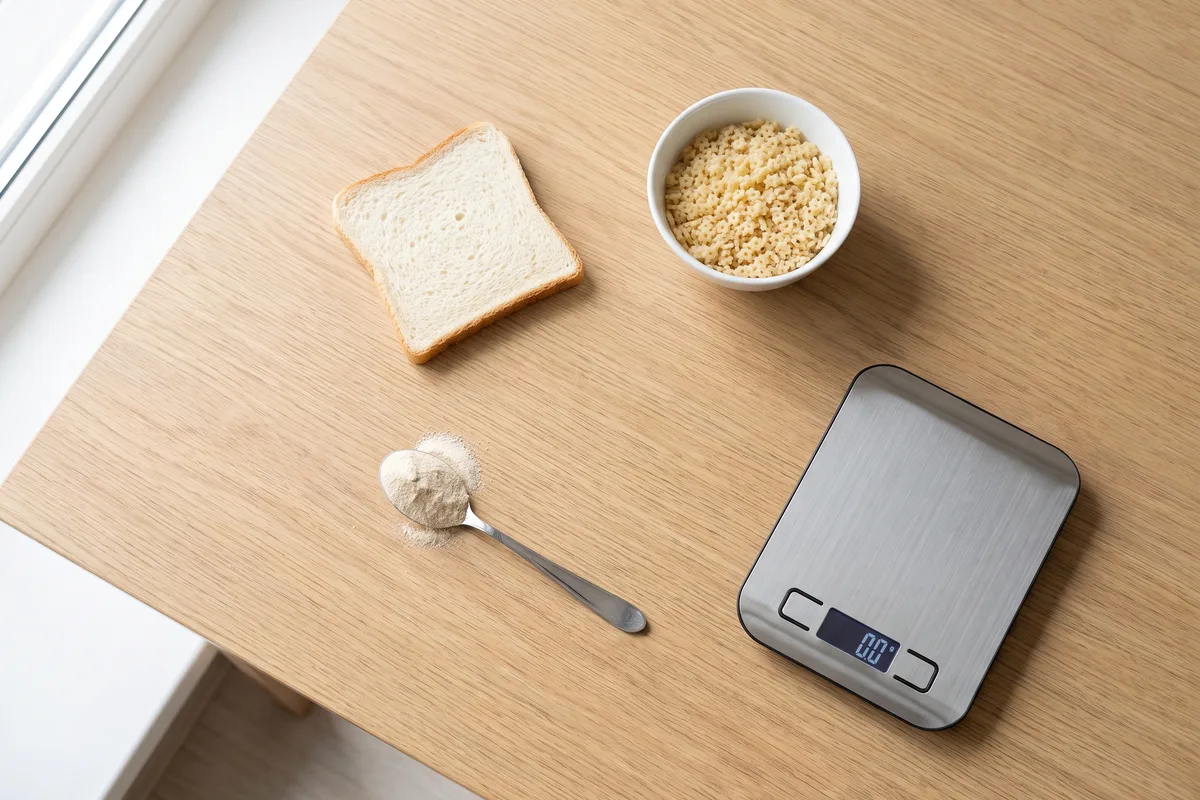
What does a gram look like? The authors put one gram at about half a slice of white bread. The average TEDDY 2-year-old was eating about 3.7 grams a day.
In a follow-up analysis, the tipping point sat at 2 grams a day at age 2, roughly one 35-gram slice of white bread or a 150-gram portion of cooked pasta. Children above it had about a 75% higher risk of celiac disease than children below it, though the authors flag that cut-point as a post hoc finding that still needs confirming.
Other cohorts point the same way with smaller effects. In Norway’s MoBa study of 67,608 children from the general population, toddlers in the top quarter of gluten intake at 18 months had a 29% higher risk than those in the bottom quarter, regardless of when gluten was introduced.
In Denver’s DAISY cohort, at-risk 1-year-olds in the highest third of intake had roughly double the rate of celiac antibodies. An earlier Swedish TEDDY analysis found that children eating more than 5 grams a day before their antibodies appeared had more than twice the odds of celiac disease.
Not every study agrees. When the PreventCD investigators went back to their own food records, the amount of gluten eaten between 11 and 36 months did not predict celiac disease for most gene types.
That inconsistency, plus the fact that intake was estimated from diaries rather than measured, is exactly why the European position paper refuses to set a limit. In its words, the optimal amount “cannot be established from the current data”, no safe threshold is known, and no recommendation can be made even for babies with a known family risk.
The same paper adds one softer line: for children at known risk, avoiding large amounts of gluten during the first five years “may be beneficial.” That is the honest state of play. Big daily doses look risky in nearly every cohort, and the safe number, if one exists, is unknown.
Where the gluten comes from may matter too. In the Swedish TEDDY children, eating more than about half a slice of bread a day at 12 months was linked to a 79% higher risk of celiac disease than eating no bread, even after accounting for total gluten. Cereal-based milk drinks in the second year carried extra risk, while the type of grain, wheat or rye, made no difference once total gluten was accounted for.
Sweden’s celiac epidemic points the same way. Cases in children under 2 quadrupled between 1985 and 1987 and then fell back within a decade, and the researchers who documented it tied the surge, at least in part, to how much gluten babies were given and how it was introduced. It remains the best real-world warning against front-loading gluten into a baby’s diet.
A real answer is coming, slowly. Lund University’s GRaIn trial has randomized 1,141 genetically at-risk children to a diet capped at 3 grams of gluten a day until age 3 or to no restriction, and will follow them to age 7. Primary results are expected around 2030.
A second European trial, PreCiSe, is testing whether waiting until age 3 to introduce gluten, with or without probiotics, changes anything. Until then, modest and consistent rather than constant is as specific as anyone can honestly be.
A Practical Feeding Plan for an At-Risk Baby
Here is how I walk a family through it, with the standing caveat that your pediatrician knows your baby and I do not.
The at-risk baby gluten plan
- Start solids around 6 months, when your baby shows the readiness signs, and never before 4 months
- Introduce wheat like any other new food: on its own, with 3 to 5 days before the next new food
- Make the first gluten measurable: a teaspoon or two of iron-fortified single-grain wheat infant cereal mixed with breast milk or formula, or a soft strip of plain toast
- Build to one small gluten-containing serving most days, and keep other grains in the rotation so gluten never becomes the base of every meal
- Keep it consistent: celiac blood tests only work in a child who has been eating gluten regularly, for up to a year, before the draw
- No honey before 12 months and no added sugars, which rules out most baby cookies as your gluten source
- Write down the date you started and any symptoms you notice; you will want both at the 2-year checkup
Plain, single-ingredient sources make the amount easy to see and any reaction easy to read. A wheat infant cereal is measured by the teaspoon and fortified with iron, which babies need more of from 6 months on. Small soft pasta shapes and toast strips come next as chewing skills grow.
🛒 First gluten foods that are easy to dose
- Iron-fortified single-grain wheat infant cereal, mixed thin at first
- Tiny pasta shapes such as pastina or stelline, cooked very soft
- Plain whole-wheat toast cut into strips, from a loaf without honey
- Soft-cooked pearl barley mashed into vegetables once textures advance
Wheat Allergy Is Not Celiac Disease, and Both Are Possible
Wheat is one of the nine major food allergens, and a wheat allergy is a separate condition from celiac disease. According to the American College of Allergy, Asthma and Immunology, it shows up as hives or rash, vomiting, stomach cramps, a runny nose, wheezing or, less commonly, anaphylaxis.
It is most common in young children, about two-thirds of whom outgrow it, and Mayo Clinic notes that symptoms usually appear within minutes to hours of eating wheat. If your baby develops hives, swelling, repeated vomiting or breathing trouble after a wheat feed, call your pediatrician the same day, and call 911 for any trouble breathing.
Celiac disease works on a completely different clock. Antibodies and gut damage build over months to years of regular gluten exposure, and nothing you see in the first week of wheat tells you anything about it.
Protecting the Celiac Adult in the House

The day the baby starts wheat, your kitchen becomes a mixed kitchen, and the person at risk of getting glutened is you. Babies smear cereal on everything, and the reflex to taste-test the spoon or finish the last bites of pasta is hard to break.
The rules are the ones that already keep a shared kitchen safe: a dedicated spoon and prep board for the baby’s wheat foods, a second toaster for the gluten-free adult, hands washed after every feed, and the high chair tray wiped before you sit down to your own meal. Never taste the baby’s gluten foods, and never finish their plate.
You can relax about kisses. In a 2026 Columbia University study, a non-celiac partner ate ten wheat crackers and then kissed their celiac partner, and only 2 of 20 kisses transferred more than 20 parts per million of gluten. None did after the cracker-eater drank a 4-ounce glass of water first. A wheat-crusted baby cheek is a far smaller dose than ten crackers.
One more reassurance for nursing mothers with celiac disease. Your gluten-free diet means your milk is essentially gluten-free, and breast milk is not how gluten gets introduced in any case.
A 2024 Spanish study found gluten fragments in the milk of some mothers who ate gluten, and in almost none of the celiac mothers on a gluten-free diet, and whether those fragments do anything at all is still unknown. Breastfeeding neither raises nor lowers your baby’s celiac risk, so feed however works.
Testing an At-Risk Child: When, What, and How Often
A baby with a first-degree relative should be tested even with no symptoms. The American College of Gastroenterology’s 2023 guideline says clinicians should consider testing asymptomatic relatives of anyone with confirmed celiac disease, and North American pediatric gastroenterology guidance has long advised starting around age 3, after at least a year of regular gluten.
The Celiac Disease Foundation puts the first screen at age 2 or 3, sooner if symptoms appear. It notes that a child needs to have been eating wheat or barley for some time, up to a year, before antibodies can form.
The test is simple: tissue transglutaminase IgA, or tTG-IgA, drawn together with a total IgA level so a low IgA does not mask a positive result. The ACG names tTG-IgA the preferred single test even in children under 2, and the European diagnostic guideline advises against deamidated gliadin peptide antibodies as a first test.
If the tTG-IgA comes back more than ten times the upper limit, European pediatric guidelines allow a diagnosis without a biopsy when a second antibody test confirms it. Our guide to understanding celiac blood work explains what each line means.
Genetic testing is optional but useful. A negative HLA-DQ2/DQ8 result means your child is very unlikely ever to develop celiac disease, a reassurance the Celiac Disease Foundation puts at about 99%, and you can stop the antibody schedule.
A positive result diagnoses nothing, since most carriers stay healthy, but it tells you which children need the blood tests repeated. If you already have a result in hand, our genetic test decoder translates it into plain English.
One negative test is a snapshot, not an all-clear. In a 2026 Turkish family-screening study, 3.9% of relatives who tested negative at first had converted when re-tested about three years later, and three of the four new cases were siblings first tested in early childhood. Denver’s DAISY cohort found new cases accumulating into adolescence. Re-test every two to three years, and immediately if symptoms appear.
Do not wait for symptoms to prompt the test. When Colorado’s ASK program screened nearly 10,000 children, digestive symptoms were just as common in children who tested negative as in those who tested positive.
Italy took that logic to its conclusion with a 2023 law that brings celiac and type 1 diabetes screening to every child. Its pilot tested children at ages 2, 6 and 10 and found celiac antibodies in about 4% of them, according to the Celiac Disease Foundation.
Signs of Celiac Disease in Babies and Toddlers
The NIDDK lists the ways celiac disease shows itself in young children, and the first signs of gluten trouble in kids are rarely dramatic.
- Stools that change. Chronic diarrhea, loose or greasy stools, or stubborn constipation, with gas and bloating.
- A swollen belly. A distended, drum-like abdomen on a child whose arms and legs look thin.
- Vomiting that keeps recurring without an obvious illness.
- Weight that stalls. Weight loss, or what the NIDDK calls failure to thrive, meaning a baby who weighs less or is gaining less than expected.
- Mood changes. In the NIDDK’s words, feeling annoyed or impatient, which in a toddler looks like relentless irritability.
- Later clues. Slowed growth and short height, dental enamel defects, and iron-deficiency anemia that does not respond to diet.
What Else Moves the Needle? Infections, Antibiotics, Vaccines, and Fiber
Parents ask about everything else they might control, so here is the evidence in one place, most of it from the same TEDDY cohort.
- Stomach bugs. In TEDDY, a gastrointestinal infection raised the risk of celiac antibodies by 33% over the following three months, and a Norwegian cohort tied enterovirus infections after gluten introduction to a roughly 50% higher risk, more for frequent or long-lasting ones. The effect was strongest when infections and higher gluten intake overlapped, which is one more argument for modest amounts.
- Rotavirus vaccine. The evidence is mixed. A Finnish vaccine-trial follow-up found less celiac disease among vaccinated children, while a 2026 Norwegian study of 740,000 children found no effect either way. Get it on schedule because it prevents rotavirus, and do not expect it to prevent celiac disease.
- Antibiotics. Two registry studies covering more than 3.5 million children found a small, dose-dependent association between first-year antibiotics and later celiac disease, roughly 9% to 26% higher risk, possibly explained by the infections being treated. That is a reason to avoid unnecessary prescriptions, never a reason to refuse one your child needs.
- Cesarean birth. TEDDY found no increased risk after adjusting for the usual factors. Cross it off the worry list.
- Fiber. A 2025 TEDDY analysis of about 6,500 at-risk children found that eating roughly 3 grams more fiber a day than average in infancy was linked to almost 40% lower risk of celiac disease later in childhood, with the strongest effect between 6 and 12 months. The Lund researchers say it needs a clinical trial before anyone recommends it, but fruit, vegetables, beans and whole grains are a no-regret choice.
- Probiotics. No proven effect yet. The PreCiSe trial is testing one, so save your money until it reports.
Our Top Picks: A Baby’s First Gluten and the Parent’s Safety Net
Nothing here prevents celiac disease. These are the tools that make a measured, low-drama introduction easier, and that keep the gluten-free adult safe while the baby learns to eat.
A single-grain wheat cereal is the cleanest first gluten: one ingredient to react to, iron-fortified, and measured by the teaspoon, so a small amount actually means something. Mix it with breast milk or formula and thin it as much as your baby needs. It is stocked at Safeway, Albertsons and through Instacart, though not every store carries it, so check before you need it.
Tiny star-shaped pasta made from durum wheat semolina and enriched with iron and B vitamins. Cooked very soft, it is the classic first pasta once your baby handles soft lumps, easy to spoon and easy to keep small. Start with a couple of spoonfuls.
Daily packets that dissolve into 2 to 4 ounces of milk or puree and deliver nine top allergens, including organic wheat protein, in pre-measured amounts that are identical every day. It was designed for allergy prevention rather than celiac disease and does not replace real wheat foods later, but for parents who want the first exposures tightly controlled, it is the tidiest option. Check with your pediatrician first.
The day toast strips enter the house, the gluten-free adult needs a second toaster. This is the compact two-slice model we recommend as a dedicated gluten-free toaster, and it fits on a crowded counter. View on Amazon
One color for the baby’s wheat foods, one for everything else, so a toast crumb never migrates into your own lunch. View on Amazon
As an Amazon Associate I earn from qualifying purchases.
Two Things to Skip
- Sweet wheat teething biscuits as the gluten source. Gerber’s Arrowroot Biscuits list enriched wheat flour, cane sugar and invert sugar among their first six ingredients. The CDC says infants and young children should not have added sugars, and a cookie gives you no idea how much gluten went in. Plain cereal, pasta and toast do the same job without the sugar.
- Adult at-home celiac test kits. Direct-to-consumer kits such as imaware are sold for adults 18 and older, and a baby’s test needs a total IgA alongside the tTG-IgA to be readable. Your pediatrician can order the right panel, and that result will actually mean something.
Common Mistakes to Watch Out For
- Waiting past the first birthday “to be safe.” Delaying gluten does not lower the odds; CELIPREV showed the cases simply arrive later. It also pushes wheat outside the months when new textures and top allergens go in most easily.
- Making gluten the base of every meal. This is the one lever the data support pulling. Bread at every meal plus crackers plus pasta puts a toddler well past the 2 grams a day TEDDY flagged.
- Going gluten-free “just in case.” Without gluten, celiac disease cannot be tested for, most carriers were never going to develop it, and the European position paper warns that the nutritional and psychosocial costs of restricting a healthy child are not understood.
- Testing too early or right after a gluten-light stretch. A tTG-IgA drawn on a 14-month-old who eats toast twice a week can be falsely reassuring. Regular gluten for up to a year first, then test.
- Treating one negative test as the end. Re-screen every two to three years and any time symptoms appear. Siblings tested very young were the group most often caught on the second pass in a 2026 family-screening study.
- Forgetting the adult with celiac. Tasting the baby’s food, sharing a spoon, and eating over the high chair are the most common ways a gluten-free parent gets sick in the first year of solids.
Frequently Asked Questions
Should I delay gluten if I have celiac disease?
No. The 2024 European position paper says gluten can be introduced any time between 4 completed months and 12 months without changing a child’s cumulative risk of celiac disease. In the CELIPREV trial, babies who started gluten at 12 months instead of 6 developed celiac disease later but not less often, with 16% affected in both groups by age 5. Introduce wheat with the other first foods around 6 months, once your baby shows the readiness signs.
How much gluten should an at-risk baby eat?
There is no official amount, because the studies disagree and none measured gluten directly. The strongest data, from the TEDDY cohort, found that genetically at-risk 2-year-olds eating more than 2 grams of gluten a day, about one slice of white bread, had roughly 75% higher risk of celiac disease than children eating less. European experts say avoiding large amounts in the first five years may be beneficial but will not set a limit. A practical reading is one small gluten serving most days rather than gluten at every meal.
Does breastfeeding protect my baby from celiac disease?
No. Two randomized trials and the large birth cohorts found that breastfeeding, whether exclusive, prolonged, or overlapping with gluten introduction, did not change the risk of celiac disease, and the 2024 European position paper says so directly. Breastfeeding still has plenty of other benefits, so feed however works for your family. If you have celiac disease and eat gluten-free, your milk is essentially gluten-free, and it is not how gluten gets introduced either way.
When should my baby be tested for celiac disease?
Around age 2 to 3 if there are no symptoms, and sooner if there are. The child needs to have been eating gluten regularly, for up to a year, before the tTG-IgA blood test can be trusted, and it should always be paired with a total IgA level. A negative result is a snapshot, so repeat it every two to three years and whenever symptoms appear. Optional HLA gene testing can end the schedule early if it comes back negative.
What are the signs of celiac disease in a baby or toddler?
The NIDDK lists chronic diarrhea or greasy stools, constipation, a bloated belly, vomiting, irritability, and failure to thrive, meaning a child who weighs less or gains less than expected. These build over months of regular gluten exposure. Hives, swelling or vomiting within minutes to hours of eating wheat point to a wheat allergy instead, which needs a same-day call to your pediatrician.
Can I prevent celiac disease in my baby?
Not with any strategy proven so far. Timing, breastfeeding, cesarean birth and rotavirus vaccination have all been studied and none reliably changes the odds; genes do most of the work. Keeping gluten modest rather than constant in the first few years is the one lever the observational data support, and two European trials now testing gluten limits should report around 2030. What you can do is catch celiac disease early with scheduled blood tests.
Feed the Baby, Watch the Baby, Test the Baby
Here is the whole article in three lines. You cannot prevent celiac disease by timing gluten, by breastfeeding, or by avoiding it, and the guilt that says otherwise is not supported by a single trial.
You may be able to shave the odds by keeping gluten modest rather than constant in the first few years, and that is a reasonable thing to do while the trials finish. And the thing that actually protects your child is a blood test at 2 or 3, repeated every few years, so that if celiac disease does come, you catch it in months instead of years.
Start solids when your baby is ready, put wheat in with the other first foods, keep it to a small serving most days, protect the celiac adult’s kitchen, and write down the date. That is the plan I give the families I work with, and it holds up against everything the research has produced.
Get our free Gluten-Free Kitchen Checklist, the one-page setup for a kitchen that now has to be safe for a gluten-free adult and a toast-flinging toddler at the same time. And if the genetics are still new to you, our genetics and gluten guides start at the beginning.
A baby learning to eat is one of the good parts. The family history does not have to take that from you.