
Here’s an unpopular opinion that might ruffle some feathers in the gluten-free community: most people buying gluten-free processed foods would be better off just eating more whole foods. I say this as someone who has spent years navigating the GF aisle, comparing ingredient labels, and spending a small fortune on specialty products for my family.
The gluten-free processed foods vs whole foods debate isn’t about shaming anyone’s choices. It’s about recognizing that a $7 loaf of gluten-free bread made with tapioca starch, xanthan gum, and sugar isn’t automatically healthier than the wheat bread it replaced. For people with celiac disease, that swap is medically necessary. But for the estimated 72% of GF consumers who don’t have celiac, research suggests the real health gains come from eating more vegetables, fruits, and naturally gluten-free proteins — not from buying specialty products.
As a registered nurse and a mom managing a gluten-free household, I’ve lived on both sides of this equation. I’ve filled my cart with every GF product on the shelf, and I’ve also leaned hard into whole-food cooking. The difference in how my family feels — and how our grocery budget looks — is dramatic.
Let’s break down what the science actually says, where the GF industry gets it wrong, and how to build a smarter approach that works for your body and your wallet.
Key Takeaways
- Most GF packaged products are ultra-processed — swapping wheat flour for rice starch and tapioca doesn’t improve nutritional quality for non-celiac consumers.
- Whole foods are naturally gluten-free — vegetables, fruits, meat, fish, eggs, nuts, seeds, legumes, and rice require no special labels or premium prices.
- People with celiac disease still need some GF specialty products — this article isn’t telling you to ditch certified celiac-safe items that keep you medically safe.
- A whole-foods-first approach can reduce GF grocery costs by 30-50% — and often improves nutrient intake compared to a GF-product-heavy diet.
- The GF industry is projected to reach $10.9 billion by 2028 — much of that growth is driven by health-conscious consumers who may not actually benefit from these products.
The GF Industry’s Dirty Secret: Most Products Are Ultra-Processed
Walk down the gluten-free aisle at any major grocery store and you’ll notice something interesting. Most of the products are essentially the same ultra-processed foods from the regular aisle — cookies, crackers, bread, pasta, frozen meals — just made with different starches and a higher price tag.
A 2020 study published in the journal Nutrients found that gluten-free processed products frequently contain more sugar, more fat, and less fiber than their wheat-based counterparts. The researchers analyzed over 600 GF products and found that many had lower protein content and higher glycemic indexes than conventional versions.
Here’s what typically happens when manufacturers remove gluten from a product. Wheat flour provides structure, elasticity, and texture. To replicate those properties without gluten, companies rely on refined rice flour, tapioca starch, potato starch, corn starch, xanthan gum, and added sugars. The result? A product that’s gluten-free but often nutritionally worse than what it replaced.
When I first went gluten-free, I basically tried to recreate our old diet with GF substitutes. GF bread for sandwiches. GF crackers for snacks. GF pasta three nights a week. Our grocery bill doubled, the kids complained about the taste, and honestly? Nobody felt much better. It wasn’t until I shifted our meals toward naturally wheat-free whole foods — think rice bowls, grilled chicken, roasted vegetables, fruit — that things changed.
Who Actually Needs GF Products vs. Who Just Needs Better Food
This is where the conversation gets nuanced, and it’s important to get it right. Not everyone following a gluten-free diet has the same medical needs, and lumping all GF consumers together is part of the problem.
People Who Medically Need GF Products
Celiac disease patients have an autoimmune condition where gluten triggers damage to the small intestine. For them, strict avoidance — including using certified gluten-free products from organizations like the Gluten-Free Certification Organization (GFCO) — is medically essential. Even trace amounts below 20 parts per million (the FDA threshold) can cause intestinal damage in some individuals.
People with wheat allergies need to avoid wheat specifically, though they may tolerate barley and rye. Dermatitis herpetiformis patients require strict gluten avoidance to manage their skin condition. These groups genuinely benefit from having clearly labeled, certified GF products available.
People Who Might Not Need the GF Aisle
Research from the Beyond Celiac organization estimates that non-celiac gluten sensitivity (NCGS) affects up to 6% of the population, though the condition remains poorly understood and difficult to diagnose. Many gastroenterologists now suspect that some people attributed with NCGS may actually be reacting to FODMAPs (fermentable carbohydrates found in wheat) rather than gluten itself.
Then there’s the largest group: people who go GF because they believe it’s generally “healthier.” A 2017 survey by the NPD Group found that nearly 25% of Americans were trying to reduce or eliminate gluten — while only about 1% have celiac disease. For this group, replacing Wheat Thins with gluten-free rice crackers isn’t addressing the actual issue. The actual issue is usually a diet heavy in processed, refined foods.
The Whole-Foods Approach: What It Actually Looks Like
Here’s the thing that the GF industry doesn’t want you to think about too hard: the vast majority of whole, unprocessed foods are naturally gluten-free. You don’t need a special label or a premium price to eat them.
When I shifted our family’s meals toward this approach, something unexpected happened: our grocery bill actually went down. A pound of chicken thighs, a bag of rice, and a head of broccoli cost less than two boxes of GF chicken nuggets. And my boys get more protein, more fiber, more vitamins, and fewer additives.
Here’s what a typical day looks like in our house now versus when I was buying every GF product on the shelf:
| Meal | Product-Heavy GF Day | Whole-Foods-First GF Day | Cost Difference |
|---|---|---|---|
| Breakfast | GF cereal + GF toast | Scrambled eggs + banana + berries | Saves ~$2 |
| Lunch | GF bread sandwich + GF pretzels | Rice bowl with chicken, veggies, avocado | Saves ~$3 |
| Snack | GF crackers + GF cookies | Apple slices + peanut butter + cheese | Saves ~$2 |
| Dinner | GF pasta + jarred sauce + GF garlic bread | Grilled salmon + roasted potatoes + salad | Saves ~$1 |
That’s roughly $8 per day in savings — about $240 per month for one person. For a family of four, the numbers are even more dramatic.
The Fiber and Nutrient Problem Most GF Eaters Don’t Know About
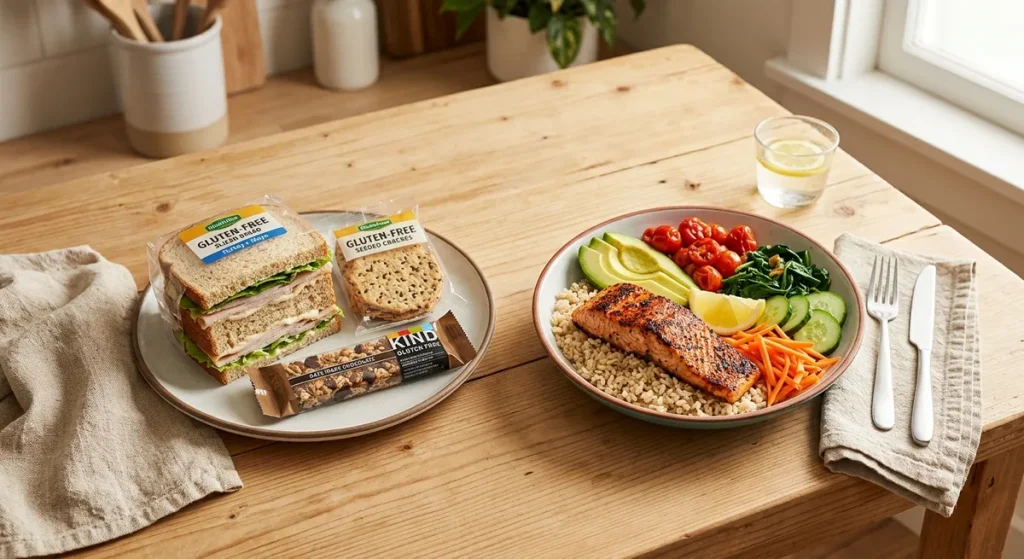
Here’s a health reality that doesn’t get enough attention: people on gluten-free diets are significantly more likely to be deficient in fiber, B vitamins, iron, and folate compared to the general population. A study published in the British Journal of Nutrition found that GF diets often fall short of recommended daily fiber intake by 50% or more.
Why? Because conventional wheat products are frequently fortified with iron, B vitamins, and folic acid. When you remove those products, you lose those nutrients. And many gluten-free processed replacements are made from refined starches that aren’t fortified at the same levels — or at all.
Whole foods solve this problem naturally. A cup of cooked lentils provides 15.6 grams of fiber. A medium sweet potato gives you 4 grams plus a massive dose of vitamin A. A cup of cooked quinoa delivers 5 grams of fiber, 8 grams of protein, and significant amounts of iron and magnesium.
My boys were classic examples of this. When we relied heavily on GF processed foods, they were eating a lot of refined starches — GF bread, GF crackers, GF pretzels. Once I started incorporating more beans, lentils, vegetables, and naturally GF whole grains like quinoa and brown rice, their energy levels improved and snack-time meltdowns decreased. Coincidence? Maybe. But research supports the connection between fiber intake, blood sugar stability, and sustained energy in children.
When GF Products Are Worth It (Yes, There’s a Place for Them)
I want to be crystal clear: I’m not anti-GF products. That would be hypocritical coming from someone who runs a gluten-free website and has GF bread in her freezer right now. There are absolutely times when gluten-free processed foods serve a real purpose.
GF products are worth buying when you have celiac disease and need safe options for sandwiches, birthday parties, and school lunches. They’re worth buying when your kid just wants to eat what the other kids are eating — because the emotional toll of being “different” at every meal is real. They’re worth buying when you’re exhausted and need dinner on the table in 15 minutes.
I’m never going to tell you that convenience is wrong or that buying GF cookies makes you a bad person. Sometimes Austin just wants a GF Oreo-style cookie after school, and you know what? He gets one. Life is about balance.
GF Products Worth the Investment
GFCO certified, softer texture than most GF breads, and uses whole grain sorghum flour. Around $6-7/loaf. Worth it for sandwiches and toast.
GFCO certified, organic, made with just two ingredients (brown rice flour and water). Better texture and nutrition than most GF pastas. About $4/box.
Purity protocol oats (mechanically sorted, not just tested). Great for oatmeal, baking, and boosting fiber intake. About $5-6/bag.
Products to Think Twice About
GF “health” snack bars loaded with sugar: Many GF granola bars and snack bars contain 12-18 grams of sugar per serving. A handful of nuts and a piece of fruit gives you better nutrition for less money.
GF all-purpose flour blends for everyday cooking: If you’re making a stir-fry over rice, seasoned grilled chicken with roasted vegetables, or a big pot of chili — you don’t need GF flour at all. Save it for actual baking projects.
Common Mistakes When Choosing Gluten-Free Processed Foods vs Whole Foods
- Assuming “gluten-free” means “healthy” — A GF cookie is still a cookie. The absence of gluten doesn’t add nutritional value. Look at the full nutrition label, not just the GF claim.
- Replacing every wheat product 1:1 with a GF version — You don’t need GF breadcrumbs, GF panko, GF croutons, AND GF stuffing mix in your pantry. Rethink the dish instead of just swapping the ingredient.
- Ignoring fiber and protein — Many people switch to GF and unconsciously eat more refined starches. Track your fiber intake for a week — you might be surprised how low it is.
- Thinking whole foods are too hard or time-consuming — Scrambled eggs take 5 minutes. A baked sweet potato takes zero active effort. Rice cooks itself in a rice cooker. Whole-food cooking doesn’t have to mean gourmet chef-level effort.
- Going all-or-nothing — You don’t have to eliminate every GF product overnight. Start by replacing one processed GF meal per day with a whole-food option and build from there.
- Forgetting that kids need transition time — If your children are used to GF chicken nuggets every night, switching to grilled chicken overnight will cause a revolt. Introduce changes gradually.
Your Whole-Foods-First GF Action Plan
- Audit your pantry — count how many packaged GF products vs. whole foods you have
- Plan 3 dinners this week around naturally gluten-free ingredients (no specialty products needed)
- Swap one GF processed snack for a whole-food snack (fruit, nuts, veggies with hummus)
- Add one new naturally GF grain to your rotation (quinoa, millet, or buckwheat)
- Read the ingredient list (not just the GF label) on your 5 most-purchased GF products
- Track fiber intake for 3 days to see where you stand
Frequently Asked Questions
In many cases, yes. Research published in Nutrients and other journals shows that GF processed products frequently contain more sugar, more fat, less fiber, and less protein than their wheat-based equivalents. They also tend to have higher glycemic indexes due to refined starch bases like tapioca and white rice flour. This doesn’t make them “bad” — but they’re not an automatic upgrade.
No. People with celiac disease need certified gluten-free products when eating packaged foods to stay safe. The point isn’t to avoid GF products entirely — it’s to build your diet primarily around naturally gluten-free whole foods and use GF specialty products strategically for convenience, variety, and quality of life.
A whole-foods-based GF diet can actually be more nutritious than a product-heavy GF diet. Vegetables, fruits, lean proteins, legumes, nuts, and naturally GF grains like quinoa and brown rice provide excellent fiber, vitamins, and minerals. However, the Mayo Clinic recommends people on GF diets pay attention to iron, B vitamins, calcium, and fiber intake, and consider working with a dietitian.
It depends. Non-celiac gluten sensitivity is a recognized condition, though its mechanisms are still being studied. Some people genuinely feel better without gluten. However, many researchers believe the benefits some non-celiac individuals experience may come from reducing processed foods overall, eating more whole foods, or reducing FODMAPs — not specifically from removing gluten protein.
Start small. Replace one meal per day with a whole-food option — scrambled eggs instead of GF cereal, a rice bowl instead of a GF sandwich. Build a rotation of 5-7 naturally GF dinners your family enjoys. Keep your favorite GF convenience products for when you need them, but let them become the backup plan rather than the foundation.
Better for Your Body, Better for Your Budget
The gluten-free industry has given us incredible options that people with celiac disease couldn’t have imagined 20 years ago. That’s genuinely wonderful. But the industry has also created a profitable illusion: that swapping wheat bread for GF bread, wheat pasta for GF pasta, and wheat cookies for GF cookies is a meaningful health upgrade for everyone. For most people, it’s not.
The real transformation happens when you shift your thinking from “what processed food can I replace?” to “what whole food can I build a meal around?” A plate of grilled chicken, roasted sweet potatoes, and sautéed spinach is naturally celiac-safe, nutrient-dense, affordable, and delicious — no special aisle required. That doesn’t mean you can never buy a box of GF crackers. It means those crackers become a supporting player, not the star of your diet.
Whether you have celiac disease, non-celiac gluten sensitivity, or you’re just exploring what makes you feel best — prioritizing whole foods over gluten-free processed foods is almost always the smarter move for your health and your wallet. You don’t have to be perfect. You just have to be intentional.
Want help building a whole-foods-first GF meal plan that actually works for busy families? Download our free nutrition cheat sheet — it includes a list of naturally gluten-free whole foods organized by nutrient, plus a simple framework for balanced GF meals without relying on specialty products.