

On this page
There is a particular loneliness in staying seated while everyone else files up to the front of your church. Maybe you have been doing it since your diagnosis, quietly passing on the one meal your whole community shares. Maybe you are reading this because your child was just diagnosed and First Communion is on the calendar, and you cannot picture how both things can be true at once.
This is fixable, and it matters that it gets fixed. Communion is not just food, and treating it like a menu problem misses why skipping it stings. The practical issue underneath, though, is very concrete: traditional altar bread is made from wheat flour and water, which makes the default wafer at nearly every church in America genuinely unsafe for someone with celiac disease.
I am a registered nurse and a mom, and for this guide I went to the primary sources — the Vatican’s actual letters, the celiac medical societies’ statements, the allergen panels, and the makers themselves — rather than the game of telephone this topic usually gets. Some of what you have heard about “the gluten-free communion ban” is wrong in ways that will genuinely reassure you.
Here is what your tradition allows, which products are safe and where to get them, how to stop cross-contamination in a shared plate and a shared cup, and exactly what to say to your priest or pastor before Sunday.
Key Takeaways
- Standard altar bread is wheat by definition. A regular wafer is a wheat product outright, not a trace exposure, and no tradition expects a celiac to eat one.
- Every tradition has a safe route. Fully gluten-free wafers work in most Protestant, Anglican, and Lutheran settings; Catholics use Vatican-approved low-gluten hosts or receive from the chalice alone.
- Low-gluten hosts test far below any clinical threshold. Independent testing cited by celiac disease specialists put one host at roughly two thousandths of a milligram of gluten — thousands of hosts below the daily amount shown to cause damage.
- The bigger risk is cross-contamination, not the wafer. Storage, handling, shared trays, and the shared cup are where gluten actually sneaks in; a separate pyx and a two-minute conversation solve most of it.
- The products are easy to get. Broadman’s dedicated-facility gluten-free wafers and TrueVine’s prefilled gluten-free cups ship from Amazon; Catholic low-gluten hosts come straight from the Benedictine Sisters who bake them.
Are Communion Wafers Gluten-Free? The Quick Answer
By default, no. Traditional communion wafers — also called hosts or altar bread — are baked from wheat flour and water, usually nothing else. That simplicity is the point liturgically, but it means the standard wafer is concentrated wheat, and “it’s just a little piece” does not make it safe.
The size argument fails on the evidence. A landmark double-blind trial in the American Journal of Clinical Nutrition found that as little as 50 milligrams of gluten a day — crumb territory — caused measurable intestinal damage in people with celiac disease, while 10 milligrams a day did not. A wheat wafer eaten weekly is not a rounding error; it is a recurring exposure.
The genuinely good news is that no major Christian tradition asks you to choose between your health and the table. The options differ by denomination — and the Catholic answer is different from what most headlines told you — but a safe route exists in every single one. Use the finder below to jump straight to yours.
Find Your Safe Communion Option
What can I safely receive?
Two quick questions — get the parts of this guide that answer your exact situation.
What Your Church Allows, Denomination by Denomination
Communion practice is one of the places where denominational differences are real and practical. What follows is what each tradition actually provides, from its own documents and suppliers where possible.
Catholic: Low-Gluten Hosts and the Chalice
Start with the rule that generates all the headlines. In a 2003 circular letter from the Congregation for the Doctrine of the Faith, reaffirmed by the Vatican in 2017, the Church holds that hosts that are completely gluten-free are invalid matter for the Eucharist, because the bread of the Mass must be truly wheat bread. This is not indifference to celiac disease; it is a requirement the Church traces to the bread Jesus himself used, and it comes paired with real accommodations.
The same letter creates the path: low-gluten hosts are valid, and a Catholic with celiac disease who cannot receive any host may receive from the chalice alone. Church teaching on concomitance holds that the whole of Christ is received under either form, so communion from the cup is complete communion, not a lesser version. The US bishops’ pastoral guidance lists four approved American makers of low-gluten hosts — the Benedictine Sisters of Perpetual Adoration, Parish Crossroads, GlutenFreeHosts.com, and the Cavanagh Company — and recommends arranging the purchase through your parish. No medical certificate is required.
So how much gluten is in a low-gluten host? The Benedictine Sisters, who have baked Vatican-approved low-gluten altar bread since 2004, report their current recipe tests below 10 parts per million. Independent testing cited in a 2017 statement from the North American Society for the Study of Celiac Disease measured an average of 56.5 parts per million — which works out to roughly 0.002 milligrams of gluten in an entire host. Set that against the 10-milligrams-a-day threshold from the trial above and you would need thousands of hosts in a day to get there. The society’s conclusion: low-gluten altar breads at these levels would be safe for consumption by celiac disease patients.
Two honest caveats belong here. Test results have varied between batches and labs over the years, so treat the exact number as a range, not a constant. And a small number of exquisitely sensitive people react below common thresholds — the Sisters themselves say so, and suggest the chalice instead. Many people with celiac disease receive low-gluten hosts without symptoms, but this is a decision to make with your doctor, not a comment section.
One logistical detail matters if you choose the cup: during Mass, a small fragment of the host is dropped into the main chalice. The bishops’ guidance therefore recommends preparing a separate chalice that is not part of that commingling rite. It is a sacristy detail your priest will understand immediately — it just has to be asked for.
Protestant and Evangelical: Full Freedom
If your church is Baptist, Methodist, Presbyterian, Reformed, non-denominational, or most anything in the evangelical world, there is no wheat requirement to work around. These traditions generally understand the elements as symbols, which leaves the bread itself a matter of practice, not validity. Fully gluten-free wafers and bread are welcome at the table.
The work here is purely practical: getting a genuinely safe product into the building and keeping it separate from the regular bread. A dedicated plate, individually wrapped portions, or prefilled cups each solve that cleanly — all covered in the picks below. A growing number of congregations have simply made the whole table gluten-free so that nobody eats a different bread than their neighbor; if your church is open to it, that is the most welcoming version of this fix.
Anglican and Episcopal: Ask, and Use a Separate Paten
Gluten-free wafers are widely available in Episcopal and Anglican parishes — often already sitting in the sacristy — and are typically offered on request. The Episcopal Church Foundation’s guidance gets the details right: keep the gluten-free wafers on a separate paten or in a dedicated pyx, and let the communicant take one themselves rather than receiving it from hands that just distributed wheat wafers. If you visit a new parish, a quiet word to an usher before the service is usually all it takes.
Lutheran: Pastoral Judgment, With Supplies Ready
The Lutheran Church–Missouri Synod treats the question as a matter of individual pastoral judgment — its theology commission notes Scripture is silent on the grain of the bread — and its own publishing house, Concordia, sells gluten-free communion wafers to churches. In practice that means your pastor decides, and the supply chain is already solved. Many congregations will also consecrate gluten-free bread you bring, together with the other elements. ELCA congregations are generally accommodating as well; in every case, the conversation with your own pastor is the step that settles it.
Orthodox: Wheat Prosphora, and a Provision to Ask About
Orthodox practice requires the prosphora — the leavened communion bread — to be baked from wheat, so a gluten-free loaf cannot be used for the Lamb. Some jurisdictions make a pastoral provision for communicants with celiac disease to receive the Blood alone, drawn from the chalice after the consecration but before the particles of the Body are placed into it, arranged with the priest ahead of time. Practice varies meaningfully between jurisdictions and parishes, so this is the tradition where the conversation with your own priest is not just recommended — it is the whole answer.
Cross-Contamination at Communion: Where It Actually Happens
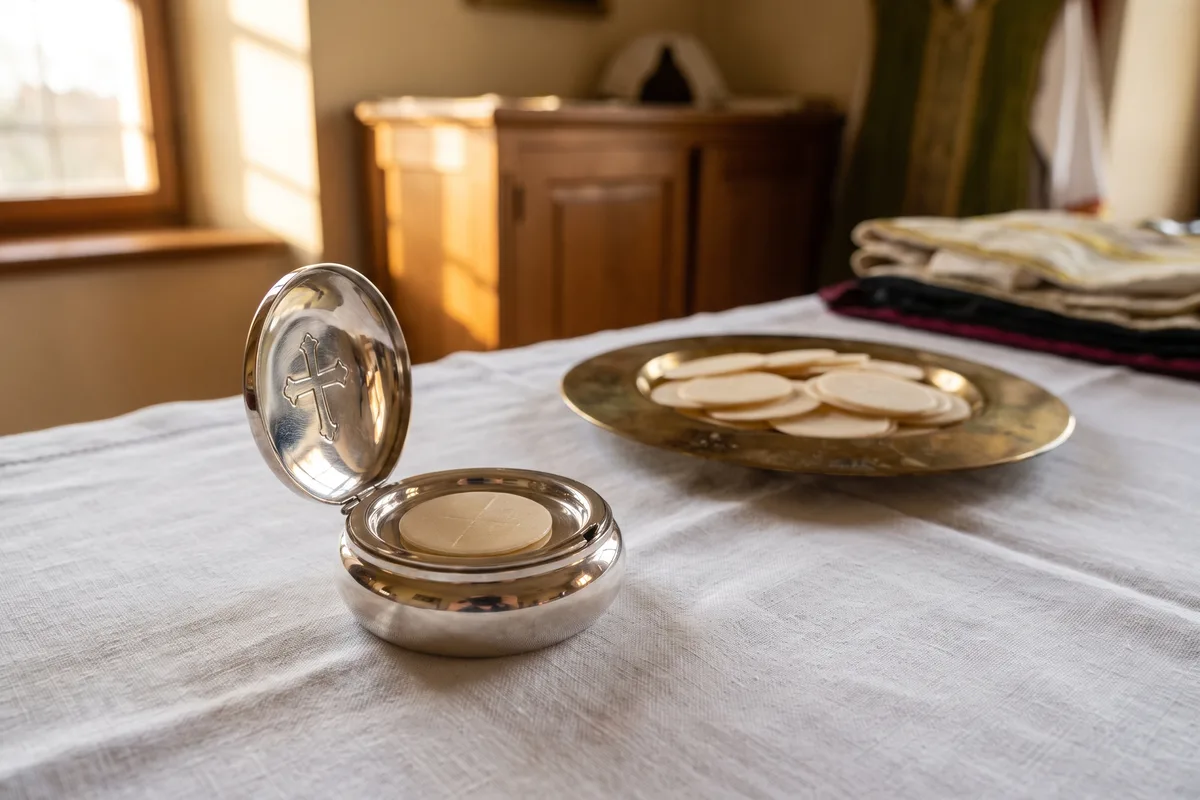
Here is the part almost every article skips: once a safe wafer exists, most real-world exposures come from what happens around it. Three moments carry nearly all the risk.
The shared cup deserves special attention because it feels safe and often is not. In Catholic Masses, a fragment of the host is placed into the main chalice as part of the rite — which is exactly why the guidance recommends a separate, non-commingled chalice for celiac communicants. In churches that practice intinction, everyone ahead of you has been dipping wheat bread directly into the wine.
If this mechanism is new to you, it works the same way at your own table — our guide to cross-contamination from shared utensils covers the household version of exactly this problem.
How to Ask Your Church: Scripts That Work
Have this conversation on a weekday, not in the thirty seconds before the service starts. Call the church office, catch your pastor after a meeting, or send a short email asking for ten minutes. You are not asking for a favor; you are giving them the information they need to include you, and nearly every church wants to get this right.
For a Catholic parish, the ask sounds like this: “I have celiac disease. Could we arrange low-gluten hosts — the kind from the Benedictine Sisters — and keep mine in its own pyx that I set on the altar before Mass? If that’s not workable, I’d like to arrange to receive from a separate chalice.” Naming the Sisters and the pyx tells your priest you have done the homework, and the diocese’s own guidance already backs everything you just asked for.
For a Protestant church: “I have celiac disease, and even crumbs of regular bread make me sick. Could we keep a few sealed gluten-free wafers with the communion supplies, on their own plate? I’m happy to supply them.” Offering to supply the product removes the only real friction, and the ushers just need to know which plate is which.
The same approach works for every awkward food conversation your diagnosis creates — our guide to talking to friends and family about gluten-free needs goes deeper on the wording that keeps these conversations warm instead of clinical.
Get the Gluten-Free Communion Card
A wallet card for your priest or pastor, a one-page sheet for ushers and altar guild, and a First Communion planning checklist. Print it, hand it over, done.
First Communion for a Celiac Child
If your child’s First Communion is coming, start the conversation two to three months out, not the week before. This day carries enormous weight for a Catholic family, and the difference between a scramble and a sacrament is entirely in the preparation.
The plan that works: meet with your priest or the parish’s religious education director early and name the diagnosis. Order the low-gluten hosts through the parish so they arrive with time to spare. Do a quiet dry run at a regular Sunday Mass a few weeks ahead — same pyx, same spot in line, same words — so the day itself holds no surprises. Brief the catechist, so a well-meaning helper does not hand your child a regular host during practice.
And then let the day be about the milestone, not the wafer. The logistics are yours; the moment is theirs. For the bigger picture of raising a confident celiac kid, our guide to raising a gluten-free child without feeling overwhelmed is the companion piece to this section.
The Best Gluten-Free Communion Wafers, Bread & Cups
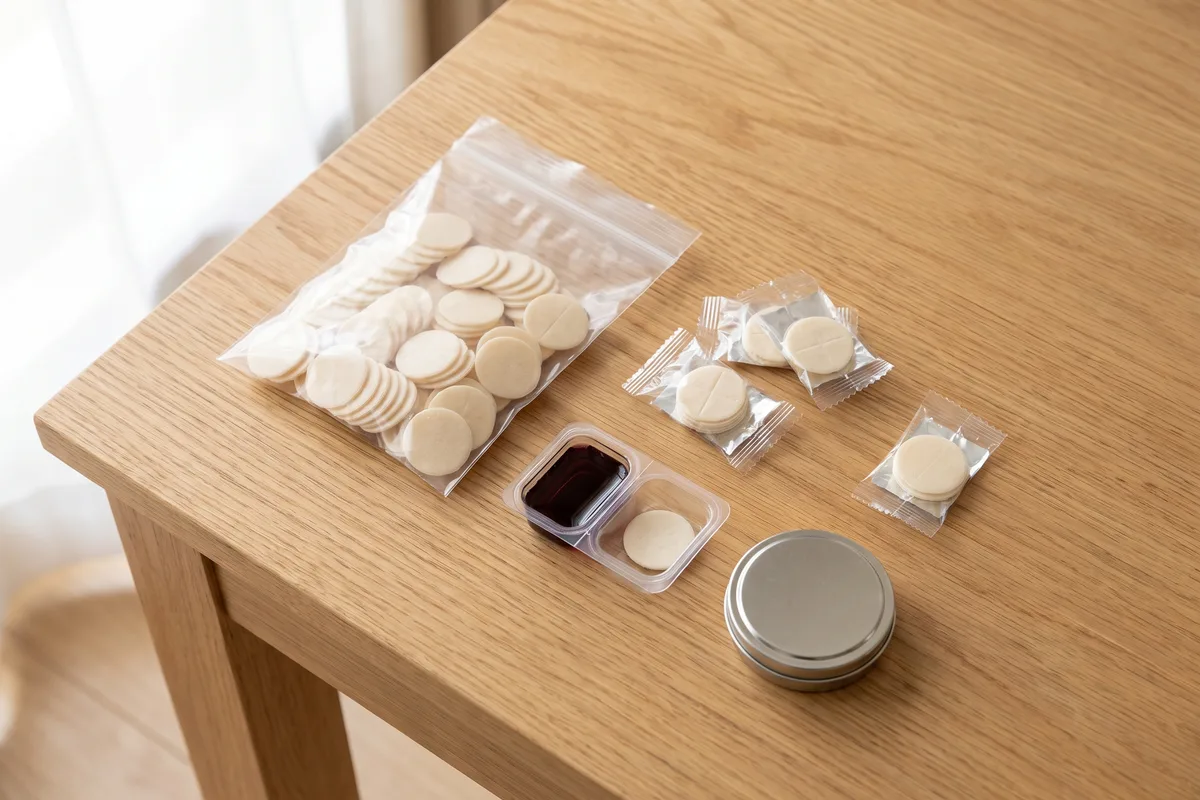
These are the gluten free communion wafers and supplies I would hand to my own church, chosen for allergen practices and how they behave in real services — wafers that do not shatter into a tray full of crumbs, portions that stay sealed until the moment they are eaten. One note up front: the low-gluten Catholic hosts are a different category from the fully gluten-free products, and the table below keeps that distinction visible.
The one I recommend to church friends first. Baked from garbanzo bean flour, potato starch, tapioca, sorghum, and fava bean flour on dedicated equipment in a dedicated facility, and free of the other major allergens too — wheat, dairy, yeast, egg, soy, nuts, and corn — so one plate can serve nearly everyone’s restriction. The resealable bag of fifty keeps the unused wafers sealed between services instead of going stale on a sacristy shelf. View on Amazon
As an Amazon Associate I earn from qualifying purchases.
A sealed two-chamber cup: grape juice below, gluten-free unleavened wafer on top. Because nothing is opened until it reaches your hand, the cross-contamination problem is solved by the packaging itself — the cleanest option for churches that pass trays, and they fit standard tray slots. View on Amazon
Soft bread portions, each in its own sealed wrapper. Ideal for the bring-your-own arrangement many Protestant and Lutheran churches prefer: your portion travels in your pocket, stays sealed on the plate, and opens only in your hands. View on Amazon
For Catholics, this is the option — Vatican-approved since 2004, baked by the Benedictine Sisters of Perpetual Adoration in Clyde, Missouri, and the low-gluten host the celiac medical literature actually tested. Not fully gluten-free by design; see the Catholic section above for what the numbers mean. Order direct or through your parish.
The long-standing classic, made from sweet rice and potato flour and free of gluten, wheat, yeast, dairy, egg, soy, nuts, and corn. Not always on Amazon, but church supply houses like Concordia stock it — worth knowing when your congregation already orders from one.
| Product | Type | Gluten status | Best for |
|---|---|---|---|
| Broadman GF Communion Wafers | Wafer, resealable bag of 50 | Gluten-free — dedicated facility | Individuals and most Protestant settings |
| TrueVine GF Prefilled Cups | Sealed cup: juice + wafer | Gluten-free per listing | Churches that pass trays |
| Individually Wrapped GF Communion Bread | Wrapped soft-bread portions | Gluten-free, sealed per portion | Bring-your-own communicants |
| Broadman GF Communion Bread (200 ct) | Bulk soft-bread pieces | Gluten-free | Large congregations |
| Ener-G Communion Wafers | Wafer, box of ~50 | Free of gluten + 7 other allergens | Churches ordering from supply houses |
| Benedictine Sisters Low-Gluten Altar Bread | Low-gluten host | Low-gluten (~10–70 ppm tested) — not fully GF | Catholic Mass — the only valid option here |
Formulations and allergen practices change — always confirm the allergen statement on the package you receive. No prices by policy; the product cards above carry the links.
Two Things to Skip
- Unlabeled “gluten-friendly” wafers. A communion product with no allergen statement and no facility information is a guess, and church suppliers sell several. If the packaging cannot tell you what is in it and where it was made, it does not belong on a celiac’s tongue.
- Fully gluten-free hosts for a Catholic Mass. Not because the products are bad — because they are invalid matter for that rite, and bringing one puts your priest in an impossible position. The low-gluten hosts exist precisely so nobody has to have that standoff.
Common Mistakes to Watch Out For
- Trusting the size of the exposure. A wafer is small; its gluten content is not negligible, and weekly exposures add up. The research threshold is milligrams, not slices.
- Solving the wafer and forgetting the cup. Commingled fragments and intinction crumbs undo a safe wafer. The cup arrangement is half the conversation with your church, not an afterthought.
- Letting kind hands ruin it. An usher who handles wheat hosts and then hands you the gluten-free one has just glutened it. The pyx-you-prepare-yourself pattern exists exactly for this.
- Making the wrong ask at a Catholic parish. Families ask for gluten-free hosts, hear a correct “we can’t do that,” and walk away believing there is no accommodation. The ask that works is low-gluten hosts or the chalice — both of which your parish can say yes to.
- Springing it on the church on Sunday morning. The thirty-seconds-before-the-service version of this conversation fails constantly. The Tuesday phone call version almost never does.
- Having no plan for a reaction. Accidents happen even in careful churches. Know your own recovery playbook — our guide to accidental gluten exposure covers symptoms, timelines, and when to call your doctor.
Frequently Asked Questions
Are communion wafers gluten-free?
No — traditional communion wafers are baked from wheat flour and water, so they contain gluten and are not safe for people with celiac disease. Safe alternatives exist in every major tradition: fully gluten-free wafers and bread in most Protestant, Anglican, and Lutheran churches, and Vatican-approved low-gluten hosts or communion from the chalice for Catholics.
Can Catholics with celiac disease use completely gluten-free hosts?
No. The Vatican holds that completely gluten-free hosts are invalid matter for the Eucharist, a rule stated in a 2003 letter from the Congregation for the Doctrine of the Faith and reaffirmed in 2017. The approved options are low-gluten hosts, which are valid, or receiving Communion under the species of wine alone from a separate chalice. Permission runs through the parish and diocese, and no medical certificate is required.
How much gluten is in a low-gluten host, and is it safe for celiacs?
Independent testing cited by the North American Society for the Study of Celiac Disease measured the Benedictine Sisters’ low-gluten altar bread at an average of 56.5 parts per million — about 0.002 milligrams of gluten in one host — and the Sisters report their current recipe tests below 10 parts per million. Clinical research puts the daily damage threshold at around 10 milligrams, thousands of times more than one host delivers, and the society concluded these hosts would be safe for celiac patients. Extremely sensitive individuals should discuss it with their doctor and may prefer the chalice.
Is communion wine gluten-free if I skip the wafer?
Wine and grape juice are naturally gluten-free — the risk is what gets into the cup. In Catholic Masses a fragment of the host is placed into the main chalice, and in churches that practice intinction, wheat bread is dipped directly into the shared cup. The fix is a separate chalice prepared before that commingling, your own small cup, or a prefilled set.
How do I prepare a celiac child for First Communion?
Start two to three months ahead: meet with your priest or religious education director, order low-gluten hosts through the parish, and set up a dedicated pyx that you prepare yourself. Then do a quiet practice run at a regular Sunday Mass a few weeks before the big day, and brief the catechist so nobody hands your child a regular host during rehearsal. With the logistics settled early, the day itself gets to be about the milestone.
Gluten-Free Communion Is Simpler Than It Sounds
The default wafer at church is wheat, and no amount of sincerity makes it safe. But the story most celiacs have absorbed — that faith communities cannot or will not accommodate this — does not survive contact with the actual documents. The Vatican approved low-gluten hosts and the chalice decades ago. Protestant traditions never had a wheat requirement at all. The products exist, they are tested, and most of them ship in two days.
What actually stands between you and the table is usually one conversation and one container: a weekday chat with your priest or pastor, and a pyx or sealed portion that stays yours from sacristy to tongue. Handle those two things and the hardest part left is deciding who in your family gets to carry the pyx.
Get our free Gluten-Free Communion Card — a wallet card for your priest or pastor, a one-page sheet for the ushers and altar guild, and a First Communion planning checklist, all printable in five minutes.
Take the Communion Card with you
The exact asks from this guide, sized for a wallet — plus the usher sheet and the First Communion checklist.
Your diagnosis changed how you eat. It does not get to decide where you belong.