

On this page
Monday morning used to be the worst twenty minutes of our week.
I would be standing at the counter at 7:10 a.m. trying to build two safe lunches out of a loaf of gluten-free bread I forgot to thaw, a jar of peanut butter with a suspicious crumb in it, and whatever was left in the snack bin. Someone needed cleats. Someone else needed a permission slip.
And the one thing that could not be improvised — the part where my kids’ food actually has to be gluten-free — was the thing I was improvising.
I am a registered nurse, and I still got beat by Monday for years. What finally fixed it was not more discipline. It was moving the hard decisions to a time of the week when I actually have the capacity to make them, which for our family is Sunday afternoon.
This is that routine, in the order I do it. It takes about ninety minutes, it is not glamorous, and it is the single highest-leverage thing I do for our gluten-free life.
Key Takeaways
- The reset front-loads the week’s decisions. Ninety minutes on Sunday replaces five separate 6 p.m. negotiations with a tired brain, which is where most gluten-free slip-ups actually happen.
- Time spent shopping and prepping is the number one driver of celiac burden. In a study ranking treatment burden across chronic conditions, celiac disease came second only to dialysis — and food logistics was the biggest reason.
- The risky kitchen habits are not the ones you think. Research testing common shared-kitchen practices found shared cooking water was a real problem while a shared toaster was not, and washing with water fixed nearly everything.
- Batch components, not finished meals. A grain, a protein, a tray of roasted vegetables, and a sauce build five different dinners. Five identical containers build resentment by Wednesday.
- One shelf of ready food beats a whole prepped week. Keeping a frozen loaf, a stocked snack bin, and one emergency dinner on hand is what saves the nights the plan falls apart.
Why Sunday, and Why It Takes About Ninety Minutes
Here is the thing nobody tells you at diagnosis: the diet is not the hard part. The logistics are.
Researchers actually put a number on this. In a survey comparing how heavy people find their own treatment across chronic conditions, celiac disease ranked second only to end-stage kidney disease on dialysis — ahead of diabetes, heart failure, and inflammatory bowel disease. And when the researchers looked at what drove that burden, the single biggest factor was the time it takes to shop for and prepare food.
Sit with that for a second, because I found it weirdly freeing. The exhaustion you feel is not a character flaw or a sign you are bad at this. It is the measured, documented cost of the treatment you were handed.
So the fix is not to try harder on Tuesday. The fix is to do the thinking once, on the day you have the most left in the tank, and let Tuesday just execute. Ours is Sunday between about 2 and 4 p.m. Yours might be Saturday morning or Thursday night — the day matters far less than the fact that it is on the calendar and it is protected.
Step 1 — The Ten-Minute Crumb Sweep
I start with the kitchen itself, before a single thing gets cooked, because prepping safe food on an unsafe surface is just laundering the problem.
The sweep is short and always the same: wipe the counters, wash the cutting boards, run the colander and the sheet pans through hot soapy water, shake out the toaster, swap the sponge and dish towels, and check the condiment jars for crumbs. That last one catches more problems in our house than everything else combined.
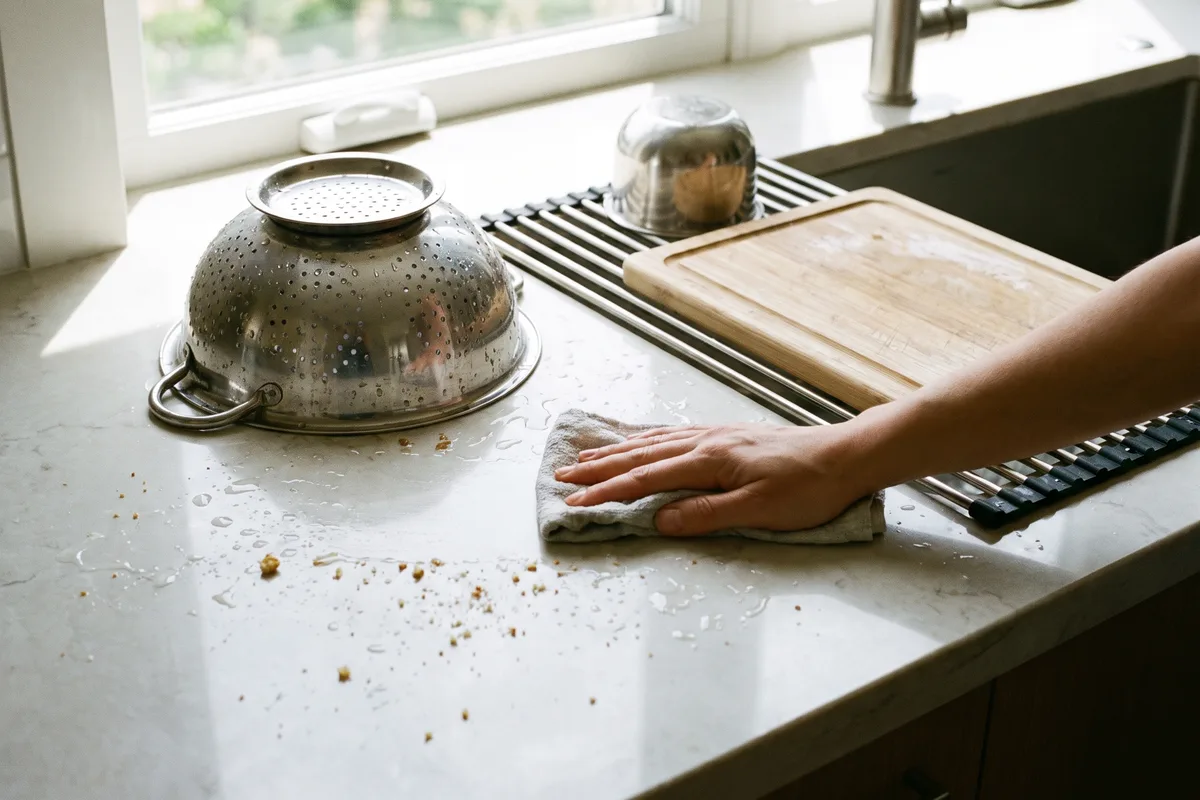
Here is the part that genuinely changed how I spend those ten minutes. A team of researchers tested common shared-kitchen practices and measured how much gluten actually transferred, and the results did not match the usual ranking of kitchen fears.
Gluten-free bread toasted in a shared pop-up toaster with visible crumbs still in it came back with no detectable gluten in any of the twenty samples. Cupcakes cut with an unwashed knife mostly landed under the limit, and washing the knife first brought every sample under it.
But gluten-free pasta cooked in water that had already cooked wheat pasta? Every single one of the twelve samples came back over the 20 ppm threshold, some more than five times over. Rinsing the pasta afterward brought it back under. Rinsing the pot with plain water left it clean.
The authors’ own conclusion was that some kitchen activities may carry less cross-contact risk than commonly believed, and that washing with water goes a long way. I want to be careful here, though. This was one small study in a controlled setting — it did not test flour dust, shared fryers, or scratched plastic, and it is not permission to get sloppy.
What it did do is tell me where to spend my ten minutes. Shared cooking liquid gets my full attention now. The toaster gets a shake-out and my blood pressure stays normal.
If you are still building your kitchen rules from scratch, our guide on avoiding cross-contamination at home walks through the setup decisions this ten minutes assumes you have already made.
Step 2 — The Fridge and Pantry Walk-Through
Next I open everything and look at it. This sounds obvious and almost everybody skips it.
I am looking for four things: what got opened this week, what is about to turn, what we are genuinely out of, and what has a label I have not read in a while. That last one matters more than people expect, because manufacturers reformulate quietly. A product that was safe in March can change in June and the only notice you get is the ingredient panel.
While I am reading, I am checking for the specific words. The FDA requires any food labeled “gluten-free” to contain less than 20 parts per million of gluten, and it treats “free of gluten,” “without gluten,” and “no gluten” as the same claim. What that rule does not cover is a voluntary “may contain wheat” line, which is a manufacturer’s own risk statement and is not standardized at all.
Everything I find goes straight onto one running list in my phone. Not a piece of paper, not my memory, and not four lists. One.
The Sunday Walk-Through
- Open packages — anything that got cross-contaminated goes in the trash now, not Wednesday
- Anything hitting its use-by date in the next three days moves to the front, eye level
- Re-read the label on one staple you buy on autopilot
- Check the freezer for the emergency dinner — is it still in there?
- Snack bin and car bin restocked to full
- Everything missing goes on one running grocery list
Our rundown of must-have gluten-free pantry staples is basically the standing version of this list — the things that should never hit zero in our house.
Step 3 — I Batch Components, Not Meals
This is the step where I broke with almost every meal-prep article on the internet, and it is the reason the routine actually survived past a month.
I do not cook five identical lunches. I cook four building blocks: a grain, a protein, a big tray of roasted vegetables, and one sauce. This week it might be brown rice, shredded chicken thighs, broccoli and carrots, and a jar of vinaigrette.
Those four things become rice bowls, a stir-fry, a pasta dish, soup, or something scooped into a container at 7 a.m. while somebody hunts for a shin guard.
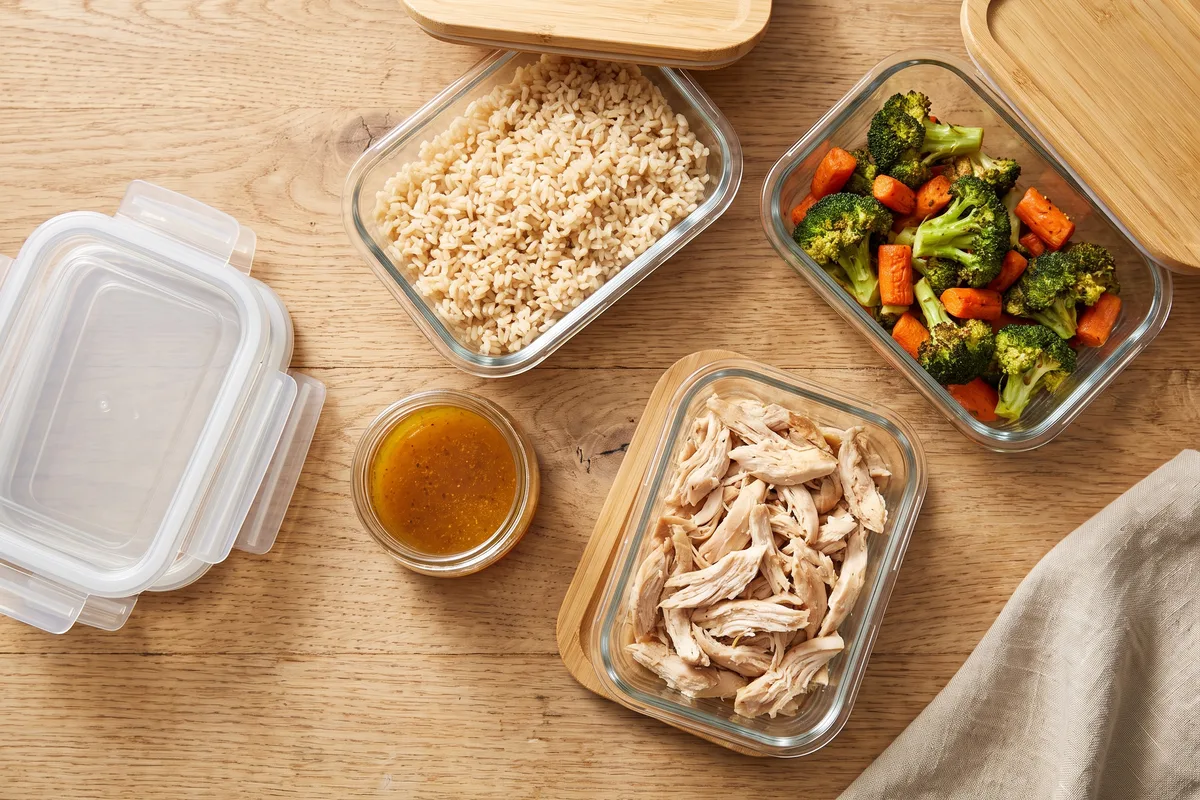
The other reason I cook this way is nutritional. Adults on a gluten-free diet average about 19 grams of fiber a day, well under the roughly 25 grams for women and 38 for men that is generally recommended.
Packaged gluten-free food is usually where that gap comes from. Beans, lentils, brown rice, and a sheet pan of vegetables are the cheapest fix there is, and batch-cooking is what makes them the easy option instead of the ambitious one.
Food safety is the one place I am rigid, because a gluten-free meal that gives somebody food poisoning is not a win. The USDA guidance is to refrigerate cooked food within two hours, use most leftovers within three to four days, and reheat to 165 °F. So Sunday’s components carry us through Wednesday or Thursday. Anything meant for Friday goes in the freezer on Sunday, not on Thursday when I remember it.
For the full batch-cooking version of this — quantities, what freezes well, what turns to mush — our weekly gluten-free meal prep guide goes deeper than I can here. And the freezer stash I keep is the backstop for everything this section assumes will go according to plan.
Step 4 — Building Monday’s Landing Pad
The last twenty minutes are not about cooking at all. They are about making Monday morning require zero decisions.
I set up a single shelf in the fridge and one bin in the pantry, and everything that has to leave the house tomorrow lives there.
Lunch components in grab-and-go containers. Snacks already portioned. Tomorrow’s breakfast decided. The safe bread out of the freezer and into the fridge so nobody is microwaving a frozen loaf at 7 a.m. again.
Then I look at the week on the calendar and find the nights that are going to be a wreck. Practice at 5:30, game at 7:00 — that night gets a dinner we can eat in the car, decided now, while I am calm. The schedule is not going to flex for me, so the food has to flex instead.
The Twenty-Minute Version for the Sundays That Fall Apart
Some Sundays there is no ninety minutes. There is a tournament three towns over, or a sick kid, or I am simply done.
On those days I do not skip the reset, I shrink it. Three things only: wipe the counters and wash the boards, pull the bread out of the freezer, and pack Monday’s lunches. That is it, and it is enough to keep Monday from becoming the twenty minutes I described at the top of this article.
The routine that survives a hard week is worth more than the perfect routine you abandon in March. I have learned that one the slow way, more than once.
What I Actually Keep on Hand for Reset Day
None of this is required, and you can run the whole routine with what is already in your kitchen. These are just the things that earn their spot in ours.
The whole landing-pad step depends on having bread that thaws well and does not crumble, and this is the loaf that finally ended the sad-sandwich era in our house. I keep one in the freezer at all times and move it down to the fridge during the reset. Widely available at mainstream grocery stores, which matters more than people admit. View on Amazon
The cheapest thing on this list and the one that removed the most arguing. Green is gluten-free, everything else is not, and nobody in my family has to remember a rule — they just have to match a color. Replace them when they get deeply scored. View on Amazon
A second, dedicated gluten-free toaster is the splurge I would defend hardest, not because the research says a shared toaster is dangerous but because it removes a daily decision from a household of four. It is small enough to live on the counter next to the other one. View on Amazon
My standing answer to the fiber gap. It holds up in a batch-cooked pasta dish instead of dissolving into paste by day three, and it puts real protein and fiber back into a meal that usually has neither. Cook it in fresh water, always. View on Amazon
Regular soy sauce is made with wheat, which surprises people years into this diet. Certified gluten-free tamari is the one bottle that makes half of my batch-cooked components turn into a stir-fry, and it ends the weekly “is this one safe?” question at the stove. View on Amazon
As an Amazon Associate I earn from qualifying purchases.
Two Things I Would Skip
- Wooden or deeply scratched cutting boards for gluten-free prep. I love a wooden board for bread and I do not use one for my kids’ food. Scores and grooves hold crumbs, and you cannot look at the surface and know whether it is clean — which is the entire job a prep surface has to do.
- The twenty-piece matching meal-prep container set. It looks incredible on Sunday and it quietly pushes you toward five identical lunches, which is exactly the thing that makes people quit by Wednesday. A handful of mismatched containers you already own will do this job fine.
Where This Goes Wrong (Mistakes I Have Made)
- Making it a four-hour project. The first version of this routine ate my entire Sunday and I quit inside a month. Ninety minutes is sustainable. Four hours is a hobby, and you will not keep it.
- Prepping food before cleaning the kitchen. I have batch-cooked a beautiful week of food on a counter that still had flour on it from Saturday’s pancakes. Order matters. Clean first, always.
- Cooking things that do not survive to Thursday. Dressed salads, cooked gluten-free pasta left sitting in sauce, anything breaded. Some things are Monday food and pretending otherwise just fills the fridge with stuff nobody eats.
- Forgetting the calendar step. Prepping a week of food and then not looking at the schedule means beautiful containers sitting home while everybody eats at a concession stand. The food has to match the week you are actually having.
- Trusting a label I read six months ago. Reformulation is real and it is quiet. Re-reading one staple label per reset costs thirty seconds and has caught two changes in our house.
- Treating one skipped Sunday as the end of the system. It is not. You do the twenty-minute version, or you start again next week, and nothing is ruined.
Frequently Asked Questions
How long does a gluten-free Sunday reset actually take?
Mine runs about ninety minutes: ten for cleaning, fifteen for the fridge and pantry walk-through, about forty-five for batch cooking, and twenty for packing Monday. On a hard week I cut it to twenty minutes and only do the counters, the bread, and the lunches. The short version still prevents most of the Monday chaos.
Do I need a separate gluten-free kitchen to do this?
No. Most gluten-free households share a kitchen with gluten, and the routine is built around that reality. A dedicated prep surface, thorough washing, and fresh cooking water for gluten-free pasta handle the practical risks for most families. If someone in your home is newly diagnosed or still symptomatic, talk to your doctor or dietitian about whether a stricter setup makes sense for you.
Is it safe to share a toaster if I clean it out?
Research testing that exact scenario found no detectable gluten in gluten-free bread toasted in a shared pop-up toaster, even with visible crumbs still inside. That said, it was one small study, sensitivity varies a lot between individuals, and many families sleep better with a dedicated toaster. It is a reasonable place to spend money if the daily uncertainty is wearing on you.
How long do batch-cooked gluten-free meals last in the fridge?
The USDA advises refrigerating cooked food within two hours and using most leftovers within three to four days, reheating to 165 °F. That means Sunday’s cooking safely covers you through Wednesday or Thursday. Anything intended for the end of the week should go into the freezer on the day you cook it, not later.
What if I only have twenty minutes on a Sunday?
Do three things: wipe the counters and wash the cutting boards, move the gluten-free bread from the freezer to the fridge, and pack Monday’s lunches. Those three cover the safety step, the thing that takes the longest to fix in the morning, and the meal you are most likely to rush. Everything else can wait for next week.
Ninety Minutes That Buy Back a Whole Week
If you take one thing from this, let it be the reframe rather than my particular routine. The heaviest part of gluten-free life is not the food rules — it is the number of decisions those rules generate, and the fact that they keep arriving at the exact hour you have the least left to give.
A reset does not eliminate those decisions. It just moves them to a calmer version of you, once a week, in a kitchen where you are not also refereeing anything.
That is the whole trick. My Mondays are not perfect now, but they are ordinary, and after years of that 7:10 a.m. scramble, ordinary feels like a genuine win.
Start smaller than you think you should. Pick one Sunday, set a timer for twenty minutes, and do the counters, the bread, and the lunches. If it helps, add a step next week.
Want the planning part done for you? Grab our free Starter Meal Plan Bundle — a week of family-tested gluten-free dinners with the grocery list already built, so your reset becomes packing instead of planning.
You are not bad at this. You have just been doing the hardest version of it at the hardest time of day. Move it to Sunday, and let Monday be boring for once.