

On this page
For years, my gluten-free grocery list lived on the back of whatever envelope was closest to the fridge. I rewrote it from scratch every week, usually in the car, and I still came home without bread and with a third jar of peanut butter.
That sounds like a small annoyance until you remember what a forgotten item costs in a gluten-free house. You can’t grab any loaf at the gas station. A missing staple on a Tuesday turns into a second trip, a pricey specialty substitute, or a takeout order I’d rather not gamble on.
I’m a registered nurse, and checklists are basically my native language. It still took me an embarrassingly long time to make a good one for groceries. What finally fixed it wasn’t an app — it was one master list I reuse every week, and ten minutes to update it.
Here’s exactly how that list is built, what’s on it aisle by aisle, the label checks I still do in the store, and the handful of brands that have earned a permanent spot.
Key Takeaways
- A reusable list beats a blank page. In one study, shoppers who always used a list had slightly better diet quality. For gluten-free families, the list is also where the safety decisions get made before you’re standing in the aisle.
- My list has three parts, and only one changes. An Always list that never runs out, a This Week list built from the calendar, and a Check Again list of labels I re-read every trip.
- Ten minutes, four steps. Two minutes on the calendar, three on the fridge and pantry, three filling in meals, and two sorting everything by aisle.
- Build around naturally gluten-free food. Specialty gluten-free products cost far more than their wheat versions, so our Always list leans on produce, eggs, rice, potatoes, and beans, and keeps the specialty items few.
- A handful of brands never leave the list. A certified gluten-free bread that freezes well, a budget pasta and a whole-grain pasta, gluten-free tamari, and a 1-to-1 baking flour cover most of our weeks.
Why I Stopped Writing a New Grocery List Every Week
The diet itself was never the hardest part of gluten-free life in our house. The logistics were. And it turns out that isn’t just my experience.
In a 2014 survey of more than 700 patients, people with celiac disease rated the burden of their treatment higher than people managing acid reflux or high blood pressure, and comparable to people on dialysis for kidney failure. The factors tied to that burden included the time it takes to prepare food and worry about what it costs.
A grocery list is where a lot of that time and money gets decided, so that’s where I started cutting.
There’s a modest bit of evidence that lists help beyond saving time, too. In a study of 1,372 grocery shoppers in Pittsburgh, people who always shopped with a list had slightly better diet quality and a slightly lower BMI than people who didn’t. It was a snapshot study, so it can’t prove the list caused the difference — healthier shoppers may simply be the list-makers.
But a list costs nothing, and in a gluten-free house it does a job no study measured. It moves the safety decisions to my kitchen table, where I’m calm and can actually read, instead of aisle five with a full cart and a kid asking for Goldfish.
My Gluten-Free Grocery List Has Three Parts (and Only One Changes)
The trick that finally made this fast was splitting the list into three sections. Two of them barely change from week to week, which is why the whole thing takes ten minutes instead of forty.
That third section is the one I’d never skip. Recipes and suppliers change, and the only notice you usually get is the package itself. The Check Again list is my reminder of which items are most likely to surprise me.
The Always list gets its own rule, too: it stays short. Once it creeps past about twenty-five items it stops being a list and turns into a pantry inventory, and I stop reading it carefully.
How My Ten Minutes Actually Go
I do this during my Sunday kitchen reset, right after the fridge walk-through, but it works on any day you’re about to shop. I really do set a ten-minute timer.
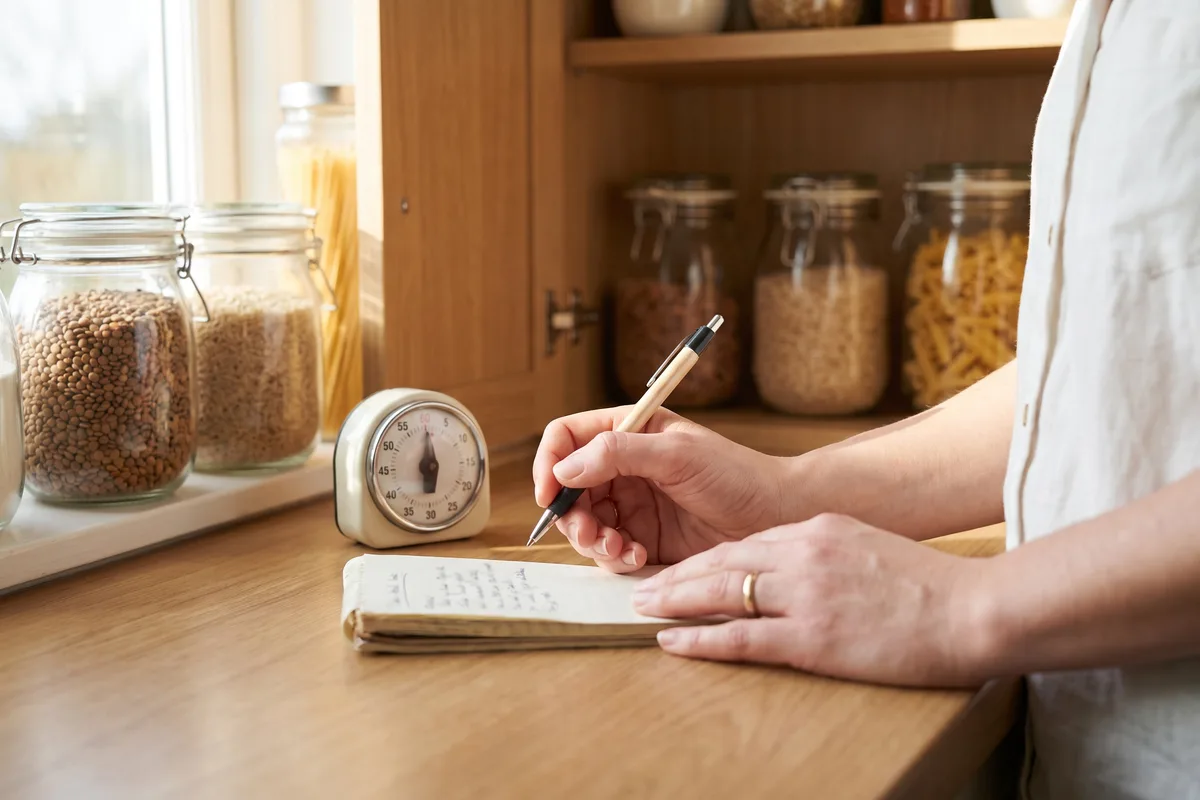
- Minutes 1–2: the calendar. I count the dinners we’ll actually eat at home, flag the practice nights that need something fast, and pick one backup meal. If deciding is the hard part, a gluten-free meal planner can build the week for you.
- Minutes 3–5: the walk-through. Fridge, freezer, pantry, snack bin. I read the Always list top to bottom and mark whatever is low — and low means one left, not zero.
- Minutes 6–8: this week’s meals. Each planned dinner gets its ingredients written out, and packaged items get the exact product: brand, flavor, and size. Writing just “pasta” is how the wrong box ends up in the cart.
- Minutes 9–10: sort and star. I reorder the list to match the path I walk through the store, then star every Check Again item so I know exactly where to slow down.
That’s the whole routine. The speed doesn’t come from rushing. It comes from the fact that two-thirds of the list was already written before the timer started.
What’s on My List, Aisle by Aisle
Here’s our actual Always list, sorted the way I walk the store. Your household’s list should look different from ours, but the shape is worth copying.
| Aisle | Always on my list | What I double-check |
|---|---|---|
| Produce | Bananas, apples, berries, carrots, onions, potatoes, sweet potatoes, broccoli, bagged greens | Salad kits, which often come with croutons or a dressing packet |
| Meat and seafood | Chicken thighs, ground beef or turkey, one fish | Anything marinated, seasoned, or breaded |
| Dairy and eggs | Eggs, milk, plain yogurt, shredded cheese, butter | Yogurts with crunchy mix-ins or toppings |
| Freezer | Gluten-free bread, frozen vegetables, one emergency dinner | Frozen meals and vegetables in sauce |
| Grains and pasta | Rice, one or two gluten-free pastas, corn tortillas | Tortillas that blend in wheat flour, and flavored rice mixes |
| Pantry | Canned beans, peanut butter, gluten-free tamari, broth | Broth, soups, and sauces, every time |
| Snacks | Popcorn, rice cakes, one gluten-free cracker, fruit cups | Flavored chips and seasoned popcorn |
| Breakfast | Oats or cereal labeled gluten-free | Oats always, and cereals made with malt |
The pattern is the point. Plain, single-ingredient foods fill most of the Always column, and the double-check column is almost entirely things that are seasoned, sauced, coated, or mixed. That’s where gluten tends to hide, so that’s where my attention goes.
Where the Grocery Money Actually Goes
The first time I priced out gluten-free replacements for everything we used to buy, I wanted to sit down in the cereal aisle. It wasn’t my imagination, either.
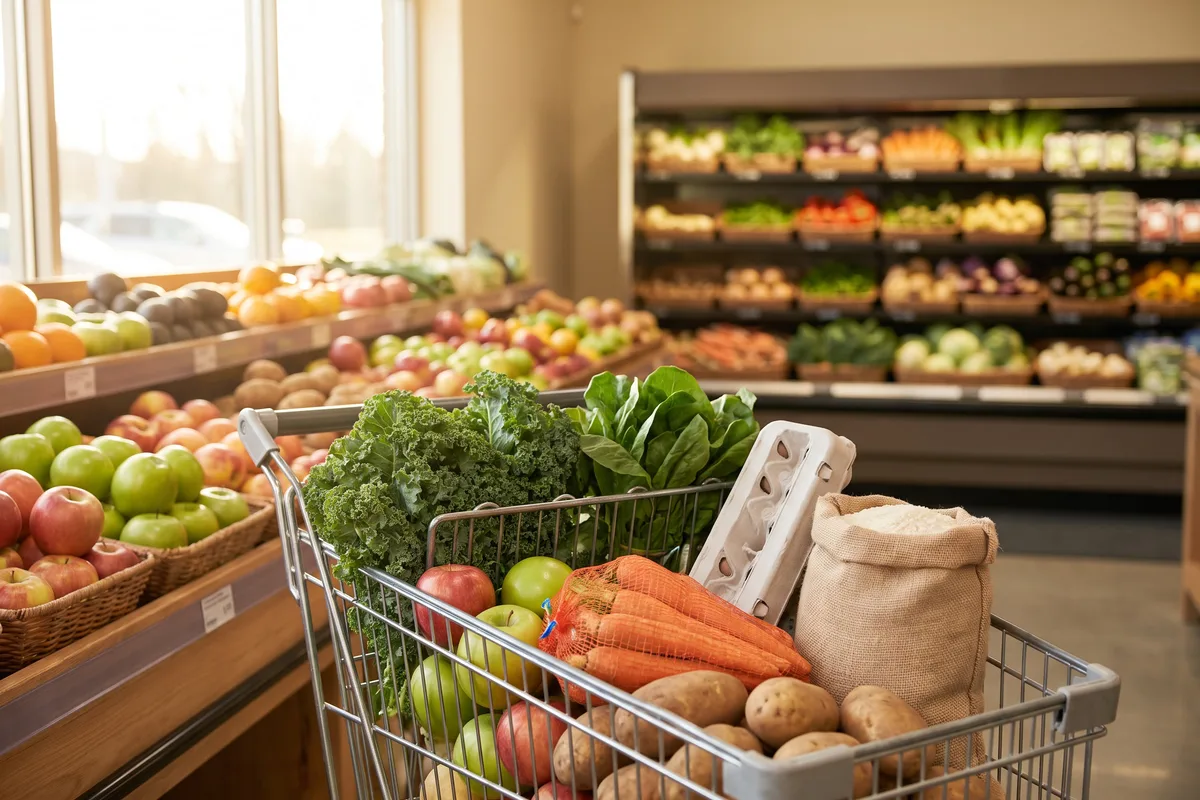
In a study that priced a gluten-free market basket in five U.S. regions, gluten-free products cost 183% more than their wheat-based versions overall. Bread came in 229% higher, pasta 227% higher, and crackers 270% higher.
Those prices were collected in 2016, and the gap had already narrowed from a decade earlier. But the lesson holds up in our cart every week: the premium sits almost entirely on specialty products made to replace wheat. Potatoes, rice, eggs, beans, and a bag of apples cost the same for us as for anyone else.
So our Always list leans hard on naturally gluten-free food, and the specialty items are few and chosen on purpose. We buy one bread we love, a couple of pastas, one cracker, and a gluten-free tamari. Everything else is regular groceries.
The same study found two more things that shape how I shop. Gluten-free versions from mainstream brands carried a smaller premium than average, and traditional grocery stores had lower per-ounce prices than online stores. Buying mainstream, shopping in person, and a few other ways to shop gluten-free on a budget add up quickly.
If Walmart, Target, Kroger or Costco is your usual store, our aisle-by-aisle guides for gluten-free shopping at Walmart, gluten-free shopping at Target, gluten-free shopping at Kroger and gluten-free shopping at Costco show you where to look and what to check before it goes in the cart.
The Thirty-Second Label Check I Still Do in the Aisle
Even with a perfect list, the starred items get a label check in the store. It takes about thirty seconds, and I do it in the same order every time.
- Look for the gluten-free claim. Under the FDA’s gluten-free labeling rule, any food labeled “gluten-free” must contain less than 20 parts per million (ppm) of gluten, a trace amount. “No gluten,” “free of gluten,” and “without gluten” mean the same thing. The claim is voluntary, so some naturally gluten-free foods won’t carry it at all.
- Read the “Contains” line, then keep reading. Wheat is one of the nine major food allergens that U.S. labels must declare, but barley and rye are not. A “Contains” line without wheat doesn’t clear them, so I scan the ingredients for barley, rye, and malt.
- Don’t lean on “may contain.” Those advisory statements are voluntary and not required by law, so a package without one tells you nothing about shared equipment.
- Check oats every time. Regular oats are at high risk of cross-contact with wheat and barley, so the only oats in our cart are labeled gluten-free.
Oats deserve one more note. The Celiac Disease Foundation notes that most people with celiac disease tolerate pure, uncontaminated oats in moderation, but some react to avenin, a protein in oats themselves, and need to avoid even gluten-free oats. If you’re not sure which group you’re in, that’s a question for your doctor, not the cereal aisle.
When a label leaves me unsure, I paste the ingredient list into our free gluten-free label scanner and read the explanation behind the result. If the package and the company’s website disagree, that item comes off the list until I hear back from the manufacturer.
The Brands That Never Leave My List
You can run this whole system on store brands and naturally gluten-free food. These are the specialty products that have earned a permanent line on our Always list, and why.
Bread is the one specialty item I refuse to run out of, and this is the loaf we keep coming back to. Canyon Bakehouse is certified gluten-free by the Gluten-Free Certification Organization (GFCO) and bakes in a dedicated gluten-free bakery. You’ll find it in the freezer aisle, it keeps up to three months in the freezer, and it lasts 7–10 days on the counter. View on Amazon
Our budget pasta, and one of the easiest gluten-free pastas to find at a mainstream grocery store. It’s made from corn and rice, labeled gluten-free, and produced on a dedicated gluten-free line. It’s the pasta nobody at our table notices is gluten-free. View on Amazon
Our splurge pasta, and the whole-grain one. The ingredient list is organic brown rice flour and water, it’s certified gluten-free, and it’s made in Italy in a dedicated gluten-free facility. Set a timer: brown rice pasta goes from firm to soft quickly. View on Amazon
Most regular soy sauce is brewed with wheat, and soy sauce shows up in more of our weeknight dinners than I’d like to admit. San-J’s gluten-free tamari is made with soy and no wheat, and it’s GFCO-certified. It’s the swap that keeps stir-fry night on the calendar. View on Amazon
The only flour on our Always list. It swaps cup for cup in pancakes, muffins, and cookies, and Bob’s Red Mill tests it in a 100% dedicated gluten-free facility. One caution: it’s made for non-yeast recipes, so it isn’t a shortcut to sandwich bread. View on Amazon
As an Amazon Associate I earn from qualifying purchases.
Two Things I Leave Off the List
- Oats that don’t say gluten-free. Regular oats are at high risk of cross-contact with wheat and barley, and I’m not willing to guess which bag got lucky. If an oat product isn’t labeled gluten-free, it doesn’t go in our cart.
- Anything from the bulk bins. I love the idea of scooping my own rice and flour, and I skip it anyway. Bins and scoops get shared, and the Celiac Disease Foundation recommends against buying grains from bulk bins because of possible cross-contact.
Grocery List Mistakes That Cost Me Time, Money, or a Rough Week
- Writing “bread” instead of the exact product. A vague list sends whoever is shopping straight to the regular bread aisle. Ours names the brand, the flavor, and the size, so anyone in the family can shop it safely.
- Letting the Always list grow forever. A long list stops getting read carefully. Anything we haven’t bought in a month comes off it.
- Trusting a label from memory. Recipes change quietly. If it’s on the Check Again list, I read it in the store even if I’ve bought it a hundred times.
- Treating a shelf tag or an online filter as the label. A “gluten-free” shelf tag or website filter is the store’s summary, not the package. When they disagree, I trust the package in my hand.
- Skipping the backup meal. Plans fall apart. One dinner I can make without thinking is what keeps a bad night from becoming a risky takeout order.
- Stocking up on specialty snacks “just in case.” They’re the priciest things in the cart and the easiest to overbuy. I’d rather buy one box we’ll finish than three we won’t.
Frequently Asked Questions
What should be on a basic gluten-free grocery list?
Start with naturally gluten-free foods: fruits and vegetables, eggs, plain meat and fish, milk and plain yogurt, rice, potatoes, and dried or canned beans. Then add the few specialty items your household relies on, such as a gluten-free bread, a gluten-free pasta, and a gluten-free tamari in place of soy sauce. Anything seasoned, sauced, or processed goes on the list with a note to check the label.
How do I keep a gluten-free grocery list on a budget?
Build most of the list from naturally gluten-free staples, which cost the same for you as for anyone else, and keep specialty products to the few you really use. A U.S. price survey found gluten-free specialty products averaged 183% more than their wheat versions, with a smaller premium for mainstream brands. In that study, traditional grocery stores also had lower per-ounce prices than online stores.
Are store-brand gluten-free products safe?
A store-brand food labeled gluten-free is held to the same FDA rule as a name brand: less than 20 parts per million of gluten. What a store brand may not have is independent certification, which is a separate, voluntary program. Read the label on the exact product you are buying, and if you are highly sensitive, you may prefer certified options for your everyday staples.
Is wheat-free the same as gluten-free?
No. Barley and rye also contain gluten, and they are not among the major allergens U.S. labels must declare, so a product can be wheat-free and still contain gluten from barley malt or rye. The Celiac Disease Foundation makes the same point: wheat-free does not necessarily mean gluten-free. Look for a gluten-free claim and read the full ingredient list.
How often should I re-check labels on foods I buy all the time?
I re-read everything on my Check Again list on every trip: oats, broths, sauces, seasoning mixes, and anything marinated or new. For everyday staples, I check whenever the packaging looks different. Manufacturers can change ingredients or suppliers, and the package in your hand is the only up-to-date source.
Ten Minutes at the Table Beats Twenty in Aisle Five
The best part of this system isn’t the list itself. It’s that the hard thinking — what’s safe, what we need, and what we’ll actually eat — happens once, at my kitchen table, instead of all over again every time I walk into a store.
If you try one thing, start with the three sections. Write your Always list once this week, keep it short, and add a Check Again section for the handful of items that deserve a second look. Next week, you’ll only be writing the middle part.
Get the 4-Week GF Meal Plan
Twenty weeknight dinners with a grocery list for every week, grouped the way the store is laid out. It’s the fastest way to fill the This Week part of your list. Free, as a printable PDF.
Gluten-free shopping may never feel effortless. But it can feel routine, and after all those envelope years, routine feels like a real win.