

On this page
The scale went up and nobody warned you.
You did the hard part. You got the diagnosis, you rebuilt your pantry, you learned to read every label and interrogate every restaurant menu. You are finally taking care of yourself. And somewhere in month three or month eight, your jeans stopped fitting and it felt like a cruel joke.
I want to say two things before anything else, because I think both get lost in how this topic usually gets written about. The first is that gaining weight after a celiac diagnosis is extremely common and, most of the time, it is your treatment working rather than failing. The second is that noticing it and not loving it does not make you vain or ungrateful. Both things are allowed to be true.
What follows is what the research actually shows, which is genuinely more reassuring than most of what gets written about gluten-free diets and weight. Then the practical part: the handful of reasons the scale moves, which of them you can do something about, and when a weight change is worth a phone call to your doctor.
Key Takeaways
- Weight gain after diagnosis is usually absorption returning. Damaged villi cannot pull nutrients out of food. When they heal, the same meal finally delivers the calories it always contained.
- The best evidence says a gluten-free diet does not raise obesity risk. A meta-analysis of 45 studies found more than twice as many patients moved out of the overweight category as into it.
- The problem is rarely gluten-free itself. It is what replaced the wheat: packaged gluten-free bread has roughly half the protein and markedly more saturated fat than its wheat equivalent.
- Fiber is the gap that matters most. Adults on a gluten-free diet average about 19 grams a day against a target of 25 to 38, and fiber is what makes food feel like it counted.
- Continued weight loss is the symptom to escalate. Gaining is expected; still dropping on a strict diet is not, and warrants follow-up.
First, the Reassuring Part: Gaining Is Often Healing
Untreated celiac disease damages the villi, the tiny finger-like projections lining your small intestine that do the actual work of absorbing nutrients. As Mayo Clinic describes it, that inflammation flattens the villi, which leads to malabsorption — and people lose weight because their bodies simply cannot get enough out of what they eat.
Sit with what that means for a moment. If you were underweight before your diagnosis, or you could eat anything without gaining, that was not a fast metabolism or good luck. It was an injured intestine failing at its job.
A gluten-free diet lets those villi heal. And as they heal, absorption comes back. The same sandwich you have eaten for years suddenly delivers the calories it always contained, because for the first time in a long time your body can actually reach them.
So the weight that arrives in the first year is usually not a diet failure. It is the most tangible evidence you have that the intestinal damage is reversing. In one large review, half of the patients who were underweight at diagnosis moved into the normal-weight range on the diet, which is exactly the outcome the treatment is meant to produce.
What the Research Actually Says About Gluten-Free and Weight
Here is where most articles on this topic get it wrong, and it is worth correcting clearly.
The strongest evidence available is a systematic review and meta-analysis of 45 studies covering nearly 8,000 people with celiac disease. Its conclusion is that a gluten-free diet does not increase the risk of developing overweight or obesity.
The numbers underneath that conclusion are worth knowing:
- 9% moved up a category. Roughly one in eleven patients shifted from underweight or normal weight into overweight or obese while on the diet.
- 20% moved down a category. More than twice as many went the other way, from overweight or obese back to normal weight.
- Average BMI rose by about 1.1 points. Real, measurable, and modest — for most adults that is a handful of pounds, not a transformation.
- The overweight rate barely budged. It was 14% at diagnosis and 13% during the diet across the pooled data.
Shorter-term studies do show a lot of early gain — one two-year follow-up found four in five people gained some weight — and that is consistent with the healing story above. But when you zoom out across decades of data, the gluten-free diet does not push people into obesity as a group. It moves people toward the middle from both directions.
If you have been reading that going gluten-free makes you gain weight, that framing is not supported by the best available evidence. Something else is usually going on, and it is generally fixable.
The Real Culprit Is What Replaced the Wheat
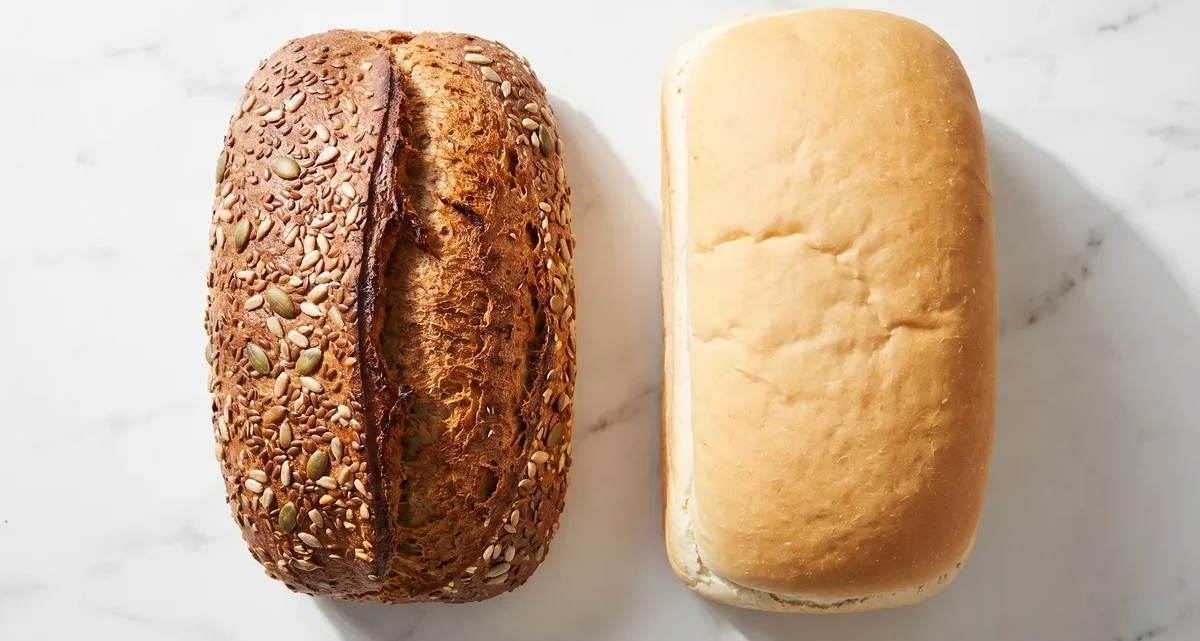
When wheat comes out of your diet, something takes its place. If that something is a shelf of packaged gluten-free substitutes, the nutrition changes in ways that have nothing to do with gluten.
A case-control study of 423 gluten-free products against 337 conventional equivalents found consistent differences. The pattern is not more sugar or more fat across the board, which is the claim you often see and which the data does not support. It is less of what makes food satisfying.
| What you are swapping | Gluten-free version | Wheat version |
|---|---|---|
| Bread — protein per 100 g | 4.1 g | 8.8 g |
| Bread — saturated fat | 80% higher | Baseline |
| Pasta — fiber per 100 g | 2.4 g | 7.0 g |
| Cereal — salt | 56% higher | Baseline |
| Products meeting “high fiber” | 38% | 51% |
Protein and fiber are the two things that make a meal register as a meal. Strip roughly half the protein out of your bread and two thirds of the fiber out of your pasta, and you get food that fills less and holds you for less time. You are not eating more because you lack discipline. You are eating more because the replacement genuinely does less work.
That is a solvable problem, and solving it does not require eating less of anything.
Five Other Reasons the Scale Moved
Healing and food swaps explain most of it. A few other things are worth ruling in or out.
- Your appetite came back. Untreated celiac suppresses appetite through nausea, pain, and bloating. When those resolve, hunger returns to normal and it can feel like a sudden surge — our piece on how gluten-free eating affects your energy covers the same rebound.
- Fluid and inflammation shifted. Some of the earliest change on the scale is not fat at all. Resolving inflammation and rehydrating after chronic diarrhea moves the number around for weeks.
- Food became emotionally loaded. A restrictive diagnosis changes your relationship with eating. Treating gluten-free packaged foods as a reward is an entirely human response to a diet that took a lot away from you.
- Thyroid disease came along for the ride. Autoimmune thyroid conditions occur more often in people with celiac disease, and an underactive thyroid affects weight directly. It is a simple blood test worth asking about.
- You are eating out less. Many newly diagnosed people cook far more at home, which is usually a good thing nutritionally but changes portion sizes in ways nobody tracks.
What Actually Helps

The fix is additive rather than restrictive. You are not trying to eat less; you are trying to make what you eat carry more protein and more fiber, so it does the job wheat used to do.
The fiber gap is the highest-leverage change. Adults on a gluten-free diet average around 19 grams of fiber a day, while the Academy of Nutrition and Dietetics puts the target at roughly 25 grams for women and 38 for men. Closing that gap changes how full you feel more than almost anything else you could do.
Beyond that, the healing itself takes time, and expecting your body to settle in a few weeks sets you up for frustration. Our piece on how long it takes to feel better after quitting gluten lays out a realistic timeline. If all of this is still new, the gluten-free 101 guide is the place to start.
Swaps Worth Making
These are the products I reach for when the goal is closing the protein and fiber gap rather than eating less.
This is the single swap that fixes the exact deficit the research describes. Conventional gluten-free pasta averages a fraction of the fiber of wheat pasta; chickpea pasta puts both the protein and the fiber back. It behaves like pasta, the kids eat it, and it holds you until the next meal. View on Amazon
Not a weight product, and I want to be clear about that. Gluten-free diets commonly run short on omega-3s once wheat-based staples come out, and this is a well-tested, third-party-verified way to close that specific gap. View on Amazon
Baking at home is the only way to control what goes into gluten-free bread. Use this as the base and add ground flaxseed, almond flour, or psyllium husk — the fiber and protein that commercial loaves leave out. View on Amazon
As an Amazon Associate I earn from qualifying purchases.
Two Things to Skip
- The gluten-free health halo. A cookie that is safe for you is still a cookie. “Gluten-free” is a safety label, not a nutrition label, and the packaging is designed to blur that line.
- Meal-replacement shakes and detox plans aimed at celiacs. Your intestine is recovering from an injury. This is the worst possible moment to under-eat, and there is no evidence any of it helps celiac recovery.
Common Mistakes to Watch Out For
- Reading early weight gain as the diet failing. In the first year it usually means the opposite. Judge the diet by your labs, symptoms, and energy, not the scale alone.
- Cutting calories while your gut is still healing. Restricting during active recovery works against nutrient repletion at the exact moment your body needs the raw materials most.
- Swapping like for like without reading the panel. Replacing wheat bread with gluten-free bread is a straight downgrade in protein unless you check. Compare the numbers, not the front of the package.
- Assuming it is the gluten-free diet’s fault. Thyroid disease, medication changes, perimenopause, and ordinary aging all move weight too, and all are easy to test for.
- Ignoring weight that keeps dropping. Continued loss on a strict gluten-free diet is the one pattern here that genuinely needs a doctor rather than patience.
Frequently Asked Questions
Is gaining weight after a celiac diagnosis normal?
Yes, and it is usually a sign of recovery. Untreated celiac disease damages the intestinal villi and causes malabsorption, so people often lose weight before diagnosis. Once a gluten-free diet lets the villi heal, normal absorption returns and weight commonly follows. Studies of the first two years on the diet find that most patients gain some weight.
Does a gluten-free diet make you gain weight?
Not according to the strongest evidence. A systematic review and meta-analysis of 45 studies and nearly 8,000 celiac patients concluded that a gluten-free diet does not increase the risk of developing overweight or obesity. About 9% of patients moved from underweight or normal weight into a higher category, while roughly 20% moved from overweight or obese back to normal weight.
Why is gluten-free bread less filling than regular bread?
Because it contains substantially less protein and fiber. In a comparison of over 400 gluten-free products with conventional equivalents, gluten-free bread averaged about 4.1 grams of protein per 100 grams against 8.8 grams in wheat bread, and gluten-free pasta contained roughly a third of the fiber. Protein and fiber are what make a meal feel satisfying and keep you full.
How much fiber should I be eating on a gluten-free diet?
The general adult target is about 25 grams a day for women and 38 grams for men. Research on people with celiac disease following a gluten-free diet finds average intake closer to 19 grams a day, so most people have a meaningful gap to close. Naturally gluten-free foods such as beans, lentils, berries, nuts, seeds, and certified gluten-free oats are the easiest way to close it.
Should I be worried if I keep losing weight on a gluten-free diet?
That is worth a call to your doctor. Continued weight loss despite a strict gluten-free diet can indicate that the intestine is not healing, that gluten is still getting in somewhere, or that another condition is involved. It is a different situation from the weight gain most people experience, and it should be investigated rather than waited out.
Can celiac disease cause weight gain instead of weight loss?
Yes. The classic picture of an underweight celiac patient is outdated. In pooled data, most people are a normal weight at diagnosis, and a meaningful share are already overweight or obese. Weight is not a reliable way to judge whether someone has celiac disease, which is part of why so many cases go undiagnosed for years.
Your Body Started Working Again
If the scale went up after you went gluten-free, the most likely explanation is that your body started working again. Villi heal, absorption returns, appetite normalizes, and weight follows. That is the treatment doing its job, even when it does not feel like a win.
Where the diet genuinely does work against you is the swap aisle. Packaged gluten-free staples carry roughly half the protein and a fraction of the fiber of what they replaced, and food that does less work leaves you reaching for more of it. Fix that gap and most of this resolves without counting a single calorie.
Be suspicious of anyone telling you to eat less while your intestine is still repairing itself. Add protein, close the fiber gap, give it a year, and get your thyroid checked if things still do not add up.
Download our free GF Nutrition Cheat Sheet — the nutrients most likely to run short on a gluten-free diet, and the labs worth asking your doctor about at your next visit.
Your body spent years not getting what it needed from food. Give it some grace while it remembers how.