

On this page
You gave up gluten and felt amazing. But what if gluten wasn’t the only thing you gave up?
I want to be careful here, because for some of us the answer is simple. If you have celiac disease, gluten is the problem, and a strict gluten-free diet is the treatment. Nothing in this investigation changes that.
This one is for everyone else: the friend who quit bread and lost the bloat, the coworker who swears her brain fog lifted in a week. I hear a version of that story all the time, and I believe it. People really do feel better.
What I wanted to know is why. So for the second LGGF Investigates, I went back to the blinded trials and the national diet data, and graded every explanation I could find on the evidence.
The short answer
Probably not gluten alone. If you have celiac disease, gluten is the cause and this question doesn’t apply to you. For everyone else, blinded trials find gluten itself is the trigger in a minority, while the fructans in wheat and plain expectation account for a good share of symptoms. And going gluten-free usually removes a lot of ultra-processed food at the same time, which makes the credit hard to assign.
Key Takeaways
- Going gluten-free changes more than gluten — by our count, three of the five biggest sources of ultra-processed calories for US adults are mostly wheat-based foods, so cutting gluten cuts into them by default.
- Gluten is the trigger for a minority — among people without celiac who report gluten sensitivity, 16 to 30% react to gluten specifically in blinded tests.
- Fructans and expectation both show up in trials — a carbohydrate in wheat caused more symptoms than gluten did in one blinded study, and in another, gluten that nobody expected caused no more symptoms than none at all.
- Packaged gluten-free food isn’t automatically better — in our label comparison, the gluten-free cracker listed more additives than the wheat one, and the two sandwich cookies were nearly identical.
- Test before you quit gluten — celiac testing is only reliable while you are still eating gluten, so cutting it first can hide the answer.
Two Plates: A Day Before and a Day After
Picture a fairly ordinary day of eating. Sweetened cereal for breakfast, a deli sandwich for lunch, crackers in the afternoon, frozen pizza for dinner, and a few cookies after.
Now picture the same person a month into going gluten-free. Eggs for breakfast, a big salad and some rice and chicken for lunch, fruit in the afternoon, meat and vegetables for dinner.
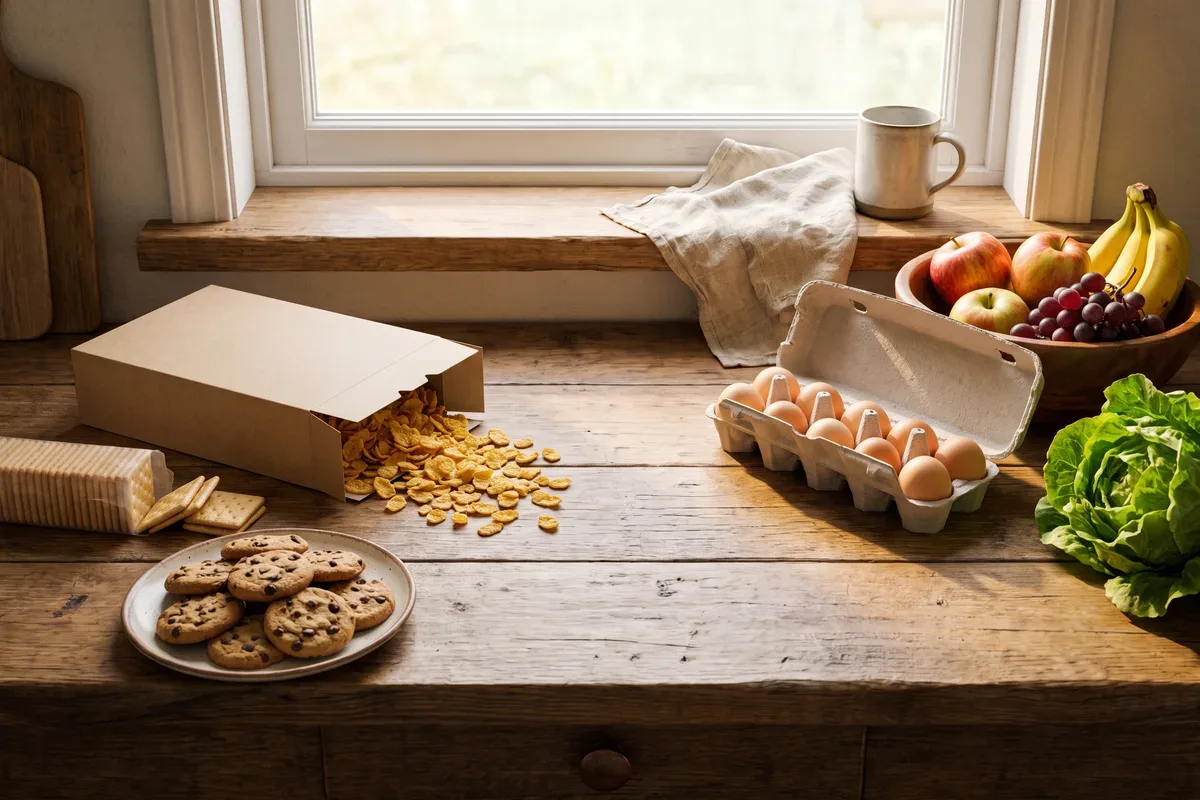
That person feels dramatically better, and gluten gets the credit. But look at what else left the plate. Every food on the first day is ultra-processed, meaning an industrial formulation built from ingredients you wouldn’t find in a home kitchen. Not one food on the second day is.
This isn’t a coincidence of my example. In the CDC’s 2025 data brief on ultra-processed food, those foods supplied 53% of the calories American adults ate. The top sources were sandwiches and burgers, sweet bakery products, sweetened drinks, savory snacks, and breads, rolls and tortillas. By my count, three of those five (the sandwiches, the bakery products and the breads) are mostly wheat.
What Did You Actually Remove?
Here is the same idea with your own plate. The example below is the two days I just described. Swap in what you really ate before, and what you eat now, and see which way seven things moved.
Interactive · Build your two days
What did you actually remove?
Pick what a typical day looked like before you went gluten-free, then what it looks like now. We’ll show you everything that changed.
Before going gluten-free
After going gluten-free
Pick at least three foods for each day.
Example: a typical before and after
Before
Sweetened cereal, Deli sandwich, Wheat crackers, Frozen pizza, Packaged cookies
After
Eggs, Big salad, Rice and chicken, Fruit, Meat and vegetables
- GlutenDown a lot
- Ultra-processed foodsDown a lot
- FiberAbout the same
- Added sugarDown a lot
- FODMAP exposureDown a lot
- Whole foodsUp a lot
- Food varietyUp a lot
Going gluten-free changed more than just your gluten intake.
Gluten came out, and less changed around it than in most diet overhauls. The rows above show what else moved.
Add at least three foods to each day to see what changed.
Your before day has no gluten in it. Add the bread, pasta or cereal you used to eat, then look again.
Your two days match. Change the after day to what you eat now.
Your after day still has gluten in it. Swap those foods for what you eat now, then look again.
Link copied.
This is a rough picture of what changed, not a nutrition assessment. It can’t tell you whether you have celiac disease. A blood test and your doctor can.
One thing surprised me when I ran my own example through it. Fiber barely moved. The sandwich, crackers and pizza on the first day carry about as much fiber as the salad, fruit and vegetables on the second. Whole food doesn’t automatically mean more fiber, which is a good reminder to check an idea before repeating it.
Nine Suspects, Graded on the Evidence
So which of those changes could explain feeling better? I found nine explanations and graded each on one question: can it account for a person without celiac disease feeling better after going gluten-free?
Case file 002 · LGGF Investigates
9 suspects, graded on the evidence
Filter by verdict, or open any card for the studies behind it.
- KnownMeasured in people and replicated.
- SuspectedA plausible mechanism and some human evidence.
- Weak evidenceAnimal, lab or single small studies only.
- Ruled outTested, and the evidence does not support it.
-
Exhibit 01 Known
Gluten itself
The theory I cut gluten and felt better, so gluten was the problem.
For celiac disease, yes, without exception. For people without celiac, gluten turns out to be the trigger in a minority: 16 to 30% of those who report sensitivity react to it in blinded tests.
See the evidence
- A 2025 Lancet review: about 10% of adults worldwide report gluten or wheat sensitivity, and 16 to 30% of them react specifically to gluten in controlled challenges.
- A pooled look at 10 double-blind trials found gluten-specific symptoms in 38 of 231 people who met the criteria for gluten sensitivity (16%).
- Celiac disease is different. Gluten is the cause, and a strict gluten-free diet is the treatment.
Biesiekierski et al., Lancet 2025; Molina-Infante & Carroccio, Clin Gastroenterol Hepatol 2017
-
Exhibit 02 Known
Fructans and other FODMAPs
The theory It’s the wheat, but not the gluten in it.
In blinded trials, the fermentable carbohydrates in wheat caused more symptoms than gluten did. Cutting wheat cuts both at once. The effect is modest and not everyone reacts.
See the evidence
- Oslo, 2018: 59 adults who had gone gluten-free on their own got hidden gluten, fructans or a placebo for a week each. Fructans scored worse than gluten, and gluten was no different from placebo.
- A 2013 trial: after 37 people cut back on FODMAPs, researchers found no specific effect of gluten.
- Uppsala, 2022: in 103 adults with IBS, FODMAPs raised symptom scores and gluten did not.
- A 2022 analysis of 13 trials (944 people with IBS) ranked a low-FODMAP diet first for overall symptoms.
Skodje et al., Gastroenterology 2018; Biesiekierski et al., Gastroenterology 2013; Nordin et al., Am J Clin Nutr 2022; Black et al., Gut 2022
-
Exhibit 03 Suspected
More fiber
The theory Swapping packaged food for vegetables, fruit and beans is what helped.
Soluble fiber eases IBS symptoms in trials, so a whole-food plate could help this way. But nobody has tested it as the reason gluten-free feels better, and packaged gluten-free food often has less fiber, not more.
See the evidence
- Across 14 trials in 906 people with IBS, fiber helped, but only soluble fiber. Bran showed no benefit.
- A UK survey of 679 gluten-free and 1,045 regular products found the gluten-free ones more likely to be lower in fiber.
- So fiber can go up or down when you go gluten-free. It depends on what you eat instead.
Moayyedi et al., Am J Gastroenterol 2014; Fry et al., J Hum Nutr Diet 2018
-
Exhibit 04 Weak evidence
Emulsifiers and additives
The theory The additives in processed food were upsetting my gut.
One small human study and mouse experiments point this way. That is a reason to keep studying it, not proof. Packaged gluten-free food relies on gums and emulsifiers too.
See the evidence
- In a controlled-feeding study, 7 healthy adults given the emulsifier carboxymethylcellulose for 11 days reported modestly more discomfort after meals than 9 who weren’t, and their gut bacteria became less diverse.
- In mice, dietary emulsifiers changed gut bacteria and promoted inflammation.
- The human study covered 16 people, one additive and 11 days.
Chassaing et al., Gastroenterology 2022; Chassaing et al., Nature 2015
-
Exhibit 05 Suspected
Eating less without trying
The theory I dropped the packaged food and the weight came off.
It is measured that ultra-processed diets lead people to eat more. Whether eating less is why someone feels better off gluten hasn’t been tested, so this is graded down.
See the evidence
- NIH, 2019: 20 adults ate about 500 more calories a day on an ultra-processed diet than on an unprocessed one offering the same calories, sugar, fat and fiber. They gained about 2 pounds on that diet and lost about 2 on the unprocessed one.
- A 2024 trial in Japan and a 2025 trial in England pointed the same way.
- None of these trials measured digestive symptoms, energy or mood.
Hall et al., Cell Metab 2019; Hamano et al., Diabetes Obes Metab 2024; Dicken et al., Nat Med 2025
-
Exhibit 06 Weak evidence
Fewer refined carbs and less sugar
The theory Cutting bread and pastries cut my sugar, and that’s what did it.
People who avoid gluten do eat less carbohydrate and sugar. No trial has tested whether that is why they feel better.
See the evidence
- In a US national survey of 15,610 adults, people avoiding gluten without celiac ate less total carbohydrate and less sugar than everyone else.
- In the NIH trial, the extra calories people ate on the ultra-processed diet came from carbohydrate and fat, not protein.
- Both findings describe what people eat. Neither shows a cause.
Unalp-Arida et al., Sci Rep 2022; Hall et al., Cell Metab 2019
-
Exhibit 07 Suspected
The whole pattern, not one ingredient
The theory I just started eating better.
Trials of whole-diet change show real improvements in gut symptoms and mood. They weren’t run on people going gluten-free, so the link is plausible, not proven.
See the evidence
- In a 2025 trial of 139 adults with IBS, 62% improved on a Mediterranean diet against 42% on standard dietary advice.
- In a 2017 trial of 67 adults with depression, those coached to improve their diet did better than those given social support.
- A 2024 review linked higher ultra-processed intake to 32 poorer health outcomes. That evidence is observational and mostly rated low quality.
Bamidele et al., Ann Intern Med 2025; Jacka et al., BMC Med 2017; Lane et al., BMJ 2024
-
Exhibit 08 Weak evidence
A changed gut microbiome
The theory Going gluten-free fixed my gut bacteria.
Diet does shift gut bacteria within days, and a gluten-free diet shifts them a little. No study ties those shifts to feeling better, and one found fewer of the bacteria usually counted as helpful.
See the evidence
- 10 healthy adults, one month gluten-free: Bifidobacterium and Lactobacillus counts fell.
- 21 healthy volunteers, four weeks gluten-free: the overall mix stayed stable and a handful of bacterial groups shifted.
- Short-term all-plant or all-animal diets changed the gut community within days.
De Palma et al., Br J Nutr 2009; Bonder et al., Genome Med 2016; David et al., Nature 2014
-
Exhibit 09 Known
Expectation
The theory I know gluten makes me sick, so I feel sick when I eat it.
In blinded trials, many people get symptoms from a placebo they think might be gluten. That makes the symptoms no less real. It does make the cause harder to pin down.
See the evidence
- A pooled look at 10 double-blind trials reported a nocebo response in 40%: similar or worse symptoms on the placebo.
- In a 2024 trial of 83 people, symptoms were highest in those told they were eating gluten who were. Gluten nobody expected scored the same as no gluten at all.
- The authors said an added effect of gluten itself could not be ruled out.
Molina-Infante & Carroccio, Clin Gastroenterol Hepatol 2017; de Graaf et al., Lancet Gastroenterol Hepatol 2024
How we graded the evidence
The four verdicts
Known means measured in people and replicated. Suspected means there is a plausible mechanism and some human evidence. Weak evidence means animal, lab or single small studies. Ruled out means it was tested and the evidence does not support it.
How we graded
We graded each explanation on whether it can account for people feeling better after going gluten-free, not on whether it matters for health in general. Where a study only partly supports a claim, we graded down.
What this isn’t
This is a review of research, not medical advice. It can’t tell you whether you have celiac disease. A blood test and your doctor can.
Reviewed October 13, 2026 by Katie Wilson, RN.
What We Know: Gluten, Fructans and Expectation
Three explanations have blinded human trials behind them, and they point in different directions.
Gluten itself is real for some people. A 2025 review in The Lancet estimated that about 10% of adults report gluten or wheat sensitivity, and that 16 to 30% of them react specifically to gluten in controlled tests. That is a real group, and it is a minority.
Then there are fructans, a fermentable carbohydrate in wheat and one of the FODMAPs. Researchers in Oslo took 59 adults who had gone gluten-free on their own and gave them hidden gluten, hidden fructans or a placebo for a week each. In the 2018 trial in Gastroenterology, fructans scored worse than gluten, and gluten was no different from placebo.
That matters because you can’t cut wheat without cutting both. Not everyone reacts, and a later trial in people with IBS called the effect of FODMAPs modest, so this isn’t the whole answer either. We looked at fructans more closely in our investigation into bread in Europe, and at how many people now avoid gluten in our first investigation.
The third is expectation. In a 2024 trial in The Lancet Gastroenterology & Hepatology, 83 people with self-reported gluten sensitivity ate bread after being told it did or didn’t contain gluten. Symptoms were highest in those told they were eating gluten who actually were. Gluten nobody expected scored the same as no gluten at all.
Please don’t read that as “it’s all in your head.” The symptoms in these trials were real symptoms. What the trials show is that the cause is harder to pin down than it feels from the inside.
What Researchers Suspect: The Food Around the Gluten
The next three explanations are about everything that travels with gluten, and here the evidence is solid for a nearby claim rather than for this exact question.
The best-known study put 20 adults in an NIH clinic for a month. In the 2019 trial in Cell Metabolism, they ate about 500 more calories a day on an ultra-processed diet than on an unprocessed one that offered the same calories, sugar, fat and fiber. They gained about two pounds on the ultra-processed diet and lost about two on the unprocessed one.
Two trials since then, in Japan and England, have pointed the same way. None of the three was designed to measure bloating, energy or mood, though. So it is fair to say ultra-processed food leads people to eat more, and only a guess that eating less is why someone feels better off gluten.
There is also evidence that people who avoid gluten end up eating differently overall. In a 2022 analysis of national survey data covering 15,610 US adults, people avoiding gluten without celiac ate less carbohydrate and less sugar than everyone else. They also took in more beta-carotene and lutein, nutrients found mostly in vegetables and fruit.
Whole-diet changes can help on their own, too. In a 2025 trial of 139 adults with irritable bowel syndrome, 62% improved on a Mediterranean diet against 42% on standard dietary advice. Fiber is the mixed one: soluble fiber eased symptoms across 14 trials in people with IBS, while bran did not.
Where the Evidence Is Weak
Three popular explanations have much less behind them than their confidence suggests.
Emulsifiers and additives are a live research question. In one controlled-feeding study, 7 healthy adults given a common emulsifier for 11 days reported modestly more discomfort after meals than 9 who weren’t. That is 16 people, one additive and 11 days, plus experiments in mice.
The gut microbiome story is thinner still. Diet does shift gut bacteria within days, and a gluten-free diet shifts them a little. But no study I found ties those shifts to feeling better, and one small study found fewer of the bacteria usually counted as helpful after a month gluten-free.
Cutting refined carbs and sugar is the third. People who avoid gluten do eat less of both, as the national survey showed. No trial has tested whether that is the reason they feel better, so I can’t tell you it is.
Gluten-Free on the Box Doesn’t Mean Less Processed
Everything above assumes you swapped packaged food for whole food. Plenty of people swap wheat bread for gluten-free bread instead, and that is a very different change. Try the labels yourself.
Interactive · 5 rounds
The Ingredient List Challenge
Two real products, one question. Make your guess, then see both labels.
-
Round 1 · White sandwich bread
Which has more protein?
Answer: Nature’s Own Butterbread (2 g protein per serving).
Nature’s Own Butterbread
2g protein per serving
- Serving
- 1 slice (26 g)
- Sugar
- 2 g
- Fiber
- 0 g
- Protein
- 2 g
- Additives
- 1
Full ingredient list (13)
wheat flour, water, sugar, yeast, butter, cultured wheat flour, wheat gluten, salt, flax seed meal, vinegar, malted barley flour, enzymes, acerola cherry powder
Label checked October 13, 2026 on the manufacturer’s product page.
Canyon Bakehouse Country White
1g protein per serving
- Serving
- 1 slice (28 g)
- Sugar
- 2 g
- Fiber
- less than 1 g
- Protein
- 1 g
- Additives
- 2
Full ingredient list (15)
water, brown rice flour, tapioca flour, whole grain sorghum flour, cane sugar, potato starch, whole grain oat flour, cultured brown rice flour, expeller pressed canola oil, xanthan gum, egg whites, eggs, yeast, sea salt, enzymes
Label checked October 13, 2026 on the manufacturer’s product page.
A slice of the wheat loaf has 2 grams of protein and the gluten-free slice has 1. The two ingredient lists are about the same length.
-
Round 2 · Crackers
Which has more additives?
Answer: Schär Table Crackers (3 additives).
Ritz Original Crackers
1additives
- Serving
- 5 crackers (16 g)
- Sugar
- 1 g (6 g per 100 g)
- Fiber
- 0 g (0 g per 100 g)
- Protein
- less than 1 g
- Additives
- 1
Full ingredient list (15)
wheat flour, niacin, reduced iron, thiamine mononitrate, riboflavin, folic acid, soybean and/or canola oil, palm oil, sugar, salt, calcium phosphate, baking soda, high fructose corn syrup, soy lecithin, natural flavor
Label checked October 13, 2026 on the manufacturer’s product page.
Schär Table Crackers
3additives
- Serving
- 6 crackers (35 g)
- Sugar
- 2 g (6 g per 100 g)
- Fiber
- 2 g (6 g per 100 g)
- Protein
- 1 g (3 g per 100 g)
- Additives
- 3
Full ingredient list (17)
corn starch, corn flour, palm fat, sunflower oil, maltodextrin, rice syrup, modified tapioca starch, soy flour, sea salt, yeast, guar gum, modified cellulose, cream of tartar, ammonium bicarbonate, baking soda, citric acid, natural flavoring
Label checked October 13, 2026 on the manufacturer’s product page.
The gluten-free cracker lists a gum, a modified starch and modified cellulose. The wheat cracker lists one emulsifier.
-
Round 3 · Sandwich cookies
Which has more additives?
Answer: Oreo Gluten Free Chocolate Sandwich Cookies (2 additives).
Oreo Chocolate Sandwich Cookies
1additives
- Serving
- 3 cookies (34 g)
- Sugar
- 14 g
- Fiber
- less than 1 g
- Protein
- 1 g
- Additives
- 1
Full ingredient list (17)
wheat flour, niacin, reduced iron, thiamine mononitrate, riboflavin, folic acid, sugar, palm oil, soybean and/or canola oil, cocoa, high fructose corn syrup, baking soda, calcium phosphate, salt, soy lecithin, chocolate, artificial flavor
Label checked October 13, 2026 on the manufacturer’s product page.
Oreo Gluten Free Chocolate Sandwich Cookies
2additives
- Serving
- 3 cookies (34 g)
- Sugar
- 14 g
- Fiber
- 1 g
- Protein
- 1 g
- Additives
- 2
Full ingredient list (15)
sugar, white rice flour, tapioca starch, palm oil, soybean and/or canola oil, whole oat flour, cornstarch, cocoa, invert sugar, soy lecithin, baking soda, salt, xanthan gum, chocolate, artificial flavor
Label checked October 13, 2026 on the manufacturer’s product page.
This is nearly the same cookie twice: the same serving, the same calories, the same 14 grams of sugar. Both list an emulsifier, and the gluten-free one adds xanthan gum.
-
Round 4 · Spaghetti
Which has the longer ingredient list?
Answer: Barilla Spaghetti (7 ingredients).
Barilla Spaghetti
7ingredients
- Serving
- 2 oz (56 g) dry
- Sugar
- 1 g
- Fiber
- 3 g
- Protein
- 7 g
- Additives
- 0
Full ingredient list (7)
semolina, durum wheat flour, niacin, ferrous sulfate, thiamine mononitrate, riboflavin, folic acid
Label checked October 13, 2026 on the manufacturer’s product page.
Barilla Gluten Free Spaghetti
3ingredients
- Serving
- 2 oz (56 g) dry
- Sugar
- 0 g
- Fiber
- 2 g
- Protein
- 4 g
- Additives
- 1
Full ingredient list (3)
corn flour, rice flour, mono and diglycerides
Label checked October 13, 2026 on the manufacturer’s product page.
The wheat pasta’s list is longer only because of the vitamins and iron added back to enriched flour. The gluten-free one is corn flour, rice flour and an emulsifier, with 4 grams of protein a serving against 7.
-
Round 5 · Graham crackers
Which has more sugar?
Answer: Honey Maid Graham Crackers (8 g sugar per serving).
Schär Honeygrams
6g sugar per serving
- Serving
- 3 cookies (27 g)
- Sugar
- 6 g
- Fiber
- 2 g
- Protein
- 2 g
- Additives
- 1
Full ingredient list (12)
corn starch, brown sugar, corn flour, palm oil, soy flour, soy bran, honey, modified tapioca starch, ammonium bicarbonate, baking soda, salt, caramelized sugar
Label checked October 13, 2026 on the manufacturer’s product page.
Honey Maid Graham Crackers
8g sugar per serving
- Serving
- 8 crackers (30 g)
- Sugar
- 8 g
- Fiber
- 1 g
- Protein
- 2 g
- Additives
- 1
Full ingredient list (15)
wheat flour, niacin, reduced iron, thiamine mononitrate, riboflavin, folic acid, whole grain wheat flour, sugar, soybean and/or canola oil, honey, baking soda, calcium phosphate, salt, soy lecithin, artificial flavor
Label checked October 13, 2026 on the manufacturer’s product page.
The wheat graham cracker has more sugar per serving, 8 grams against 6. On this shelf the gluten-free box is the less sweet one.
Gluten-free on the front of the box tells you one thing about what is inside. The ingredient list tells you the rest.
How we counted additives: Ingredients added for texture, shelf life or appearance rather than as food: gums and thickeners, emulsifiers, preservatives, modified starches, dough conditioners (including enzymes), added colors and artificial sweeteners. Vitamins and minerals added for enrichment, leavening, sweeteners and flavorings are not counted. Figures are from each product’s own label on the date shown, and recipes change, so check the package you buy.

Larger shelf surveys find a mixed picture too. In a 2018 UK comparison of 679 gluten-free and 1,045 regular products, the gluten-free ones were more likely to be lower in fiber and protein, and more of them rated high or medium for fat, sugar and salt. It wasn’t uniform: fewer gluten-free crackers were high in fat and sugar.
So if your “after” day is gluten-free cereal, gluten-free sandwich bread, gluten-free crackers and gluten-free pizza, you removed gluten and the wheat that carries it, and less of everything else. If you feel much better on that diet, the explanations left standing are gluten, fructans and expectation, and that is worth telling your doctor.
If you have celiac disease, packaged gluten-free food can be a real help in keeping a strict diet. Whether a given product is right for you comes down to its label, which our guide to reading food labels for hidden gluten covers.
What This Means If You’re…
Diagnosed with celiac disease
Nothing here changes your diet. Gluten damages your small intestine whether or not you feel it, and a strict gluten-free diet is the treatment. What this research can offer you is a nudge toward the whole-food side of gluten-free eating, since the packaged swaps tend to be lower in fiber and protein.
Not diagnosed, and feeling better off gluten
Your improvement is real, and it deserves a proper answer. The catch is that the NIDDK’s guidance on celiac diagnosis says doctors don’t recommend starting a gluten-free diet before testing, because the diet can change the results. Talk to your doctor about how to get tested from where you are now.
Once celiac is ruled out, it may be worth asking a registered dietitian about FODMAPs, since that is where the blinded trials point for some people. Our guide to gluten-free versus low-FODMAP explains how the two differ.
Thinking about trying gluten-free
Get the blood test first, while gluten is still in your diet. Then talk with your doctor or a registered dietitian about what to change. Cutting gluten and cutting back on packaged food are two different experiments, and doing both at once makes the result hard to read.
Mistakes People Make When Gluten-Free Feels Better
- Skipping the celiac test — feeling better off gluten doesn’t tell you whether you have celiac disease, and going gluten-free first can make the test miss it.
- Crediting one ingredient — a diet change moves many things at once, so a single before-and-after can’t tell you which one mattered.
- Assuming gluten-free means healthier — a large study that followed more than 100,000 US health professionals found gluten intake wasn’t linked to heart disease, and warned that avoiding it can mean eating fewer whole grains.
- Dismissing other people’s symptoms — expectation plays a part in blinded trials, but the symptoms are real, and “it’s in your head” helps no one.
Frequently Asked Questions
Why do I feel better gluten-free if I don’t have celiac disease?
There are several possible reasons, and more than one may apply. Some people do react to gluten itself. Others react to fructans, a carbohydrate in wheat, or feel better because cutting gluten also cut a lot of ultra-processed food. Expectation plays a measurable part in blinded trials too.
Is it gluten or ultra-processed food that makes me feel bad?
A single diet change can’t tell you, because wheat-based foods are among the largest sources of ultra-processed calories in the US diet. Removing one usually removes the other. A doctor and a registered dietitian can help you test the two separately.
Is gluten-free food healthier?
Not automatically. Shelf surveys in the UK and Australia found packaged gluten-free foods tend to be lower in protein than the regular versions, and the UK survey found them lower in fiber too. For people with celiac disease, they can make a strict gluten-free diet easier to keep. For everyone else, the words on the front of the box say little about nutrition.
Should I get tested for celiac disease before going gluten-free?
Yes. Celiac blood tests look for antibodies your body makes in response to gluten, so they are only reliable while you are still eating it. If you have already cut gluten, talk to your doctor before changing anything, so you can be tested properly.
Are gluten-free breads and crackers ultra-processed?
Many are. Without gluten to give structure, packaged gluten-free baked goods often rely on gums, modified starches and emulsifiers, which are markers of ultra-processed food. Some have short, simple ingredient lists, so it is worth reading the label.
So Why Do You Feel Better Gluten-Free?
Probably for more than one reason. Gluten is the answer for people with celiac disease and for a minority of those without it. For others, blinded trials point to the fructans in wheat and to expectation. The ultra-processed food that leaves the plate along with the gluten is a plausible part of the story that nobody has tested directly.
That doesn’t make your experience less real. It makes it more useful, because it gives you more than one thing to test. Start with the celiac blood test, and take the rest to your doctor.
If gluten does turn out to be your problem, you’ve got this, and we can help with the first month.
Going gluten-free for real?
Our First 30 Days guide is the plan we wish we’d had: a day-by-day transition plan, a label-reading cheat sheet and a pantry restocking checklist.